The Teletype Model 28 · Volume 7
The Teletype Model 28 — Vol 7: Buying and Moving One Today
Model 28s still turn up, often for less than a good typewriter and sometimes for nothing. The cost comes afterwards: the weight, the missing parts, and the speed gears it arrived with. This volume covers what is out there, what it costs, what to check, how to move it, which version suits which job, and how to change its speed.
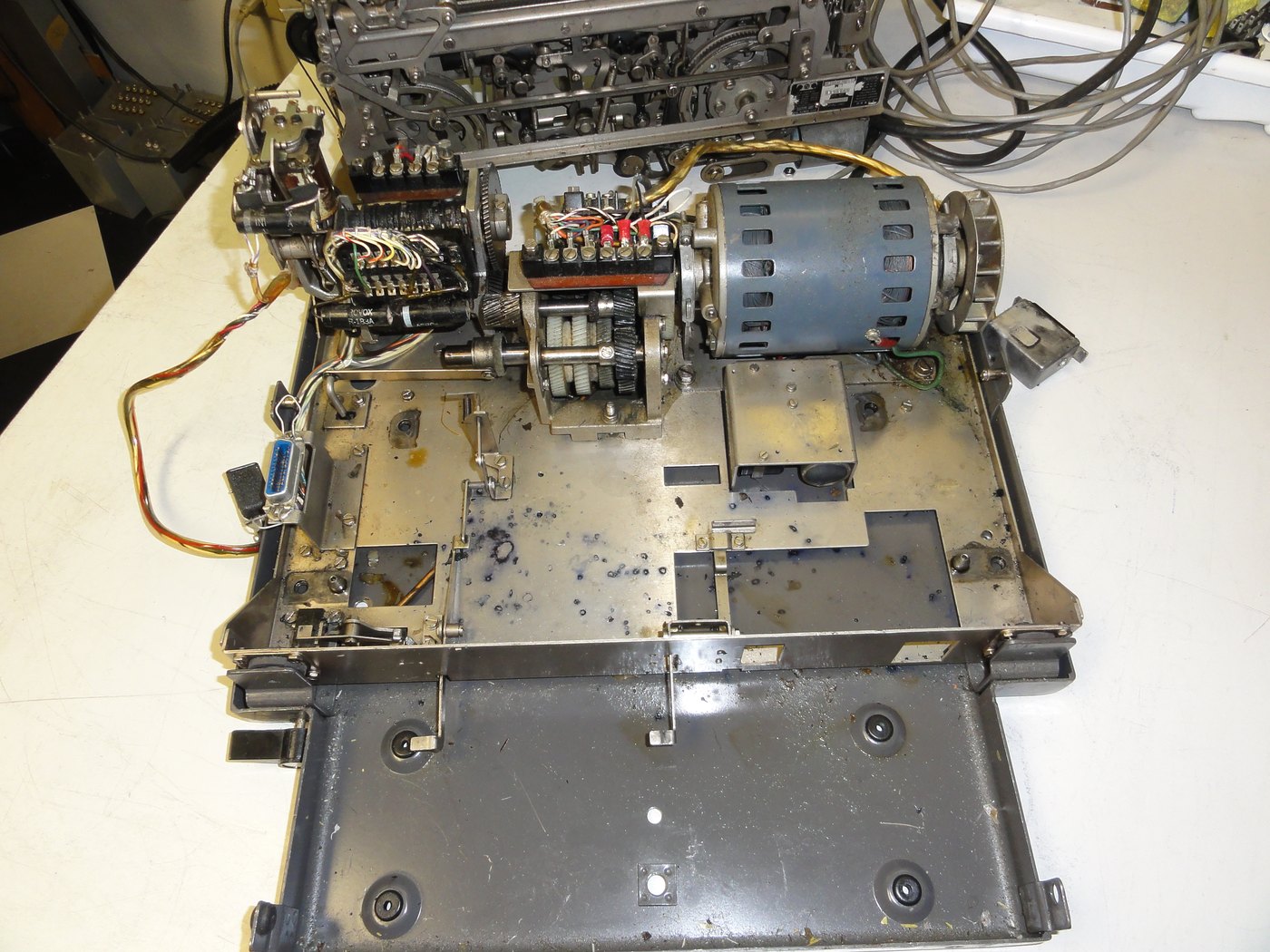
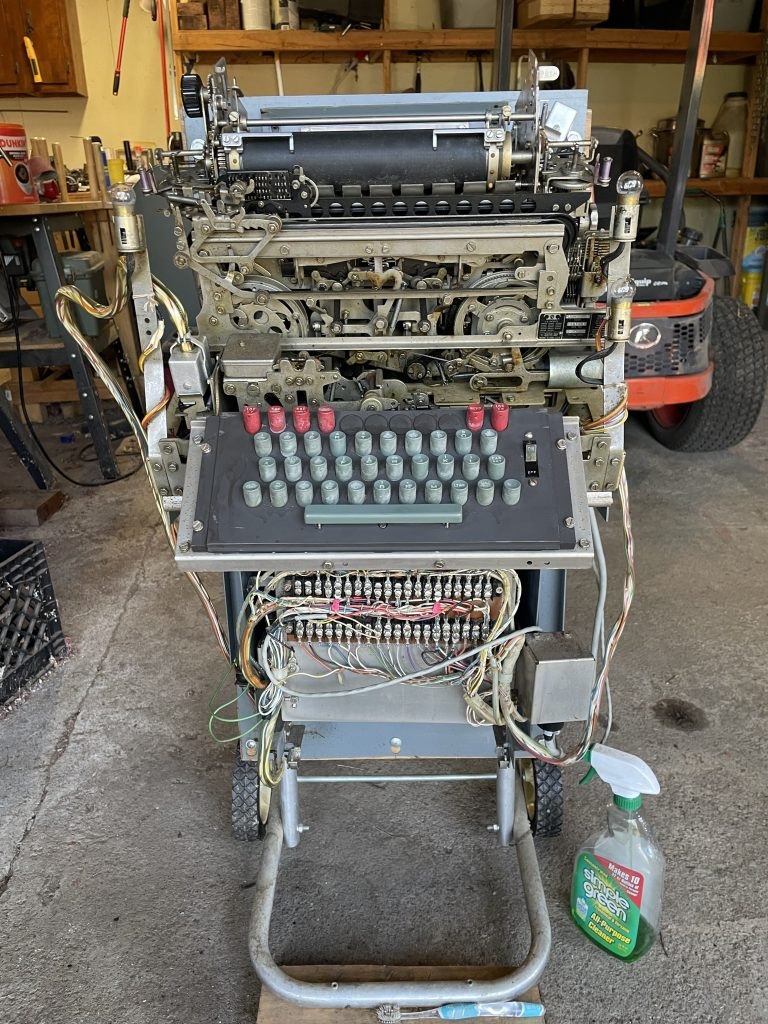
7.1 Where I stand
I do not own a Model 28 yet. This volume is written for the buyer I am about to be, and for anyone else in the same position. Everything in it comes from the documents and from people who have done it. When I have bought and moved one, the personal account belongs here.
7.2 What turns up
Model 28s were made in large numbers for about thirty years, and the Navy, the Bell System, Western Union, the airlines, the weather services and industry all disposed of theirs eventually. The common survivors are:
- 28 KSR in a floor console: the most common complete machine, often ex-Bell or ex-military, often geared for 100 wpm.
- 28 RO: common, because so many were installed for receive-only circuits, and usually cheaper than a KSR.
- 28 ASR: less common and much heavier. Often found incomplete, with the TD or auxiliary reperforator missing.
- Wall-mount and table KSRs and ROs: common, often on improvised carts.
- Compact Navy sets (AN/UGC-20 KSR, AN/UGC-25 RO): smaller and lighter, with built-in three-speed gearshifts.
- Tape units on their own: TDs, LPR reperforators, ROTR and KTR sets, and RT sets.
- Bare typing units, keyboards, motors and parts lots: very common, and the basis of most restorations.
- Low-level and TEMPEST military sets (AN/UGC-49, -77, -91, TT-603, TT-605): these look like ordinary 28s but have ±6 V interfaces (Volume 8).
7.3 What they cost
There is no formal market in Model 28s, and prices vary enormously with condition, completeness, location and who is selling. A few dated reference points:
Table 1 — There is no formal market in Model 28s, and prices vary enormously with condition, completeness, location and who is selling. A few dated reference points
| When | Item | Price | Source |
|---|---|---|---|
| c. 1965 | 28 KSR, new | $1,200 | Hoff, K8DKG |
| c. 1965 | 28 ASR, new | $2,200 | Hoff |
| c. 1965 | 28 KSR, used | ”$400 or more” | Hoff |
| c. 1965 | 28 ASR, used | ”$750 or more” | Hoff |
| 1969 | 28 ASR | $2,500 | Telegram & Cable Co. |
| Jan 2025 | 28 KSR keyboard signal generator assembly (used) | $45 asking | eBay listing |
| Nov 2026 | 28 KSR “Mark II with polar relay” | $450 asking | eBay, via PicClick |
| Nov 2026 | 28 self-contained TD | $235 asking | eBay, via PicClick |
| Nov 2026 | LPR23 typing reperforator, no typewheel | $128 asking | eBay, via PicClick |
| Nov 2026 | 28 KSR, ex-TWX, sold “for parts or not working” | about $1,350–1,500 asking | eBay, via PicClick |
| undated | 28 ASR | $700, marked sold | VarageSale listing |
These are mostly asking prices, not completed sales, and should be treated as such. A few points come out of them. A complete-looking 28 KSR or RO in unknown condition is usually priced in the hundreds of dollars, not thousands. High asking prices on “untested” machines are not a guide to what they sell for. Parts and sub-assemblies are cheap. Some 28s are simply given away to whoever will haul them off. In that case the hauling is the real price, and the rest of this volume is about it.
7.4 What to check before buying
A 28 that cannot be seen running should be judged on completeness and condition. The list below is in roughly the order it can be checked at the seller’s.
- Is it all there? For a KSR: typing unit, keyboard, motor, electrical service unit, the gears between motor and keyboard, cabinet, and the cables between them. For an ASR, also the punch, the TD and its base, and the auxiliary reperforator if it is meant to have one. A missing typing unit or motor is a long search. A missing ESU or cable is a wiring job.
- Does it turn by hand? With the power off, turn the motor’s handwheel. The main shaft and keyboard drive should turn smoothly with the clutches latched. If it is stiff, the lubricant has varnished (Volume 5). If it is locked solid, something is jammed or broken, and the overload clutch may click as the motor tries.
- The type box. Lift the dome and look at the type box. Is it present, and does it have the communications arrangement or a special one (weather symbols, another alphabet, upper and lower case)? A missing or unusual type box can be replaced, but it is worth knowing.
- Data plates. Photograph every plate (Volume 3), including the gears if they can be seen.
- Speed gears. Find out what speed it is geared for (below). Ex-commercial and ex-Navy machines are very often geared for 100 wpm.
- Wiring and the motor leads. Look for brittle or crumbling insulation, especially where the motor leads leave the motor (Restoring a Teletype). Do not plug it in at the seller’s unless the leads are sound.
- Rust and damage. Surface rust on the cabinet is cosmetic. Rust on the typing unit’s working parts is not. Bent levers in the keyboard or typing unit usually mean it was dropped.
- The foam and rubber. Expect the cabinet foam to be dust and the rubber to be hard (Volume 5). It does not affect running.
- Documents. A machine with its own wiring diagrams or Navy manual is worth more.
- If it can run: ask the seller to switch it on in the test position of the electrical service unit, so the keyboard works the printer without a line (Restoring a Teletype, Vol 2). A machine that types its own keyboard input is a very good sign.
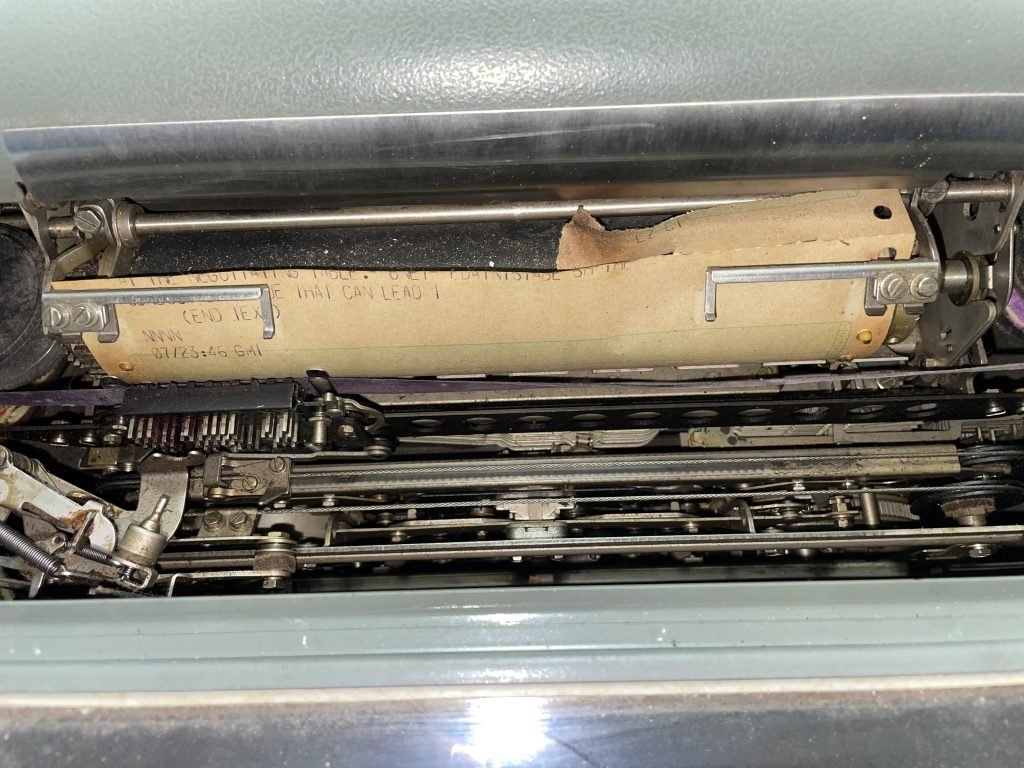
7.5 How much it weighs
Weight decides how to move a 28 and where it can go:
Table 2 — Weight decides how to move a 28 and where it can go
| Item | Approximate weight | Source |
|---|---|---|
| 28 typing unit alone | 19 lb (friction feed) to 22 lb (sprocket) | BSP 573-115-100 |
| 28 KSR, wall model | 110 lb | Wikipedia |
| 28 KSR, floor or table model | 130 lb | Wikipedia |
| 28 typing unit and printer, table set (CHM example) | 93 lb | Computer History Museum catalogue |
| 28 ASR | 260 lb | Wikipedia; Teletype specification sheet |
| 28 RT set | 110 lb; its two-set cabinet 300 lb | Wikipedia |
| LRS receiving selector | 16½ lb | Wikipedia |
A 28 KSR is a two-person lift complete. An ASR needs a team or a lift gate and an appliance dolly. The Teletype Model 15 dive gives comparable weights for the older machine (a TT-5/FG set is about 200 lb).
7.6 Moving one
The 28’s modular design is what makes it movable. Bulletin 216B explains that the keyboard, typing unit and motor sit together on a rubber-mounted cradle inside the cabinet, and the restorers’ accounts show how quickly they come apart: “Just a small handful of fasteners, two electrical disconnects and the typing unit and base/keyboard unit came out without a fuss” (Stickelman). In practice:
- Photograph everything, especially the cable connections to the electrical service unit and any wires to terminal blocks.
- Take the paper out and remove the ribbon spools.
- Lift off the typing unit. It is held to the base by four screws and connected by a plug. At 19–22 lb it is easy to carry, and it is the most delicate part, so carry it separately, upright, on a padded base.
- Lift out the keyboard or base and motor, or leave them on the cradle if the cabinet can be moved with them in it.
- Move the cabinet empty. An empty console cabinet is awkward but light enough for two people.
- Strap nothing across the keyboard or the type box carriage, and do not stand the cabinet on its back with units inside.
- Keep the screws and small parts in labelled bags, and tape the bag to the unit it came from.
For a vehicle, the 28 travels well if the units are separate and padded, which is no surprise in a machine designed for ships and vehicles. Stickelman, who plans to carry a 28 in an M35A2 truck for field operation, notes the need to “shield it from shock while moving.”
7.7 Which version to buy for which job
Table 3 — Which version to buy for which job
| Job | Best choice | Why |
|---|---|---|
| A first machine, RTTY on the air or from a computer | 28 KSR, floor or table, geared for 60 wpm or with a gearshift | Sends and prints; the common, well-documented configuration |
| Printing only: ITTY news, a computer’s output, a cipher machine’s output | 28 RO | Cheaper and simpler than a KSR, with the same typing unit |
| Making and sending tape | 28 ASR, or a KTR or ROTR plus a TD | The ASR is everything in one cabinet but is the heaviest; separate tape sets are lighter and easier to find |
| Small space, or a vehicle | Compact 28 KSR or RO (UGC-20/25), checked to be a 60 mA version, or a wall-mount set on a cart | Smaller, lighter; the compact sets have three-speed gearshifts |
| A pair for a two-machine setup (keyboard in, printer out) | 28 KSR + 28 RO | The KSR sends and prints a local copy; the RO prints the other side (Volume 8) |
| Parts for an existing 28 | A typing unit or a parts machine | The most useful spare |
| Avoid unless you plan for it | Low-level and TEMPEST sets | Need a ±6 V interface (Volume 8) |
The KSR plus RO pair deserves emphasis. It is what a teletype circuit looks like, and it is exactly what the PURPLE replica needs (Volume 8). An operator types on the KSR, which sends the text and prints a copy as it goes. The RO prints whatever comes back. Both use the same typing unit, gears, documents and spares.
7.8 The speed question
7.8.1 Why it matters
A 28 prints correctly only at the speed its gears are set for. Amateur RTTY in North America runs at 60 wpm (45.45 baud), and so do the main ITTY streams. Many surplus 28s were geared for 100 wpm (74.2 baud), the speed the machine was designed for and used in commercial and military service. Stickelman’s first 28 was one: he found its nylon gear’s part number and confirmed “the speed of this machine is 100WPM,” concluding that “100WPM is not common on amateur radio, so getting this to work directly on the air wont be practical.” His second 28 was “geared for 60 words a minute so this is what I would need to participate in on air teletype contacts.”
A 100 wpm machine is still useful. It can print from a computer at its own speed, and it can print RTTY.COM’s ITTY 100 wpm stream (75 baud, close enough to the 28’s 74.2), which carries news like the 60 wpm channel (Volume 8). For amateur RTTY or a 60 wpm system, the gears have to change.
7.8.2 The gears
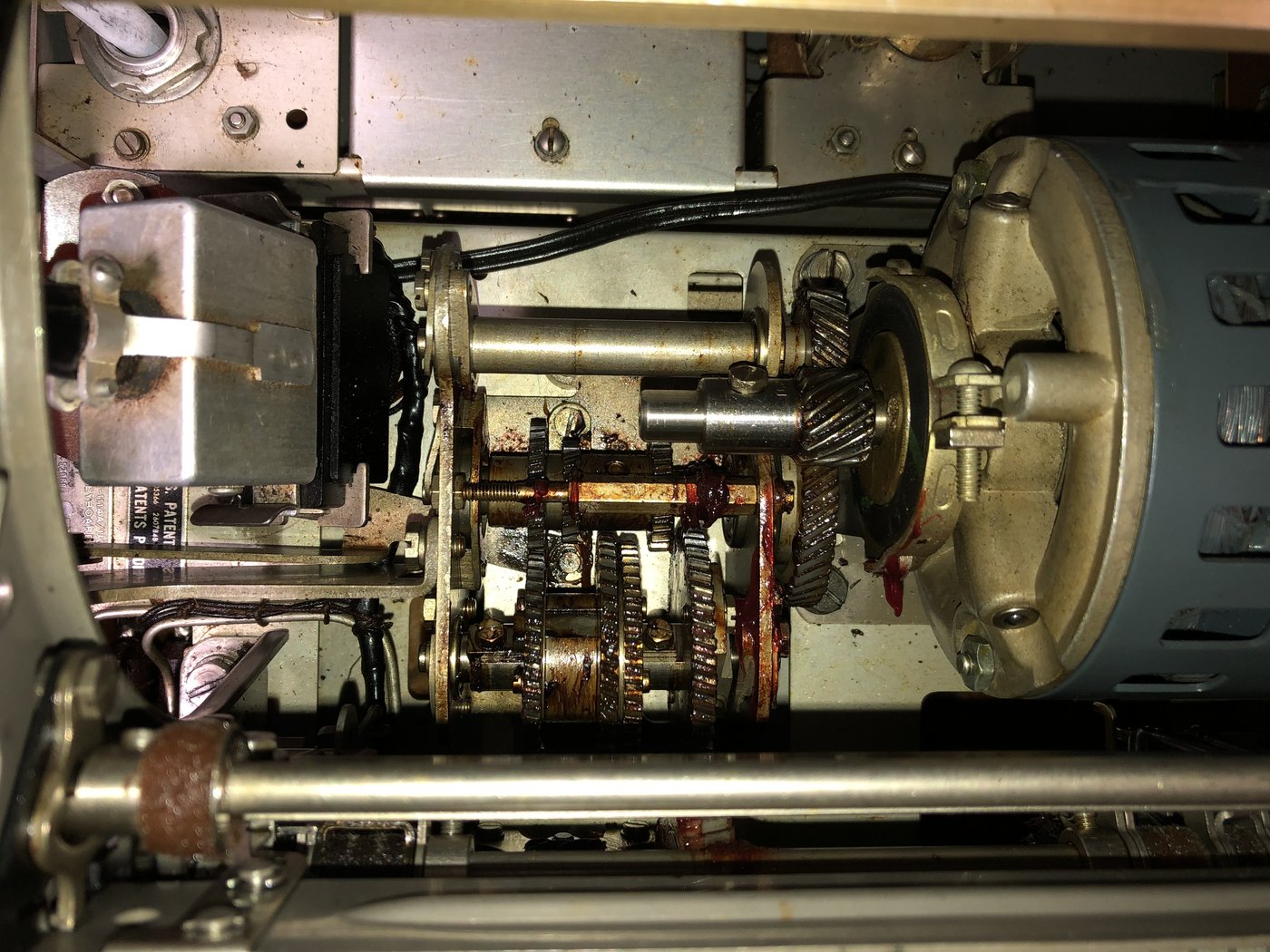
On a KSR or RO, the speed is set by a gear set: the motor pinion and the intermediate driven gear on the keyboard or base. The installation section lists them (BSP 573-100-200TC, §2.19 and §2.73):
Table 4 — On a KSR or RO, the speed is set by a gear set: the motor pinion and the intermediate driven gear on the keyboard or base. The installation section lists them (BSP 573-100-200TC, §2.19 and §2.73)
| Speed | 7.42-unit code, 60 Hz | 7.42-unit code, 50 Hz | 7.00-unit code, 60 Hz |
|---|---|---|---|
| 60 wpm | TP161293 | TP307850 | TP173795 |
| 67 wpm | — | TP307851 | — |
| 75 wpm | TP161294 | — | TP163504 |
| 100 wpm | TP161295 | TP307852 | TP163505 |
Older gear boxes may be stamped TP151060 (60 wpm), TP151075 (75), TP151100 (100) or TP152766 (67). The section notes that “Numbers TP161293, TP161294, and TP161295 are sets of nylon gears.” The 7.00-unit sets are for circuits with a one-unit stop element, Western Union’s practice (Haynes). The shorter stop element means more characters per minute at the same baud rate, so what the installation section calls the 7.00-unit “60 wpm” set (TP173795, 45.45 baud) runs at 390 operations per minute, about 65 wpm; the collector’s table below lists it that way. An amateur wants the 7.42-unit sets.
An ASR is more work, because its keyboard, TD and auxiliary reperforator each have their own gears. A collector’s gear-set table on navy-radio.com (dated 2000) gives, for the 7.42-unit code:
Table 5 — An ASR is more work, because its keyboard, TD and auxiliary reperforator each have their own gears. A collector's gear-set table on navy-radio.com (dated 2000) gives, for the 7.42-unit code
| Speed | ASR keyboard (LAK) | Single TD base (LCXB) | Reperforator (LPR or LPRE) |
|---|---|---|---|
| 60 wpm (368 opm) | 161293 | 158029 | 163023 |
| 67 wpm (404 opm) | 194927 | 161356 | 195184 |
| 75 wpm (460 opm) | 161294 | 158328 | 163024 |
| 100 wpm (600 opm) | 161225 | 158027 | 163025 |
Check these numbers against the parts bulletin for the actual units before ordering. This table is a secondary compilation, and its 100 wpm keyboard set (161225) differs from the KSR’s (TP161295), which is plausible because the ASR keyboard base is a different unit.
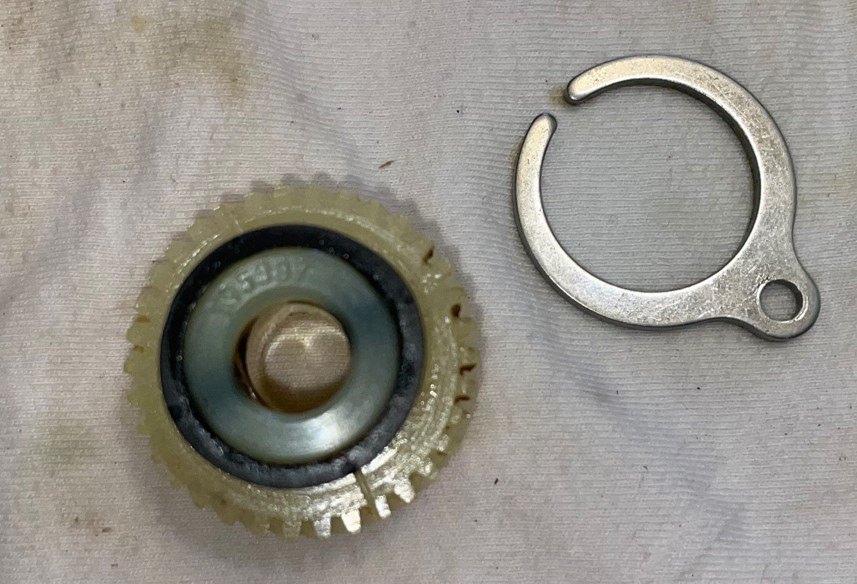
7.8.3 Gearshifts
The Navy fitted many 28s with gearshifts, so a machine could be switched between speeds with a lever. navy-radio.com lists the MK-810/UG gearshift modification for the 28 KSR and RO (Teletype kit 195415, 7.42-unit), kit 311728 for the 7.00-unit code, and kits 195154 and 317202 for the 28 ASR. The compact UGC-20 and UGC-25 have three-speed shifts (45.5, 50 and 74.2 baud) built in. A gearshift-equipped 28 is worth looking for if you want both 60 and 100 wpm.
7.8.4 Changing them
Changing a gear set is a short job on a KSR or RO. Remove the motor pinion (it sits on the motor shaft behind an isolator, held by two posts), take the driven gear off the intermediate gear hub (two screws), fit the new pair, and set the mesh by loosening the four intermediate gear assembly screws and repositioning it (573-100-200TC, §2.72–2.75). Then take a range at the new speed (Volume 6), because the best range finder setting may move. Gear sets turn up regularly as parts. Greenkeys members trade them.
7.8.5 Sources (Vol 7)
- Prices about 1965. Irvin M. Hoff, K8DKG, Introduction to Amateur Radio Teletype. https://www.rtty.com/development/literature/introduction.htm
- 1969 price of a 28 ASR. Telegram & Cable Co. https://www.telegramcableco.com/teletype-model-28-asr.html
- Asking prices, November 2026 and January 2025. PicClick, “Teletype Model 28” (current eBay listings, read 3 Nov 2026), https://picclick.com/Popular/teletype-model-28 ; eBay item 326145405556 (keyboard signal generator assembly, snapshot 13 Jan 2025); VarageSale, “Teletype Printer Model 28 ASR.” ⟨asking prices only; no completed-sale data was available⟩
- Weights and dimensions. BSP 573-115-100 (typing unit); Wikipedia, “Teletype Model 28” (KSR, ASR, RT, LRS); Computer History Museum catalogue 102673728 (93 lb); Teletype, Model 28 Specifications (ASR about 260 lb), navy-radio.com.
- 🔴 KSR and RO gear sets, older stamped numbers, nylon gear note, and the gear change procedure. Teletype Corporation, BSP 573-100-200TC, 28 KSR and RO Teletypewriter Sets — Installation, Issue 1 (May 1967), §2.19, §2.72–2.75, in NAVSHIPS 0967-173-7010. https://www.navy-radio.com/manuals/tty/0967-173-7010-6707.pdf
- ASR, TD and reperforator gear sets. “M28 Gear sets” (compiled by “Andy,” last updated 1 Oct 2000), navy-radio.com. https://www.navy-radio.com/manuals/tty/M28_Gear_sets.pdf ⟨secondary compilation⟩
- Gearshift kits MK-810/UG (195415), 311728, 195154, 317202; compact set gearshifts; low-level sets. navy-radio.com, “US Navy Teletype Equipment.” https://www.navy-radio.com/tty.htm
- The cradle and cabinet. Teletype Corporation, Bulletin No. 216B (1953). https://bitsavers.org/communications/teletype/28/216B_Model28_Descr_Jun53.pdf
- Disassembly, the heavy wall mount on a cart, the 100 wpm gear 195997 and parts section 573-116-800TC, the 60 wpm machine and the M35A2. David Stickelman, stickelman.net (2024–2025). http://stickelman.net/
- 7.00-unit code and Western Union. Jim Haynes, Some Notes on Teletype Corporation. https://deramp.com/downloads/mfe_archive/030-Terminals/Teletype/History/haynes—notes.pdf
- ITTY 100 wpm at 75 baud. RTTY.COM, “ITTY” (read 3 Nov 2026). https://rtty.internet-tty.net/itty.html
- Cross-links: Restoring a Teletype (motor leads, test mode, first power); The Teletype Model 15 (comparable weights and buying advice, https://dots-and-dashes.fubsypoly.com/teletype-model-15/); Interfacing Teletypes and Paper Tape (https://dots-and-dashes.fubsypoly.com/interfacing-teletypes-and-paper-tape/).