The Teletype Model 28 · Volume 1
The Teletype Model 28 — Vol 1: A Printer Built for a Hundred Words a Minute
Teletype set out to build a page printer that ran at 100 words a minute with less upkeep than its old machines needed at 60, that was quieter and lighter, and that kept working on a rolling ship. The result was the Model 28. It went to the armed forces in the Korean War and stayed in Navy, Bell System and amateur service into the 1980s.
1.1 Why the 28 gets a dive of its own
Dots & Dashes already has a general dive on teleprinters (Teletype Machines) and two dives on how they work and how to restore them (Inside the Teletype Mechanism and Restoring a Teletype). The Model 28 shows up in all three. In Inside the Teletype Mechanism it takes a few paragraphs at the end, as the machine that answered the Model 15’s problems in a different way. This dive starts from the 28. It covers where the machine came from, how its typing unit actually works, how to tell its many versions apart, how its tape equipment fits together, how to oil and adjust it, what buying and moving one involves now, and how to wire one to something modern. It sits beside The Teletype Model 15, written in parallel, and Interfacing Teletypes and Paper Tape, which covers the general methods of connecting any of these machines to a computer.
There is a personal reason too. I grew up in my father’s ham shack in the late 1960s and early ’70s. The teletypes chattered there, and the pink paper tape curled out of the punch into the wastebasket. Those were the years when Model 28s were reaching amateurs in numbers (this volume returns to that below). I do not yet know which machines my father ran, and I am not going to guess.
The third reason is practical. I am building a replica of the Japanese PURPLE cipher machine (the subject of a series on the Iconic Machines site), and for its keyboard and printer I am considering a pair of teletypes, a Model 15 pair or a Model 28 pair, as well as a pair of electric typewriters. Volume 8 of this dive works through that choice for the 28.
1.2 The brief: 100 words a minute on less maintenance
By the end of the Second World War, the Model 15 was the standard American page teleprinter. It was built of cast iron, used friction-felt clutches, normally ran at 60 words per minute, and could be pushed harder only at a price. Jim Haynes, who worked at Teletype, recalled that “Model 15s were operated at 100 WPM during World War II. At this speed they need a lot of maintenance attention; but the war emergency was deemed to justify it” (Haynes, Some Notes on Teletype Corporation). The military, the Bell System and Western Union all wanted a faster machine that did not need that kind of attention.
Teletype’s own fiftieth-anniversary history, The Teletype Story (1957), set out the brief for the new machine almost as a specification:
“It was to run at 100 words per minute with less maintenance than required by conventional equipment at 60 words per minute — and at the same time it must be quieter in operation and lighter in weight. It was to have provision for incorporating extra features and remote controls on a scale hitherto undreamed of. It must take in its stride environmental handicaps such as arctic cold and tropical heat, as well as the shock, vibration, and non-level positions inherent in operating aboard moving vehicles.”
The last requirement was a “building block” design: separate units that could be swapped and combined, made in quantity, and assembled into whatever set a customer needed. According to the same history, the plan dated from before the war, and serious work began when the war ended.
The specification breaks down into concrete engineering choices, and all of them can be seen in the finished machine:
Table 1 — The specification breaks down into concrete engineering choices, and all of them can be seen in the finished machine
| Requirement | What Teletype did about it | Where it shows up in this dive |
|---|---|---|
| 100 wpm | A light type box about 1 × 3 inches, not a heavy type basket or carriage, so the moving mass is small | Vol 2 |
| Less maintenance | All-steel internal-expanding clutches oiled “once or twice a year, in contrast to two weeks for felt clutches” (The Teletype Story) | Vols 2, 5 |
| Quieter, smoother | Parts moved with “harmonic motions,” not hammer blows, so the machine “runs more smoothly and easily at 100 words per minute than conventional designs at slower speeds” (The Teletype Story) | Vol 2 |
| Lighter | ”No structural castings; side frames and base plate are resilient sheet metal” (The Teletype Story) | Vols 2, 7 |
| Shipboard use | Spring-driven carriage return checked by an air dashpot, which the sales literature promised would work “at any angle” | Vol 2 |
| Extra features | The stunt box, a built-in sequential selector with dozens of slots for non-printing functions | Vol 2 |
| Building blocks | Separate L-coded units: typing unit, keyboard, base, motor, electrical service unit, punches, readers | Vol 3 |
The Wikipedia article on the Model 28 also says that adjustments are made with screws, not by bending levers, and that the type box weighs about eight ounces against more than five pounds for the Model 15’s moving carriage. Its sources are W. J. Zenner’s 1953 article “A New Teletypewriter” in the RTTY Journal and Teletype’s parts bulletin 1149B. I have not seen the Zenner article myself, so those two details rest on the Wikipedia summary. The rest of the table rests on Teletype’s own documents.
1.3 Korea first, then everyone else (1950–1953)
The Teletype Story dates the first production run precisely:
“After a succession of models, laboratory tests, and extensive field trials, the first lot of the new Model 28 page printers was ready late in 1950. Urgent needs of the Armed Forces in the Korean crisis were given priority, and it was not until 1953 that the machine was available to the general public.”
Wikipedia’s version is that the Navy received the KSR in 1951, after about twelve years of research, and that the machine was introduced commercially in 1953. The two accounts agree. The first 28s went into uniform, and civilians could buy them from 1953.
The first technical bulletin also dates from 1953. Bulletin 216B, General Description and Theory of Operation, Model 28 Printer, is dated June 1953 and carries the line “Subsidiary of Western Electric Company, Chicago, U.S.A.” It describes a machine running at “368 opm (60 wpm), 460 opm (75 wpm), and 600 opm (100 wpm) as desired,” with interchangeable gear sets for each speed. It is factory-wired for a 60 mA signal line and can be changed to 20 mA by rewiring the selector magnet coils (Volume 8). It types on paper eight and a half inches wide. Bulletin 216B is the primary source for most of Volume 2.
1.3.1 The ASR arrives in 1957
The page printer came first. The fully equipped office set, a page printer with keyboard, tape punch and tape reader in one floor cabinet, followed. The Teletype Story uses it to show off the building-block idea: “the new composite set, the Model 28-ASR, introduced in 1957. Innumerable variations are possible in the basic combination of send-receive page printer, tape punch, and tape reader to fit the requirements of the individual user.” Volume 4 covers the ASR in detail.
In Teletype’s own catalogue, set names stayed as 28 KSR, 28 RO and 28 ASR. Computer users later reversed the order to “ASR-28” and “KSR-28.” Wikipedia traces that usage back to a Digital Equipment Corporation PDP-4 brochure of September 1963, which offered the 28 as a console.
1.3.2 A company growing around the machine
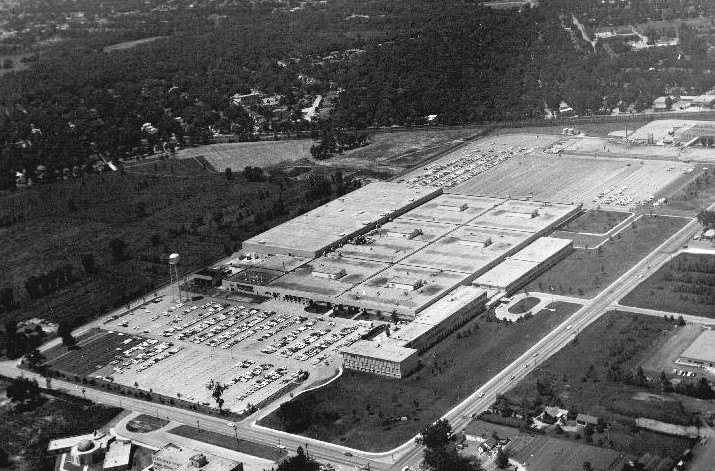
In 1957 Teletype was a fast-growing Western Electric subsidiary. The Teletype Story says it bought land at its Touhy Avenue site that year for three new buildings, and acquired a 160-acre site at Little Rock, Arkansas, for a second, self-contained factory. By the 1960s the bulletins give the company’s address as 5555 Touhy Avenue, Skokie, Illinois.
1.4 The L in LP: names inside the family
Each unit of a Model 28 carries a letter code on its data plate, and the codes begin with L. Haynes explains why. Teletype gave each product line a letter, and the Bell System gave the same lines model numbers: “F is for what Bell calls Model 14; B is Model 15; K is Model 31; L is Model 28. Hence you could have a typing unit labelled 28-A and a Bell System nameplate, or labelled LP-2 with a Teletype nameplate.” A Model 15 typing unit is a BP and a Model 28 typing unit is an LP. The 28’s keyboard is an LK, its motor an LMU, its electrical service unit an LESU, its typing reperforator an LPR, its transmitter-distributor an LXD, and so on. Volume 3 decodes these in full. Haynes adds that the Model 35, Teletype’s ASCII machine, uses the L codes as well, “since they are of the same family.” Many parts are common to the two.
1.5 The 28 in uniform
The armed services were the 28’s first customer and its largest. They gave each version a military designation, so a surplus 28 often arrives with a Navy or Army nameplate and no Teletype model number visible. The Navy listings on navy-radio.com, which cross-refer each designation to its Teletype components, are the most complete public source. The table gives the common designations, each checked against that site and, where noted, against Teletype’s own cross-reference sheet (BSP 573-100-000TC, May 1967):
Table 2 — The armed services were the 28's first customer and its largest. They gave each version a military designation, so a surplus 28 often arrives with a Navy or Army nameplate and no Teletype model number visible. The Navy listings on navy-radio.com, which cross-refer each designation to its Teletype components, are the most complete public source. The table gives the common designations, each checked against that site and, where noted, against Teletype's own cross-reference sheet (BSP 573-100-000TC, May 1967)
| Designation | What it is | Notes from the source |
|---|---|---|
| TT-47/UG, TT-48/UG | 28 KSR, floor cabinet | TT-47 has a synchronous motor, TT-48 a governed motor. TT-47 components: typing unit LP1/291 (MX-1115/UG), keyboard LK1, motor LMU1, ESU LESU1, cabinet LAC200BJ. Suffixes A–L track later versions |
| TT-69/UG, TT-70/UG | 28 KSR, tabletop | ”Same as TT-47 & TT-48 but with CY-971/UG cabinet”; TT-69 synchronous, TT-70 governed |
| TT-171/UG | 28 RO, floor cabinet | ”Same as TT-47A/UG except uses base LB3/101 and is without a keyboard” |
| TT-176/UG | 28 KSR, rack-mounted “skintight” | Relay-rack set with stepping magnets and automatic CR/LF |
| AN/UGC-5, AN/UGC-6 | 28 ASR | UGC-5: floor cabinet, typing unit, keyboard, chadless typing perforator, TD, gears for 45.5, 56.9 and 74.2 baud. UGC-6 adds an auxiliary chadless typing reperforator with its own motor and ESU |
| AN/UGC-20 | 28 KSR “compact” | M32-style electrical keyboard with a separate distributor; three-speed gearshift for 45.5, 50 and 74.2 baud |
| AN/UGC-25 | 28 RO “compact” | Friction feed, synchronous motor, the same three-speed gearshift |
| TT-192/UG | 28 ROTR (receive-only typing reperforator) | LPR9AWA reperforator, LRB8 base, LMU3 motor; TT-192A is the miniature version |
| TT-187/UG | 28 TD (transmitter-distributor) | Standard size; TT-187A miniature; gears for 45.5, 56.9 and 74.2 baud |
| TT-253/UG | 28 KTR (keyboard typing reperforator) | AN/UGC-78 is the low-level version |
| TT-306/UG, TT-307/UG | 28 RO and KSR, skintight, CRITICOM | 100 wpm, 7.00-unit code |
| AN/UGC-49, AN/UGC-77 | Low-level 28 sets | ±6 V MIL-STD-188B polar interface and Teletype’s TEMPEST shielding. A collector should know what these are (Volume 8) |
A few notes on the table. “45.5 baud” is the military’s name for the 45.45-baud, 60-wpm standard. 56.9 baud is 75 wpm and 74.2 baud is 100 wpm, all with the 7.42-unit code (one start, five data, and a stop element 1.42 units long). The 50-baud setting is the 66–67 wpm international speed. The Navy also made projector versions of the 28 (AN/UGR-1, TT-262/UG) that typed onto a transparent web and threw the text onto a screen for briefing rooms.
Some designations I could not confirm. No source I found ties an AN/FGC number to a plain Model 28 set. The early AN/FGC designations on navy-radio.com (FGC-8, -9, -11, -12) are Model 15 and Model 19 systems. FGC numbers do appear on the 1967 Teletype cross-reference sheet as cabinet designations (CY-3689/FGC-74, CY-4166/FGC-79, CY-4787/FGC-100), so some 28 installations sat inside FGC systems. Treat any “AN/FGC = Model 28” claim with caution until a manual confirms it.
1.6 The 28 in civilian service
The 28 sold to everyone who moved text in volume. Wikipedia names the financial and manufacturing industries alongside the armed forces. The Bell System and Western Union bought it for their own networks. Haynes recalls that Western Union, when the later Model 32 and 33 were being designed, persuaded Teletype to use “M28 style clutches” in place of the felt friction clutches it had planned, which suggests what the telegraph company thought of the 28’s clutch.
Two other civilian uses stand out in the sources:
- Aviation. The FAA’s teletype weather and flight-plan networks were large users. Haynes notes that “the FAA converted from 60 to 100 WPM circa 1960,” which was the 28’s design speed. Teletype’s 1959 stunt-box brochure opens with commercial jet travel and “automatic polling of outlying stations” for weather data, a job done with the 28’s stunt box (Volume 2).
- Data processing. By 1957 Teletype was selling the 28 for “integrated data processing”: an order typed once, with the stunt box sending the relevant lines to each department’s printer. The tape units also produced and read the punched tape that drove other machines (Volume 4).
Prices give a sense of what this was worth. Irvin Hoff, K8DKG, writing for amateurs in about 1965, gave “the typical 28KSR costing $1200 new and the basic 28ASR costing $2200 new.” Telegram & Cable Co., which still types telegrams on a restored 28 ASR, says its machine cost $2,500 in 1969.
1.7 The successor that wasn’t, and the long tail
Teletype’s later machines did not so much replace the 28 as surround it. The Model 35 (ASCII, 1960s) was built on the 28’s mechanism and shares many of its parts. The light-duty Models 32 and 33 were built for offices that typed a couple of hours a day. A KSR or ASR 28 kept the heavy-duty five-level work. Electronic and CRT terminals ended that work. Wikipedia dates the 28’s replacement in new installations to the mid-to-late 1970s and gives 1981 as the end of production. That date is marked “citation needed,” and I have found no primary source that confirms it. Other secondary sources disagree (one wiki gives 1960, which the Navy’s procurement of new 28 sets through the 1960s and 1970s rules out). The safest statement is that 28s were built for about thirty years and were still being serviced and installed by the Navy into the 1980s. A newly installed AN/UGC-77, the low-level compact 28, is shown on navy-radio.com newly installed aboard the frigate FFG-60 in 1987.
1.8 Hams and the surplus 28
Amateur radioteletype grew up on surplus. The first hams on the air with RTTY, from the late 1940s, used Model 12s, 15s and 26s that the services and wire companies had retired (RTTY on the Air tells that story). The 28 joined them later, because a newer machine stays in commercial service longer and costs more when it does come out.
Hoff’s Introduction to Amateur Radio Teletype, written around 1965 and kept on RTTY.COM, gives a good picture of the 28’s standing among amateurs at the time. He calls the Model 15 “the backbone of amateur radioteletype,” available for $25 to $100. He says the 28 is “the most versatile for the advanced enthusiast,” with “entire catalogs” of accessories. Used, it was still expensive: “around $400 or more for the 28KSR and around $750 or more for the 28ASR.” He also notes that “some of these beautiful machines are occasionally available to MARS members at no cost” (MARS, the Military Affiliate Radio System, could issue equipment to amateurs who ran traffic for the services), and expected prices to come down.
They did. Through the 1970s, as Bell companies moved to ASCII equipment and the military moved to newer machines, 28s came out in quantity. That is when the 28 became a common sight in American ham shacks, often as a KSR or ASR geared down from 100 to 60 wpm for amateur RTTY. Volume 7 covers that gear change in detail, because a buyer today has to make it too.
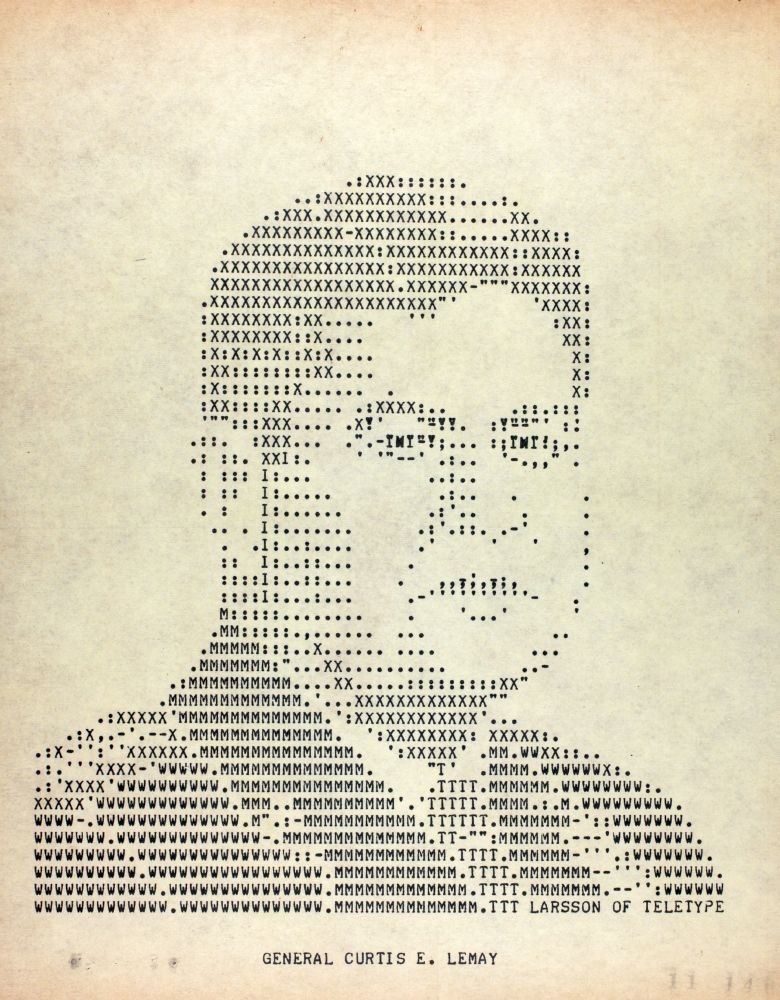
Amateurs made the 28 do more than copy traffic. Its keyboard, tape punch and tape reader made it an ideal tool for building long messages, test tapes and RTTY art on tape, and the stunt box gave it features no Model 15 could match. Amateur RTTY organisations and the RTTY Journal (published from 1953) traded notes on all of it. The Model 28 itself was announced to amateurs in Zenner’s article in the RTTY Journal’s first year.
1.9 How the 28 sounded
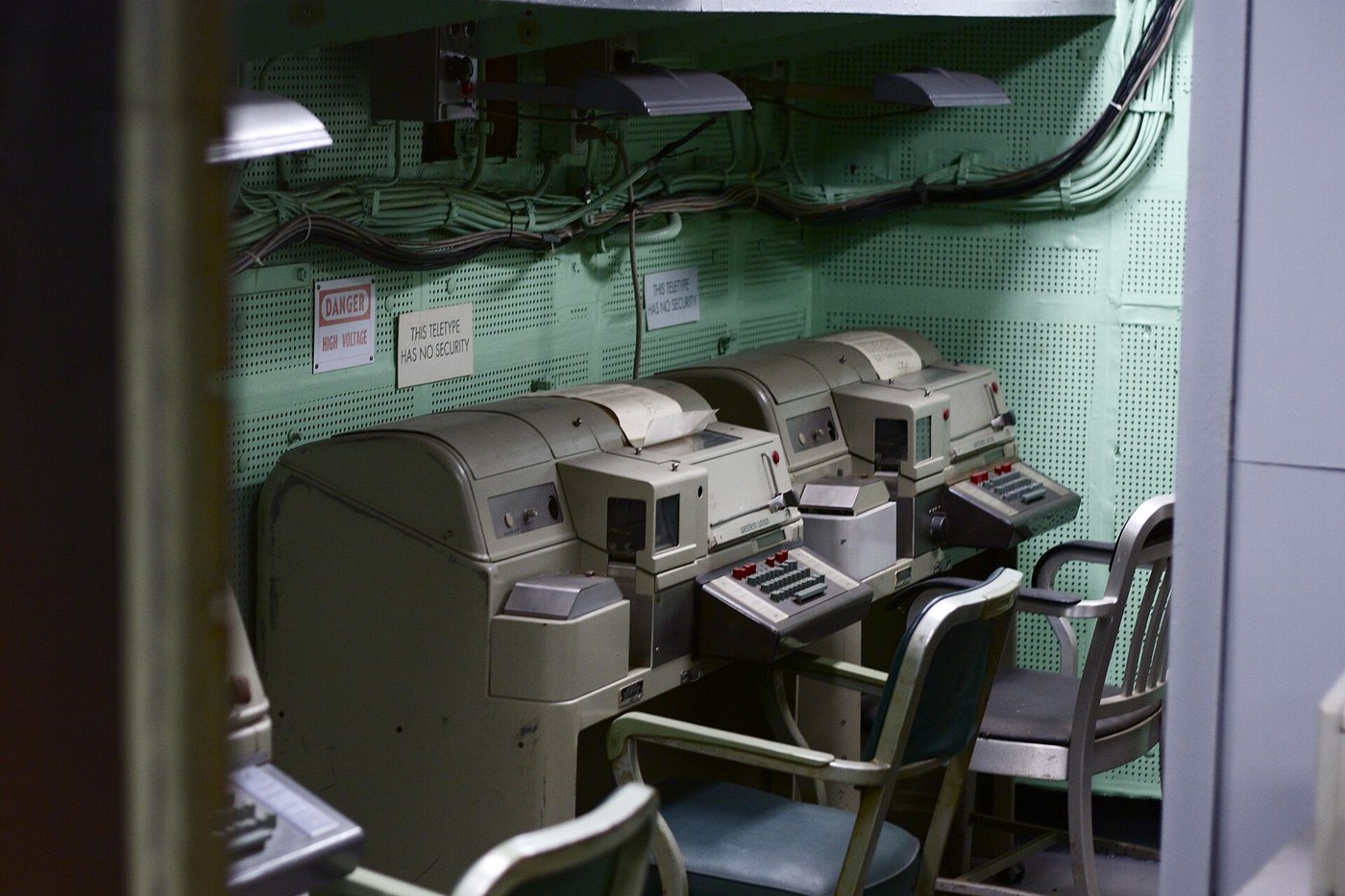
Machine sounds are hard to describe, but Haynes managed it well. After hearing a Prokofiev piano sonata played as an encore, he wrote that it “reminded me of being in the midst of a bunch of Model 28s. Not so much chugging like a Model 15 as all those little parts moving in a 28.” The 15 thuds and its type bars slap. The 28 makes a quicker, busier, more complicated clatter, the sound of many small parts moving. The 28 was meant to be quieter than the 15, and its cabinets had rubber seals and sound-deadening foam. On a surplus machine today that foam has usually turned to powder (Volume 5).
1.10 What the rest of this dive covers
- Vol 2 — Inside the typing unit. The six clutches, the two-coil selector, nine code bars, the type box and how five bits choose one of 64 pallets, the printing hammer, the spacing drum and dashpot, the stunt box, the keyboard and the motor.
- Vol 3 — The family. KSR, RO, ASR, KTR, ROTR, TD and RT sets; the unit codes; floor, table, wall-mount, compact and skintight cabinets; data plates and dating.
- Vol 4 — Tape on the 28. The four punches, the TD family, the ASR’s K, K-T and T modes, tape stock, torn-tape relay, and getting tape in and out of a computer.
- Vol 5 — Oil, grease and cleaning. The lubrication sections and intervals, KS-7470 and KS-7471 and their modern equivalents, cleaning, and the motor.
- Vol 6 — Adjustment, range and repair. The adjustment sections, the critical adjustments, taking a range and what the numbers must be, common faults, tools, parts and the community.
- Vol 7 — Buying and moving one. What turns up, what it costs, what it weighs, how to move it, which version to buy for which job, and the speed gears.
- Vol 8 — Wiring a 28, and 28 or 15? Neutral and polar, 20 and 60 mA, the electrical service unit, the low-level trap, a comparison table, and the PURPLE pair.
1.10.1 Sources (Vol 1)
- The design brief, first production lot late in 1950, Korean War priority, general availability in 1953, the 28 ASR introduced in 1957, the stunt box, “no structural castings,” harmonic motions, clutches oiled once or twice a year against two weeks for felt clutches, the 1 × 3 inch type box; Touhy Avenue expansion and the Little Rock site (1957). Teletype Corporation, The Teletype Story (Chicago, 1957), pp. on “Model 28” and “What of the future?” Copy at RTTY.COM: https://rtty.internet-tty.net/downloads/teletype-story.pdf ⟨also at samhallas.co.uk; staged for the Library⟩
- First delivered to the Navy in 1951; commercial introduction 1953; design goals; screw adjustments; type box about 8 oz against more than 5 lb for the Model 15 carriage; 1149B lists sixteen type boxes; production said to end in 1981 (citation needed); “ASR-28” from the DEC PDP-4 brochure of September 1963. Wikipedia, “Teletype Model 28,” citing W. J. Zenner, “A New Teletypewriter,” RTTY Journal (1953), pp. 4–7, Teletype Bulletin 1149B, and DEC brochure F-41D. https://en.wikipedia.org/wiki/Teletype_Model_28 ⟨Zenner not seen directly⟩
- Speeds of 368, 460 and 600 opm; gear sets per speed; factory wiring for 0.060 A with 0.020 A by rewiring; 8½-inch paper; “Subsidiary of Western Electric Company, Chicago.” Teletype Corporation, Bulletin No. 216B: General Description and Theory of Operation, Model 28 Printer (June 1953), Section 1. https://bitsavers.org/communications/teletype/28/216B_Model28_Descr_Jun53.pdf
- Model 15s at 100 wpm in the war; L = Model 28 (LP-2 versus “28-A”); 28 and 35 the same family; Western Union and M28-style clutches in the 32/33; FAA from 60 to 100 wpm about 1960; 100 wpm the 28’s design maximum; the Prokofiev comparison. Jim Haynes, Some Notes on Teletype Corporation (2000–2001), deramp.com archive. https://deramp.com/downloads/mfe_archive/030-Terminals/Teletype/History/haynes—notes.pdf
- Military designations and components (TT-47/48, TT-69/70, TT-171, TT-176, AN/UGC-5/6, -20, -25, -49, -77, TT-192, TT-187, TT-253, TT-306/307, AN/UGR-1); FGC-8/9/11/12 as Model 15/19 sets; UGC-77 aboard FFG-60 in 1987. navy-radio.com, “US Navy Teletype Equipment — 1950’s & early 1960’s.” https://www.navy-radio.com/tty.htm ⟨read via the Internet Archive; the live host refuses automated clients⟩
- KSR/RO cross-reference chart with FGC cabinet designations. Teletype Corporation, BSP 573-100-000TC, 28 KSR and RO Teletypewriter Sets for U.S. Navy — General Cross Reference Information, Issue 1, May 1967. https://www.navy-radio.com/manuals/tty/573-100-000-6705.pdf
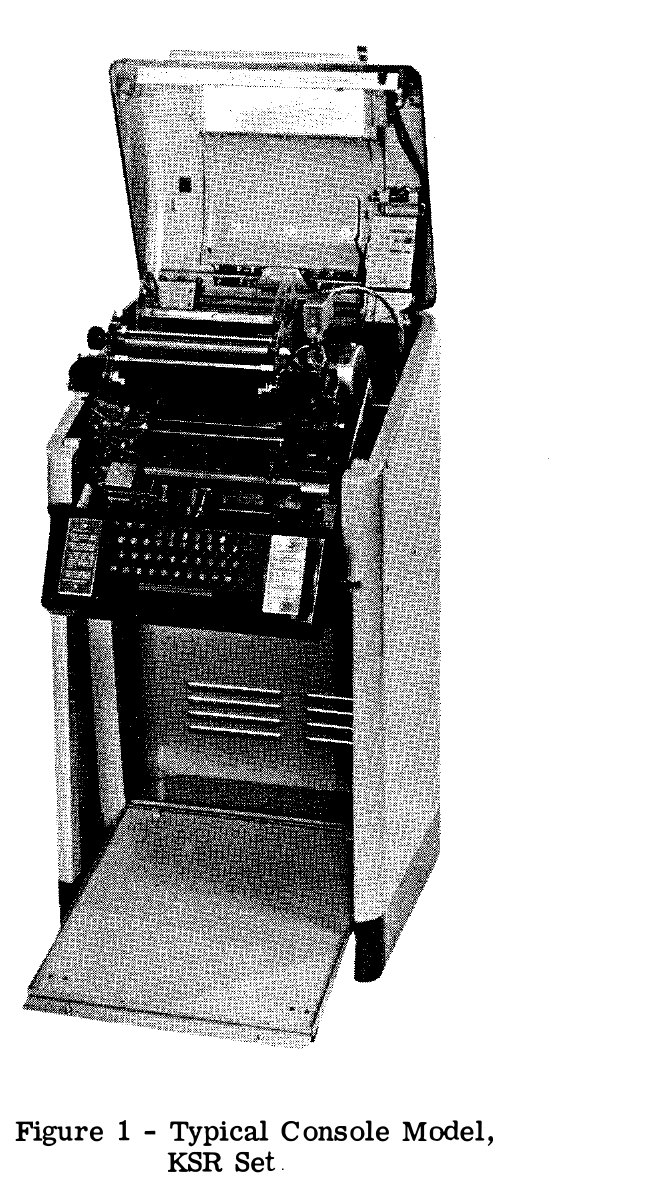
- The console KSR photograph. BSP 573-100-200TC, Issue 1 (May 1967), Fig. 1, in Technical Manual, 28 KSR and RO Teletypewriter Sets, NAVSHIPS 0967-173-7010 (Teletype Bulletin 311B, Vol. 1, July 1967). https://www.navy-radio.com/manuals/tty/0967-173-7010-6707.pdf
- Amateur prices and status about 1965 (Model 15 at $25–100; 28 KSR at $1,200 new and $400 used; 28 ASR at $2,200 new and $750 used; free machines to MARS members). Irvin M. Hoff, K8DKG, Introduction to Amateur Radio Teletype, at RTTY.COM. https://www.rtty.com/development/literature/introduction.htm
- The 1969 price of $2,500 for a 28 ASR. Telegram & Cable Co., “Teletype Model 28 ASR.” https://www.telegramcableco.com/teletype-model-28-asr.html
- Stunt-box brochure on jet-age weather polling and selective calling. Teletype Corporation, The Stunt Box (1959), at RTTY.COM. https://rtty.internet-tty.net/downloads/stuntbox.pdf
- Cross-links: Teletype Machines; Inside the Teletype Mechanism; Restoring a Teletype; RTTY on the Air; The Teletype Model 15 (https://dots-and-dashes.fubsypoly.com/teletype-model-15/); Interfacing Teletypes and Paper Tape (https://dots-and-dashes.fubsypoly.com/interfacing-teletypes-and-paper-tape/); PURPLE, Iconic Machines (https://iconic-machines.fubsypoly.com/purple/vol-10/).