The Teletype Model 28 · Volume 3
The Teletype Model 28 — Vol 3: The Family, and How to Tell What You Are Looking At
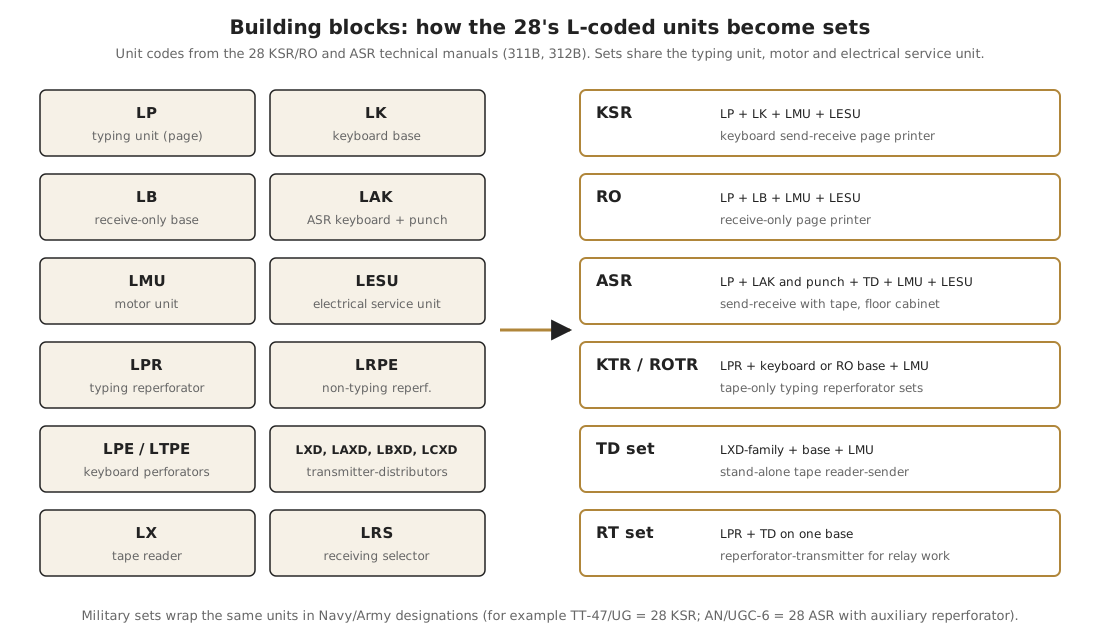
Teletype built the 28 from separate units, so a 28 is really a combination: a typing unit on a keyboard or base, a motor, an electrical service unit, perhaps a punch and a reader, in one of a dozen cabinets. This volume names the units, the sets they make, and the plates that tell you which one you have.
3.1 Units first, sets second
The Teletype Story (1957) described the 28 as designed on the “building block” principle, and the documents bear that out. Teletype sold and documented the 28 unit by unit, and each unit has its own Bell System Practice sections: a description (‑100), adjustments (‑700), lubrication (‑701), disassembly (‑702) and parts (‑800). A finished machine is a combination of units in a cabinet, and the name of the combination (KSR, RO, ASR and so on) depends on which units are in it.
This matters to a buyer and a restorer for three reasons:
- Units are swapped. Decades of service and hobby trading mean a cabinet’s typing unit, keyboard and motor may have started life in different sets. The data plate on each unit is the only reliable guide.
- The documents are organised by unit. To find the adjustment procedure for a particular keyboard, find its unit code and then the section for that unit (Restoring a Teletype explains the numbering).
- The interface is a property of the electrical service unit, not of the printer. Two KSRs that look the same can need different signals (Volume 8).
3.2 The unit codes
Every Model 28 unit code starts with L, Teletype’s letter for the 28 family (Volume 1). The main ones, from the Navy’s 28 KSR/RO and ASR technical manuals and their cross-reference charts:
Table 1 — Every Model 28 unit code starts with L, Teletype's letter for the 28 family (Volume 1). The main ones, from the Navy's 28 KSR/RO and ASR technical manuals and their cross-reference charts
| Code | Unit | Notes |
|---|---|---|
| LP | Typing unit (page printer) | Friction or sprocket feed; e.g. LP14RN/AY |
| LK | Keyboard (KSR) | Sometimes listed as the keyboard base; e.g. LK4RN126, LK10ARN |
| LB | Receive-only base | Takes the place of the keyboard in an RO; e.g. LB3/101 |
| LAK | ASR keyboard (perforator-transmitter base) | Carries the keyboard and the keyboard tape punch |
| LPE, LTPE | Keyboard perforators, non-typing and typing | Punch tape from the ASR keyboard |
| LPR, LRPE | Reperforators, typing and non-typing | Punch tape from incoming signals |
| LXD, LAXD, LBXD, LCXD | Transmitter-distributors (tape readers that send) | Several designs of reading head (Volume 4) |
| LX | Tape reader | Used with an LXD as a second reading head |
| LCXB, LRB | Bases for TDs and reperforators | |
| LMU | Motor unit | Synchronous or governed; e.g. LMU3 |
| LESU | Electrical service unit | Fuses, power switch, terminal blocks, line relay, selector strapping |
| LAC, LAAC, LPC | Cabinets and covers | e.g. LAC200BJ floor cabinet |
| LRS | Receiving selector | Serial-to-parallel converter, no printer |
| LARP | Multi-magnet reperforator | Parallel-input punch for switching centres |
The letters and numbers after the base code identify a specific version with specific features. They are not a simple scheme. The only reliable way to decode a full code such as LP14RN/AY or LESU7/147 is to find it in the parts bulletin (1149B for the KSR and RO printer units) or in a set’s cross-reference chart.
3.3 The sets
3.3.1 KSR — keyboard send-receive
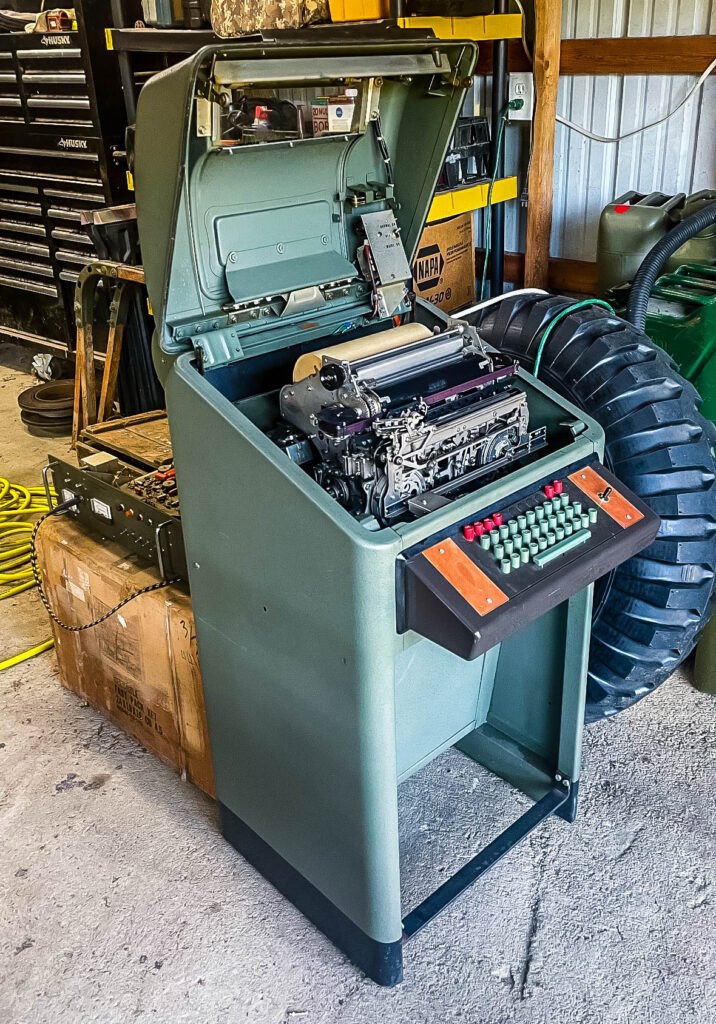
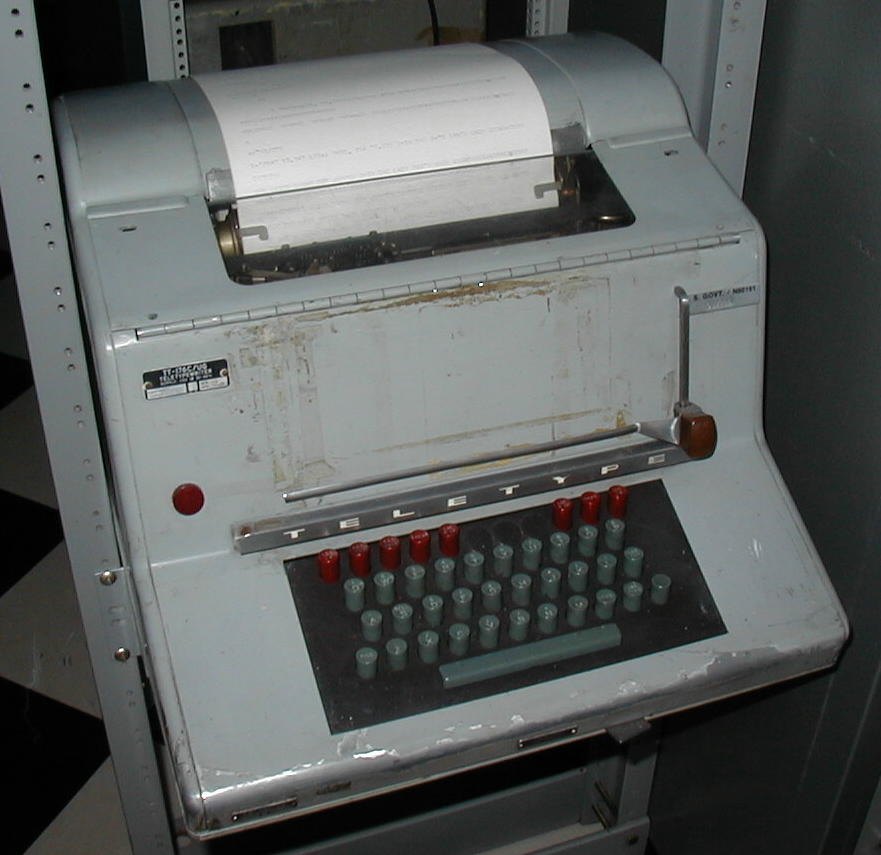
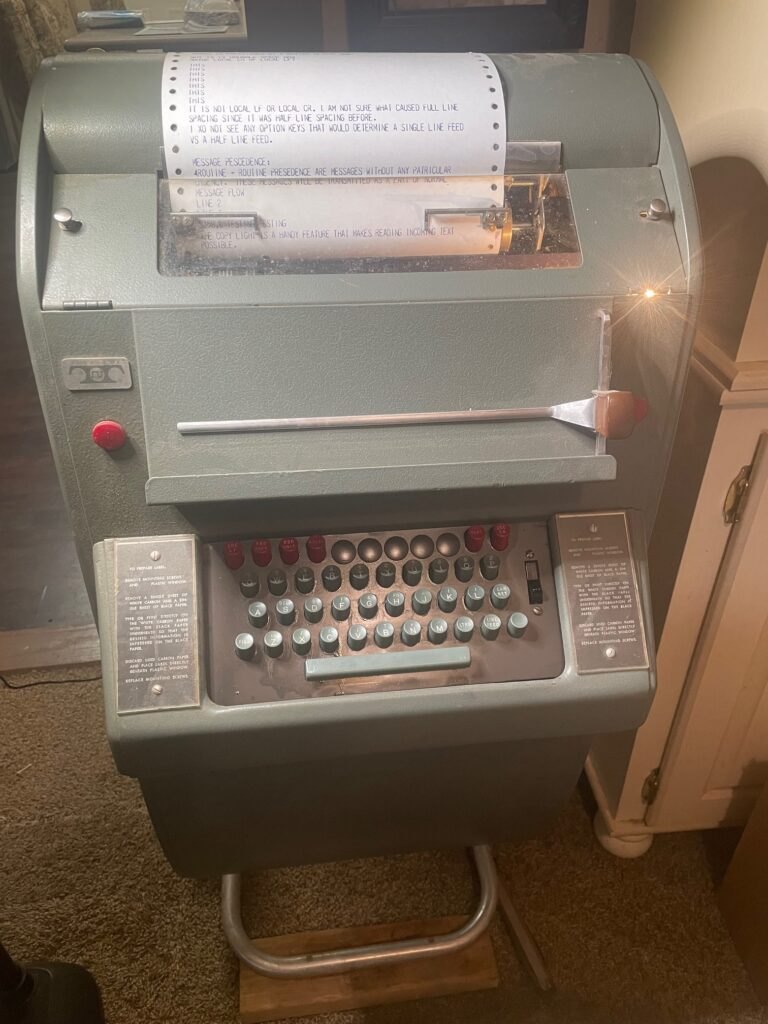
The basic set and the most common survivor. A typing unit (LP) on a keyboard (LK), with a motor (LMU) and electrical service unit (LESU), in a cabinet. The keyboard sends and the typing unit prints everything on the line, including what the keyboard sends. Wikipedia gives these sizes and weights:
Table 2 — The basic set and the most common survivor. A typing unit (LP) on a keyboard (LK), with a motor (LMU) and electrical service unit (LESU), in a cabinet. The keyboard sends and the typing unit prints everything on the line, including what the keyboard sends. Wikipedia gives these sizes and weights
| KSR cabinet | Height | Width | Depth | Weight |
|---|---|---|---|---|
| Floor model | 40 in | 20½ in | 18½ in | 130 lb |
| Table model | 16 in | 20½ in | 18½ in | 130 lb |
| Wall model | 30 in | 16½ in | 14½ in | 110 lb |
The keyboard sticks out 4½ inches in front of the cabinet. The whole set draws “under 1.5 A at 115 VAC, 60 Hz” and was rated for 40–110 °F and 2–95 percent relative humidity. Paper is a roll 8.44 inches wide and 4½ inches in diameter. The ribbon is ½ inch wide and 60 yards long, the same size as a standard typewriter ribbon (Volume 5 covers modern ribbons).
3.3.2 RO — receive only
The same typing unit on an LB base with no keyboard, only local CR and LF levers. ROs were installed in large numbers wherever traffic only had to be received: weather circuits, news and broadcast monitoring, and the receive side of message centres. The floor RO is the same size as the floor KSR (40 × 20½ × 18½ inches). Its Navy designation is TT-171/UG, which navy-radio.com describes as “Same as TT-47A/UG except uses base LB3/101 and is without a keyboard.”
3.3.3 ASR — automatic send-receive
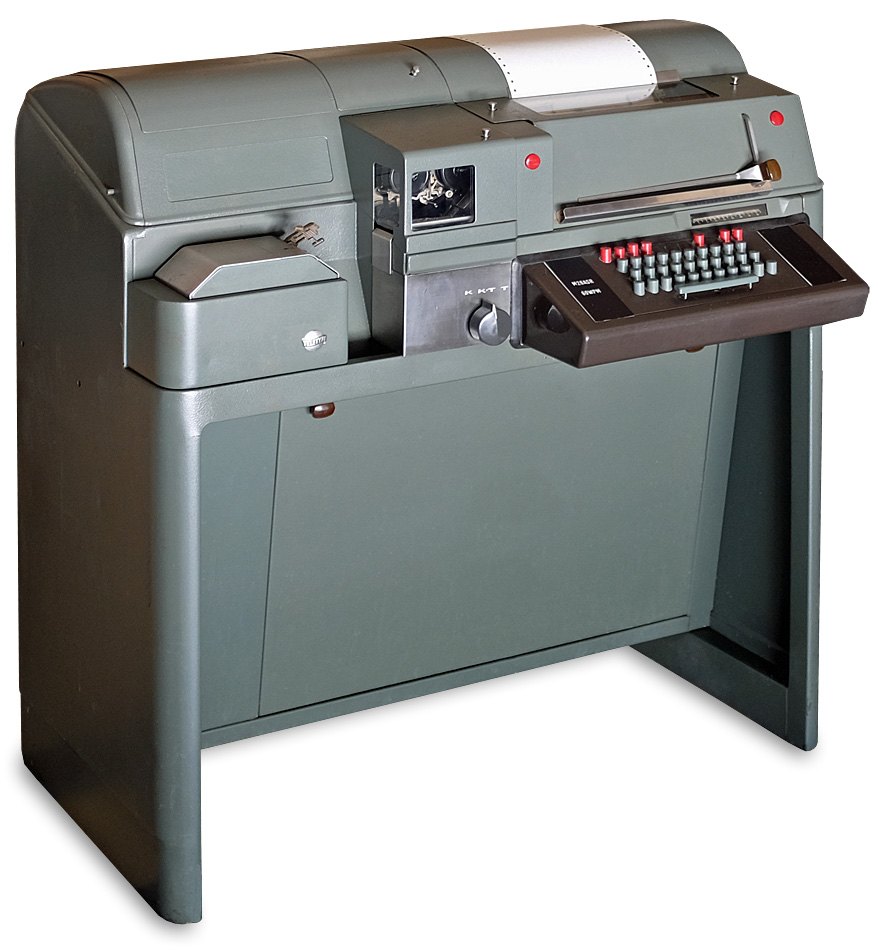
A typing unit on an LAK keyboard that carries a keyboard tape punch, a separate transmitter-distributor on the left of the cabinet driven by the same motor, and room in the cabinet for an auxiliary typing reperforator with its own motor and ESU. Wikipedia gives the ASR cabinet as 40 inches high, 36 wide and 18½ deep, and the set as 260 lb. A Teletype specification sheet on navy-radio.com gives “approximate weight: 260 pounds” too. Volume 4 covers how the ASR works.
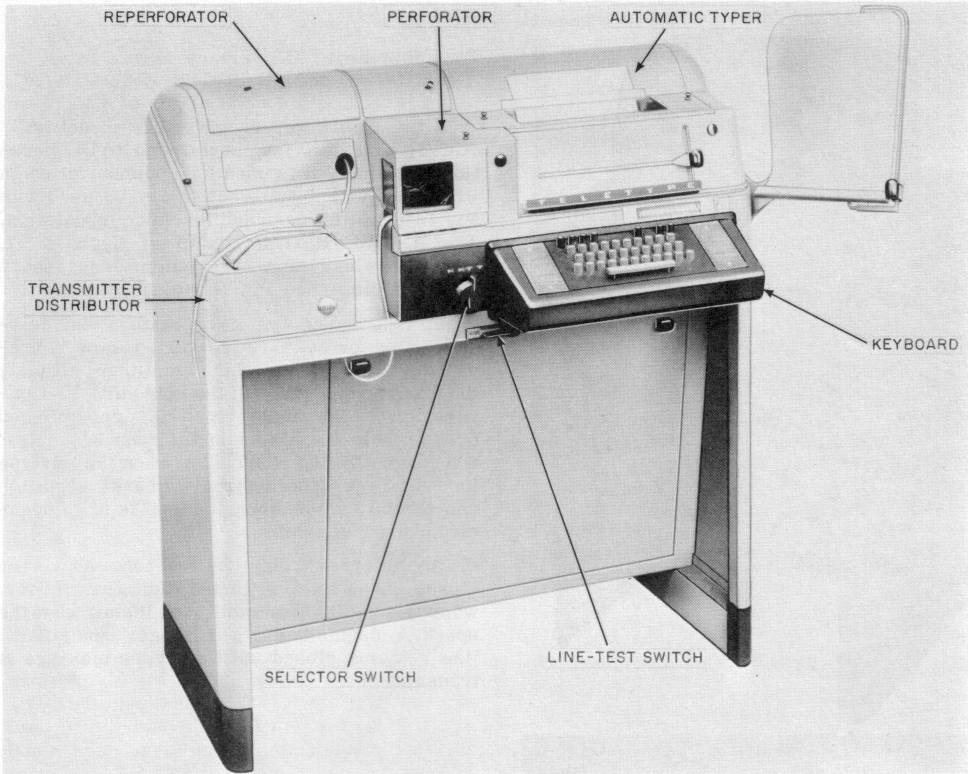
3.3.4 Tape-only sets: KTR, ROTR, TD, RT
- KTR (keyboard typing reperforator, also called SRTR, send-receive typing reperforator): a keyboard and an LPR typing reperforator, no page printer. Used to prepare tape off-line and to receive onto tape. Navy TT-253/UG.
- ROTR (receive-only typing reperforator): an LPR on a receive-only base, punching and printing incoming traffic onto tape. Navy TT-192/UG, and the miniature TT-192A/UG with the tape reel on top, not at the side. Teletype’s description section lists table models, a “miniaturized” set with a close-fitting cover, and “Multiple ROTR Sets,” three reperforators on one mounting for torn-tape relay centres (BSP 573-102-100).
- TD set: a transmitter-distributor on its own base with a motor, to send tape onto a line. Navy TT-187/UG and the miniature TT-187A/UG.
- RT set (reperforator-transmitter): an LPR and a TD on one base, so traffic punched from one line can be read straight onto another. Wikipedia gives the RT set as 35 inches high, 8½ wide, 20 deep and 110 lb, with a cabinet holding two sets that weighs 300 lb. RT sets were the building block of the 28 torn-tape and automatic relay systems.
3.3.5 The specialists
A few other 28-family products turn up and puzzle buyers:
- LRS receiving selector: a typing unit’s selector and code bars with no printer, giving a five-wire (optionally six-wire) parallel output. About 8 × 8½ × 9¾ inches and 16½ lb (Wikipedia).
- LARP multi-magnet reperforator: a punch that takes parallel input at high speed, used in store-and-forward switching (Haynes cites Western Union’s Plan 55 and gives its speed as up to 200 wpm). Wikipedia gives its weight as 24 lb.
- Projector sets (AN/UGR-1, TT-262/UG): a 28 typing unit printing on a transparent web for a screen (Volume 1).
- 28 tape printer and stock ticker (Bulletin 288B), and late “Model 37 technology, but considered Model 28” ticker parts (Bulletin 1194B).
- Selective-calling and torn-tape system cabinets with several 28 units, from the “Universal Torn Tape System” manuals.
3.4 Cabinets and enclosures
The same KSR or RO can be housed in very different enclosures, and the enclosure largely decides how heavy and how portable it is.
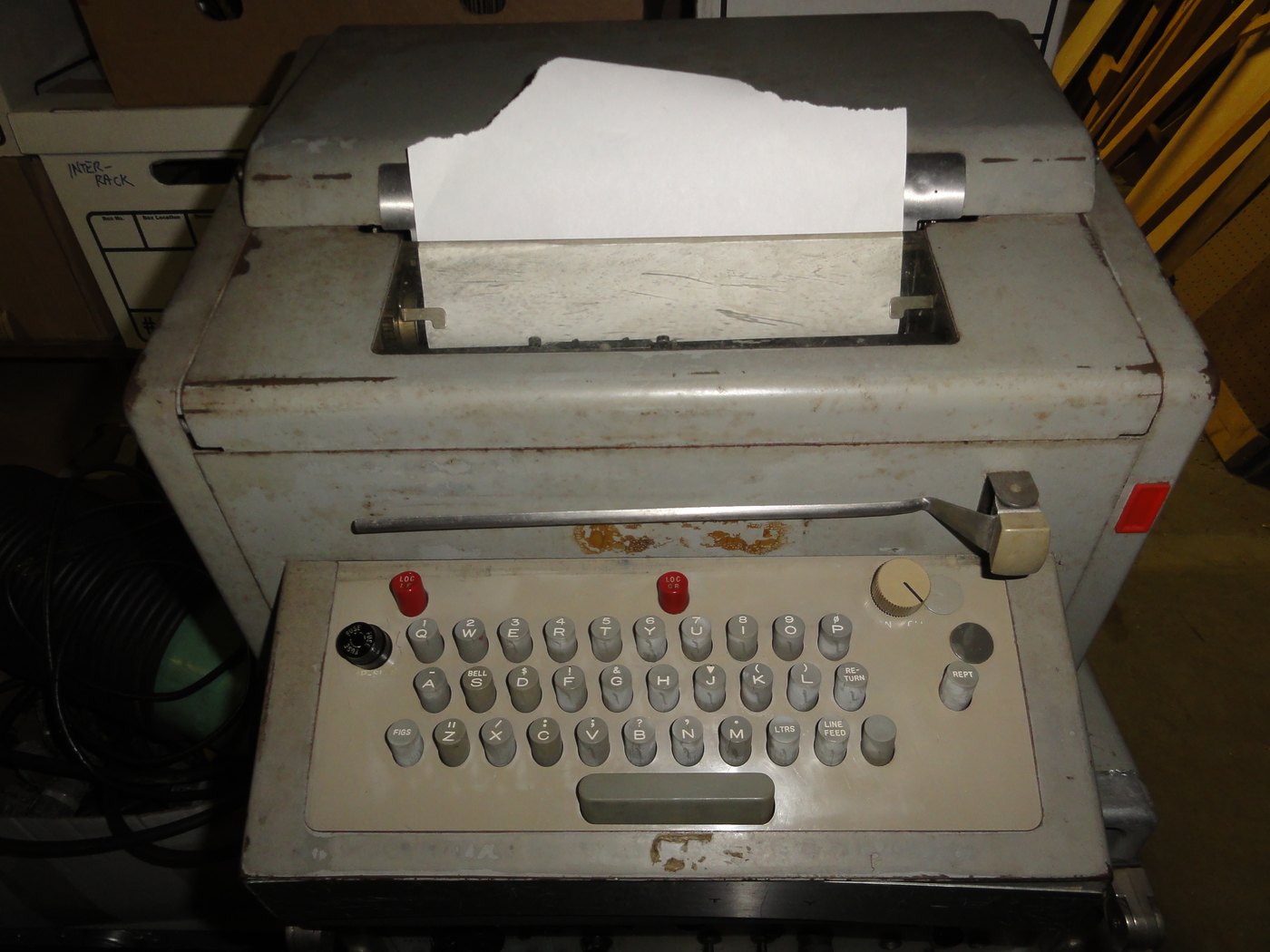
- Console (floor) cabinet: the classic 28 look, a domed lid hinged at the rear, a window over the printed line, a copyholder on the front of the dome, and a lower compartment with shelf space. Bulletin 216B describes a counterbalanced dome and a “tilting arrangement which permits the assembled Keyboard, Motor, and Typing Units to be tilted forward and supported when the dome is open.” A panel from the lower compartment can be hung horizontally inside to serve as a work shelf for the typing unit. These features make it the easiest to service.
- Table model: the same mechanism under a cover, for a desk or a separate stand. Navy TT-69/UG and TT-70/UG.
- Wall mount: a shallow cabinet that hangs on a backplate. The installation section gives the backplate’s mounting holes, 14⅝ inches apart horizontally. These are often found on home-made carts now, because nobody wants to bolt 110 lb to a living-room wall.
- “Skintight” rack mount: a close-fitting cover for a 19-inch relay rack, used on ships and in message centres. Navy TT-176/UG (KSR), TT-306/UG (RO), TT-307/UG.
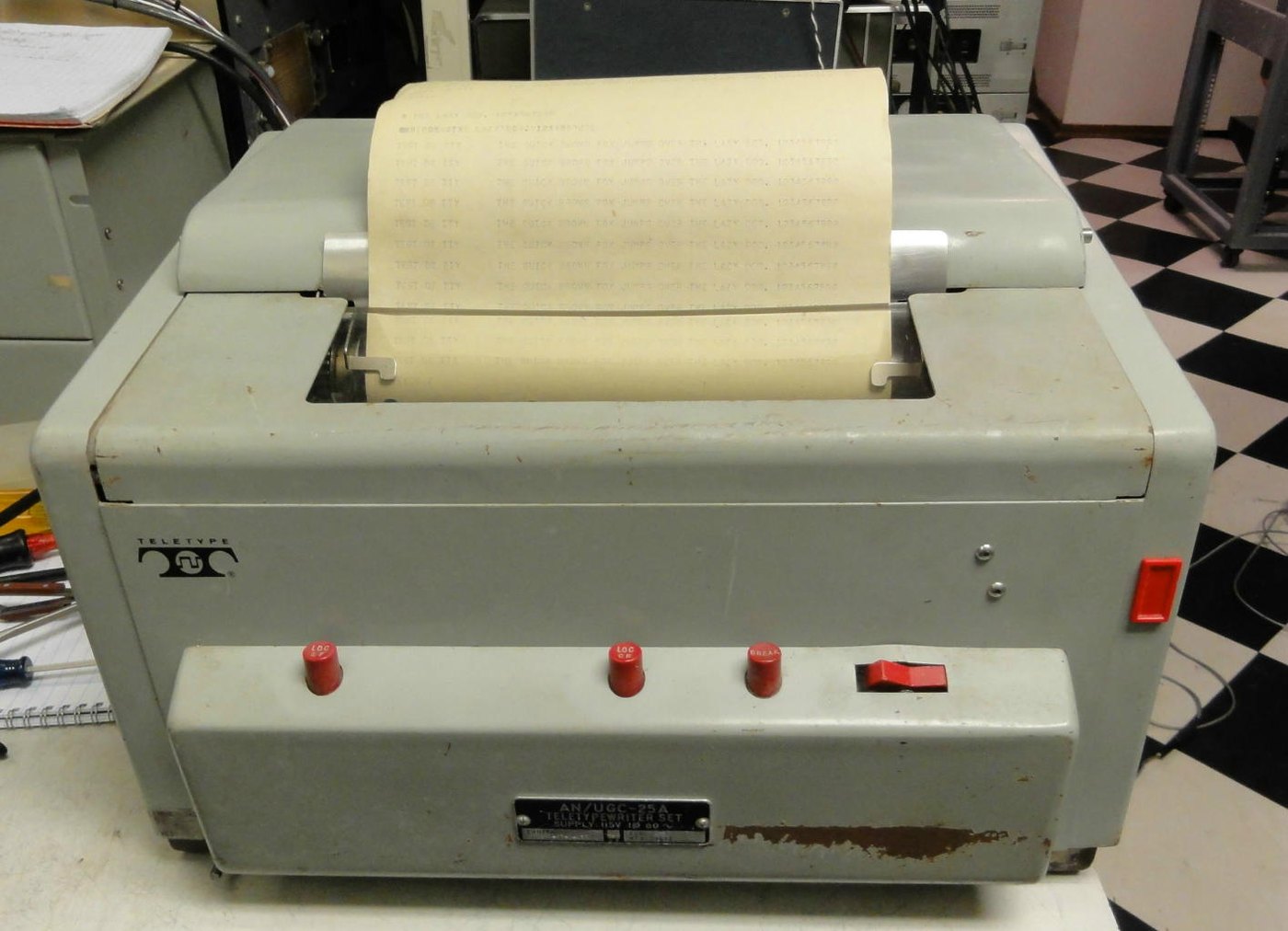
- Compact: the late Navy design (AN/UGC-20 KSR, AN/UGC-25 RO) with a low, square cabinet. The UGC-20 uses “a M32-style 5-line parallel electrical unit” for its keyboard, with a separate distributor on the typing unit’s shaft (navy-radio.com). It is a 28 typing unit with a different keyboard, and a three-speed gearshift for 45.5, 50 and 74.2 baud.
3.5 Reading the plates
3.5.1 Teletype data plates
Each major unit carries its own data plate. A typing unit plate and a base plate are shown below. The typical layout gives the Teletype name and address, the patents, a CODE (the unit code, such as LP14RN/AY or LK…), a SER. NO., and the type of unit (“TYPING UNIT,” “TTYWR BASE”).
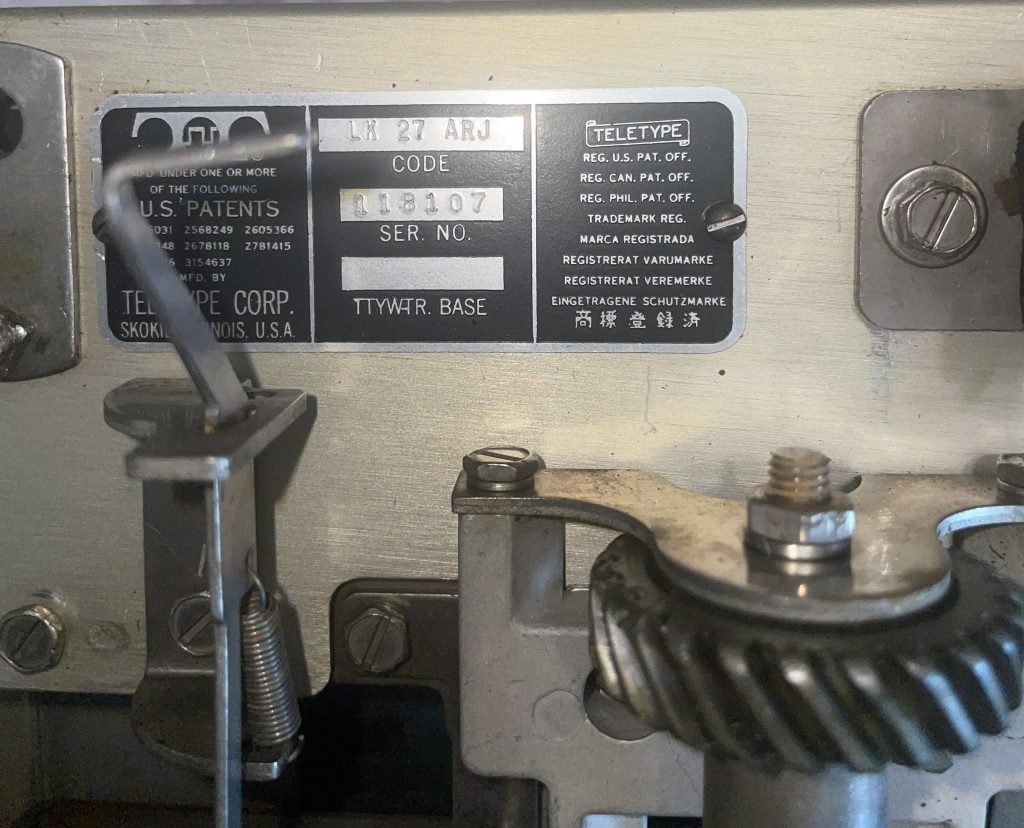
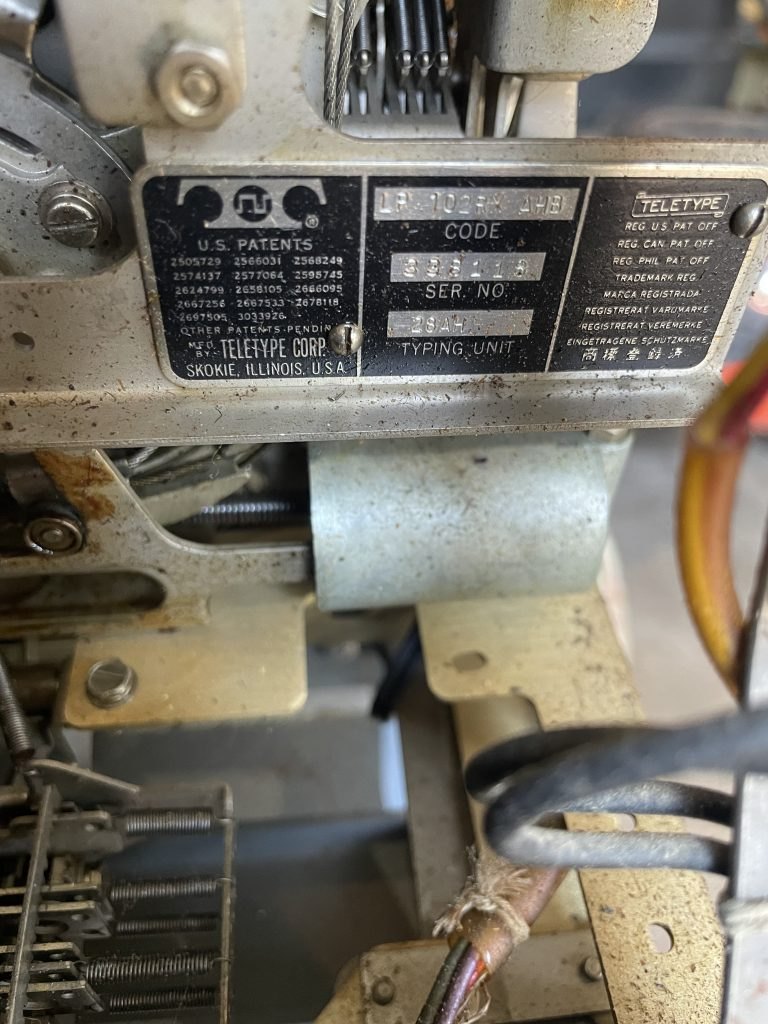
Read the code, not just the plate’s existence. Write down every unit’s code before moving anything, because once units are separated it is easy to lose track of which belonged to which set. The codes are what you will use to find the right documents (Restoring a Teletype, Vol 1, “Step one is paperwork”).
3.5.2 Military plates
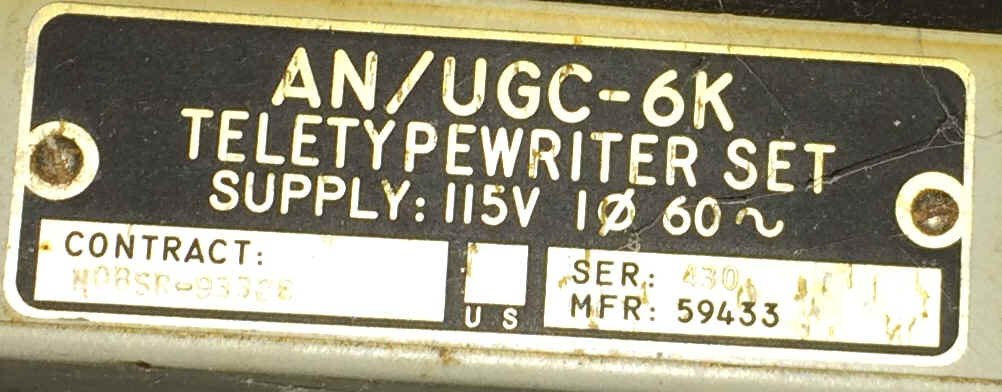
A military set has a Navy or Army plate on the cabinet with the set designation, the power supply, a contract number, a serial and a manufacturer field. The individual units inside still carry Teletype plates, and many also carry military component designations (MX-1115/UG for a typing unit, for example). The cross-reference sheet BSP 573-100-000TC maps the Navy component designations of the KSR and RO sets to Teletype codes, unit by unit.
3.5.3 Dating a 28
I could find no published table that converts a 28 serial number to a year of manufacture. The Computer History Museum’s own catalogue record for a 28 typing unit gives the serial but no date, and a Canadian museum record dates its unit to a range (“1955–1970”). The clues that do exist:
- The address. Bulletin 216B (1953) gives Teletype’s address as Chicago; later documents give 5555 Touhy Avenue, Skokie. A plate that reads Chicago suggests an earlier unit, though this is an inference, not a documented rule.
- Features. Early units have a function box, not a stunt box, and some early adjustments are illustrated in the bulletins as “early design.” The adjustment sections often show the earlier and later forms of a part side by side.
- Military contracts. A contract number on a military plate can sometimes be traced to a year.
- Documents found with the machine. Wiring diagrams carry issue letters and dates. A diagram or inspection tag in the cabinet dates at least that configuration.
None of these gives an exact year. It is usually enough to know roughly which decade the machine came from and which documents apply to it.
3.6 A field guide
Table 3 — A field guide
| You see | It is probably |
|---|---|
| Domed floor cabinet, keyboard, page printer only | 28 KSR (TT-47/48 if military) |
| Domed floor cabinet, no keyboard, local CR/LF levers | 28 RO (TT-171) |
| Wide floor cabinet, keyboard, tape reader at left, punch in the middle, K/K-T/T switch | 28 ASR (AN/UGC-5/6) |
| Low square cabinet, keyboard of round keys, three-speed knob | Compact 28 KSR (AN/UGC-20/77) |
| Low square cabinet, no keyboard | Compact 28 RO (AN/UGC-25) |
| Close-fitting cover with rack ears | Skintight 28 KSR/RO (TT-176, TT-306/307) |
| Small box with a keyboard and a tape punch, no page | 28 KTR (TT-253) |
| Small box printing and punching tape, no keyboard | 28 ROTR (TT-192) |
| A small unit that reads tape, start-stop switch, no printer | 28 TD (TT-187) |
| A “28” with a keyboard of a different style and parallel wiring | Check for a Model 32-style keyboard or a low-level set (Volume 8) |
| An ASCII machine with the same look | Probably a Model 35, the 28’s eight-level relative, which shares many parts |
Volume 7 covers what each of these is good for, and which to choose.
3.6.1 Sources (Vol 3)
- Unit codes and their roles; the ASR units (LAK with LPE, LTPE, LRPE or LPR; LAXD, LBXD, LCXD, LXD or LX; LCXB; auxiliary LPR with LRB and LMU; LAAC cabinet). Teletype Corporation, BSP 573-101-100TC and 573-101-200TC (28 ASR description and installation), in Technical Manual, 28 ASR Teletypewriter Sets, NAVSHIPS 0967-173-6010 (Bulletin 312B, Vol 1, July 1967). https://www.navy-radio.com/manuals/tty/312b-v1-orig-6707.pdf
- KSR and RO units; the cross-reference chart of Navy and Teletype codes; installation, wall-mount backplate holes 14⅝ in apart. Bulletin 311B Vol 1 (NAVSHIPS 0967-173-7010), sections 573-100-000TC and 573-100-200TC. https://www.navy-radio.com/manuals/tty/0967-173-7010-6707.pdf
- Dimensions and weights of the KSR (floor, table, wall), ASR (260 lb), RO, LRS, RT set and cabinet, LARP; electrical and environmental ratings; paper roll and ribbon sizes. Wikipedia, “Teletype Model 28,” citing Teletype specification material. https://en.wikipedia.org/wiki/Teletype_Model_28 · ASR at about 260 lb also from Teletype, Model 28 Specifications (on navy-radio.com). https://www.navy-radio.com/manuals/tty/28-specs-equip-1806.pdf
- Tilting cradle, counterbalanced dome, maintenance plate as a work shelf; Chicago address in 1953. Teletype Corporation, Bulletin No. 216B (June 1953), Section 1. https://bitsavers.org/communications/teletype/28/216B_Model28_Descr_Jun53.pdf
- KTR and ROTR sets: table, miniaturized and multiple sets. Teletype Corporation, BSP 573-102-100TC, in Bulletin 246B (1964). https://www.navy-radio.com/manuals/tty/246B-6402.pdf
- Navy designations, compact KSR keyboard and gearshift, skintight sets, TT-192A reel on top, the UGC-6 drawing and UGC-6K nameplate photographs. navy-radio.com, “US Navy Teletype Equipment.” https://www.navy-radio.com/tty.htm
- The bulletin index (1149B KSR/RO parts; 288B tape printer; 1194B ticker parts). Hertzmail Teletype bulletin index. http://www.hertzmail.com/TTY/TeletypeManuals/INDEX.TXT
- LARP and Plan 55; L codes; the Model 35 as the 28’s relative. Jim Haynes, Some Notes on Teletype Corporation. https://deramp.com/downloads/mfe_archive/030-Terminals/Teletype/History/haynes—notes.pdf
- Museum records with serial but no date, and a date range. Computer History Museum, catalogue 102673728; Ingenium (Canada), 1992.0352.001. https://www.computerhistory.org/collections/catalog/102673728
- Wall-mount, floor KSR and data plate photographs; disintegrated foam replaced with carpet tile. David Stickelman, stickelman.net (2024–2025). http://stickelman.net/index.php/2024/11/12/model-28-ksr-wall-mount-progress/
- The restored 28 ASR. Telegram & Cable Co. https://www.telegramcableco.com/teletype-model-28-asr.html
- Cross-links: Restoring a Teletype (finding the right documents); Paper Tape and the Perforator; The Teletype Model 15 (https://dots-and-dashes.fubsypoly.com/teletype-model-15/).