The Teletype Model 28 · Volume 5
The Teletype Model 28 — Vol 5: Oil, Grease and Cleaning
Teletype's lubrication sections say exactly where each drop goes, how often, and which two lubricants to use. The lubricants have been out of production for decades. This volume covers the schedule, the modern equivalents that have been worked out, how restorers clean a 28 without harming it, and the motor, which needs care of its own.
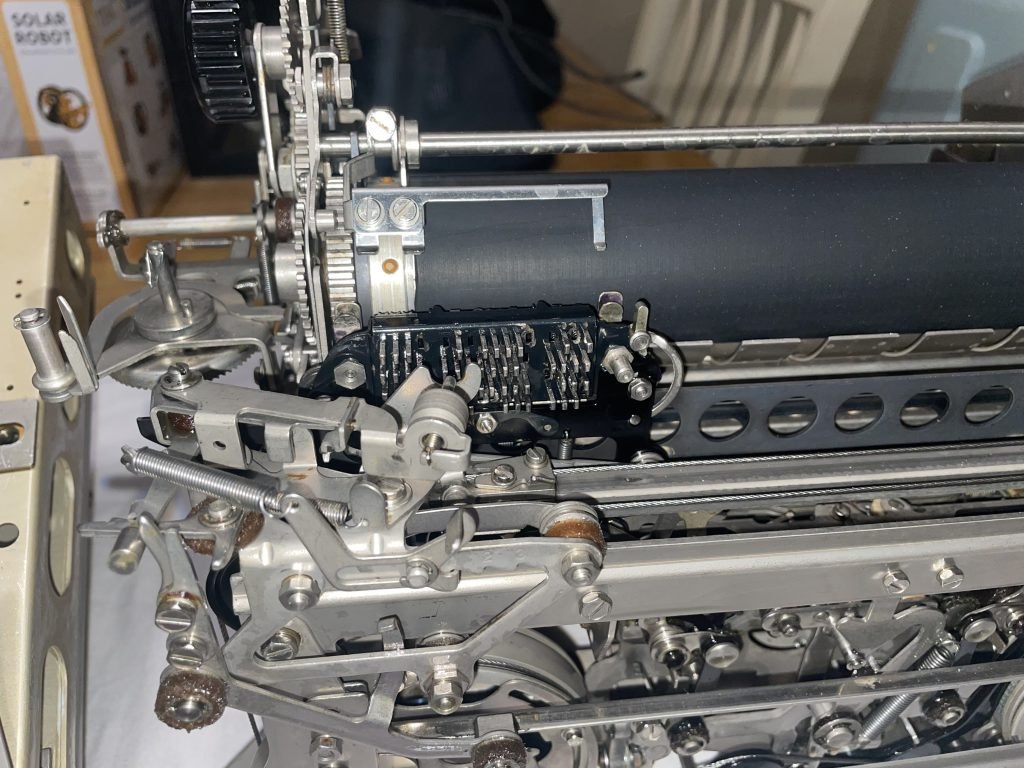
5.1 What this volume adds to Restoring a Teletype
Restoring a Teletype gives the general method: inspect first, clean with a mild degreaser, rinse, dry and oil the same day, and use very little oil (one restorer’s whole 28 took about 3–4 cc of oil and 1 cc of grease). This volume covers the Model 28 specifically, from Teletype’s own lubrication sections in the Navy’s 28 KSR/RO manual, and the modern substitutes collectors have identified for Teletype’s lubricants.
The 28 was designed to need far less lubrication than the Model 15. The Teletype Story said its all-metal clutches “call for oiling once or twice a year, in contrast to two weeks for felt clutches.” It still needs oil, in the right places and the right amounts, and a surplus machine that has sat for decades has usually lost what it had, or had it turn to varnish.
5.2 The documents
Each 28 unit has its own lubrication section, numbered -701 in the Bell System Practice scheme:
Table 1 — Each 28 unit has its own lubrication section, numbered -701 in the Bell System Practice scheme
| Unit | Lubrication section | Issue in the 1967 Navy manual |
|---|---|---|
| 28 Typing Unit | 573-115-701TC | Issue 3, September 1964 |
| 28 Keyboard and Base (KSR and RO) | 573-116-701TC | Issue 3 |
| 28 Electrical Service Unit | 573-133-701TC | Issue 2 |
| 28 Cabinets for KSR and RO | 573-134-701TC | Issue 3 |
| Motor units | 570-220-701TC | Issue 4 |
| 28 ASR perforator-transmitter base, perforators, reperforators, TD | 573-117-701TC, 573-139-701TC, 573-118-701TC, 573-127-704TC | In Bulletin 312B, Vol 2 |
Older printings gather them into Teletype bulletins: 217B (Adjustments and Lubrication, Model 28 Printer, the one Stickelman worked from in 2024), 247B (typing reperforator), 252B (the LAXD and LCXD transmitter-distributors) and 250B (ASR perforator-transmitter). The typing unit section is 50 pages of photographs and line drawings, each with every lubrication point marked. As Restoring a Teletype advises, print it out. It is easier to work from paper than from a screen with oily hands.
5.3 The rules in the typing unit section
Section 573-115-701 begins with the general instructions, and they are worth having in full:
- When. “Lubricate the typing unit just before placing it in service. After a few weeks of service, relubricate the unit to make sure that all points have received lubrication.” After that, on a schedule set by speed:
Table 2 — - When. "Lubricate the typing unit just before placing it in service. After a few weeks of service, relubricate the unit to make sure that all points have received lubrication." After that, on a schedule set by speed
| Operating speed | Lubrication interval (whichever comes first) |
|---|---|
| 60 wpm | 3,000 hours or 1 year |
| 75 wpm | 2,400 hours or 9 months |
| 100 wpm | 1,500 hours or 6 months |
- What. “Use KS-7470 oil at all locations where the use of oil is indicated. Use KS-7471 grease on all surfaces where grease is indicated.”
- How much. “All spring wicks and felt oilers should be saturated. The friction surfaces of all moving parts should be thoroughly lubricated. However, overlubrication, which will permit oil or grease to drip or be thrown on other parts, should be avoided.”
- Gears and cams. “Apply a thick film of grease to all gears and the spacing clutch reset cam plate.” “Apply oil to all cams, including the camming surfaces of each clutch disc.”
- The warning in capitals. “SPECIAL CARE MUST BE TAKEN TO PREVENT ANY OIL OR GREASE FROM GETTING BETWEEN THE SELECTOR ARMATURE AND ITS MAGNET POLE FACES. KEEP ALL ELECTRICAL CONTACTS FREE OF OIL AND GREASE.”
The drawings use a short code at each point: O1 for one drop of oil, O2 for two, and so on; G for a thin film of grease; SAT for saturate (felts, washers, wicks).
The section also asks the serviceman, at each lubrication, to check six adjustments from the adjustment section (573-115-700): the printing carriage position, the printing hammer bearing stud, the printing track, the printing hammer stop bracket, the carriage draw wire rope, and the dashpot vent screw, checking “dashpot transfer slide for freeness.” Volume 6 explains why these are on the list.
5.3.1 Why the selector warning matters
The selector armature is held to its poles by a 20 or 60 mA current and released by a light spring (Volume 2). A film of oil between armature and pole face acts like glue: the armature releases late on every start element, which shifts all five sampling points and shrinks the machine’s range. The 28’s later armatures have “anti-freeze buttons” for exactly this reason. Section 573-115-700 even gives a cleaning procedure: pass a clean, dry piece of paper “between the armature and the pole pieces to remove any oil or foreign matter.” If a newly oiled 28 prints garbage, check that gap first.
5.3.2 Electrical contacts
The same applies to the keyboard’s transmitting contacts, the stunt box contacts, the time-delay motor-stop contact and the margin and bell contacts. Oil on a contact collects dust, insulates, and causes intermittent faults that look like a mechanical problem. The keyboard section’s figures repeat “KEEP CONTACTS FREE OF OIL AND GREASE” beside each one.
5.4 KS-7470 and KS-7471, then and now
Western Electric’s KS numbers are specifications, not brands, and the original products are long gone. Douglas W. Jones of the University of Iowa, who has written about it on Greenkeys, worked out what they were and what replaces them, from the original safety data sheets and military supply records. His page is the best single reference on the subject, and its main findings are:
KS-7470 oil is a light instrument oil. The supply record (NSN 9150-00-488-5009, “Lubricating Oil, Instrument”) gives a viscosity of 39.7–41.9 at 100 °F, a viscosity index above 100, a pour point no higher than −10 °F, and a flash point of at least 400 °F. A Navy training manual says KS 7470 meets MIL-L-17672, a light turbine and hydraulic oil specification. Jones’s list of equivalents, from his page:
Table 3 — KS-7470 oil is a light instrument oil. The supply record (NSN 9150-00-488-5009, "Lubricating Oil, Instrument") gives a viscosity of 39.7–41.9 at 100 °F, a viscosity index above 100, a pour point no higher than −10 °F, and a flash point of at least 400 °F. A Navy training manual says KS 7470 meets MIL-L-17672, a light turbine and hydraulic oil specification. Jones's list of equivalents, from his page
| Product | Jones’s assessment |
|---|---|
| Nye Delicate Machinery Oil 113 | ”Very close match” (40 cSt at 40 °C) |
| Starrett 1620 Tool and Instrument Oil | One data sheet says it is really Nye 113 |
| Lubriplate FMO-200 AW | Slightly heavy |
| Sonneborn LP-200 | Slightly heavy |
| Nye NyOil; Clarion white mineral oil 200 | Slightly light |
| 3-in-1 motor oil | ”Significantly too heavy” |
| Anderol 456 (synthetic ester) | Slightly light, and incompatible with the acrylic and ABS parts in Teletypes |
KS-7471 grease was made by one supplier, General Bearing Cleaning Co. of Trenton, New Jersey. Its supply number was cancelled and replaced by NSN 9150-00-944-8953, Grease, Aircraft, to MIL-G-81322. Products made to that specification include Aeroshell Grease 22 and Mobilgrease 28, both easy to buy. An NSA document on storing Teletype equipment says the original KS-7471 was equivalent to Alemite No. 38.
Jones adds two cautions. The original oil and grease were meant to be used together, and Teletype’s drawings sometimes call for oil and grease at the same point. The modern substitutes are different kinds of product (a light mineral oil and a synthetic hydrocarbon grease), and greases of different thickener types should not be mixed, so “it would be prudent to run some tests before committing to the large-scale use of such mixtures.” And ester-based synthetic oils attack ABS and other plastics, so whatever is used, follow the manual’s instruction to keep oil off the plastic parts.
5.4.1 What working restorers actually use
Not everyone goes to that trouble, and the 28s on their benches still run. Practices reported by restorers include:
- kb8ojh.net (a Model 28 KSR): 20-weight full synthetic motor oil and Lucas Red-N-Tacky grease, noting that a non-detergent oil is recommended but detergent oil was what was at hand.
- Aetheric Message Machine Company (2016 supplies page): 0W-20 synthetic motor oil; Lucas Red-N-Tacky for open gears only; white lithium grease for sliding parts where the manual calls for “oil, grease, oil.” It also says plainly that WD-40 will not work.
- Stickelman (2024): silicone grease in the typing unit ball bearings. He reports that the grease “turned orange after some use, so I cycled grease until it stayed clean looking,” which was the old grease being flushed out.
These are opinions from practice, not specifications. The safest choice is Jones’s: an instrument oil close to Nye 113 and a MIL-G-81322 grease. Avoid penetrating oils and spray lubricants, and do not use heavy motor oil.
5.5 Cleaning a 28
5.5.1 The bath
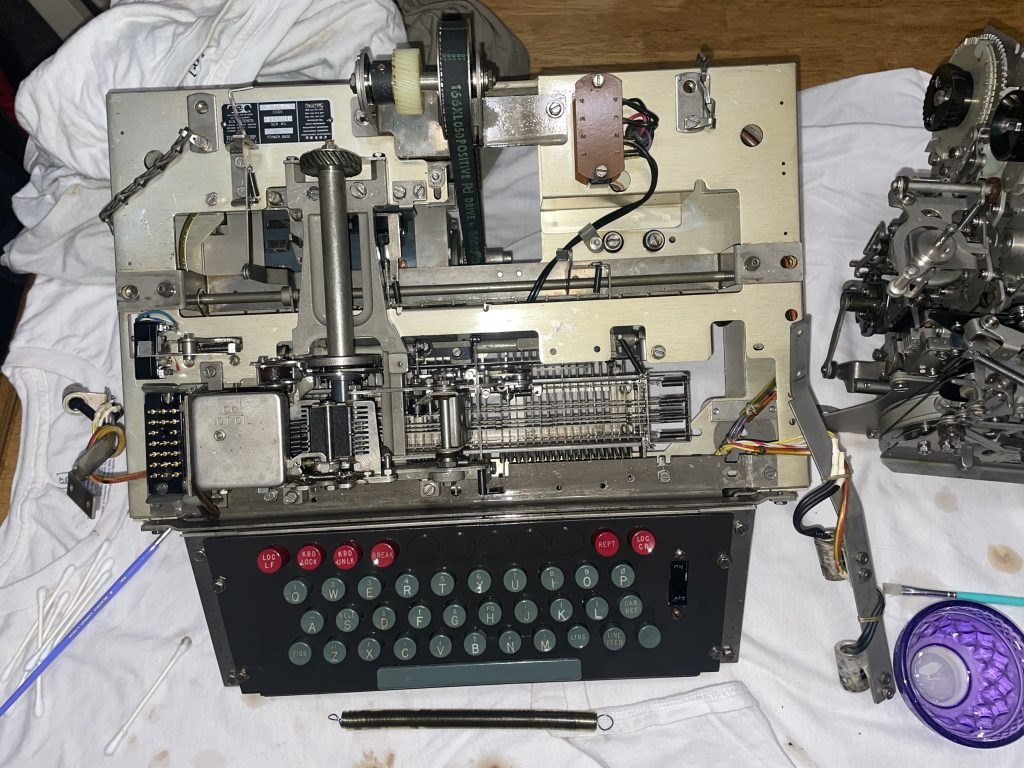
Stickelman’s 2024 account of cleaning a 28 KSR wall mount describes the method most restorers now use. “Simple Green concentrate and a soft toothbrush cleaned up the Teletype really well. Stubborn oil residue came off with a fingernail or toothpick.” He worked unit by unit in a plastic tub, used light pressure because “several springs … probably could come loose with vigorous scrubbing,” rinsed, dried the parts in the sun, and then lubricated “according to the manual — Teletype Bulletin 217B.” He also notes that “disassembly of the subcomponents was surprisingly easy. Just a small handful of fasteners, two electrical disconnects and the typing unit and base/keyboard unit came out without a fuss.”
Some practical points follow from the 28’s design:
- Take the units apart first. The typing unit comes off its base with four screws (Stickelman’s commenters had to hunt for the third and fourth) and a plug. Clean each unit separately.
- Keep water out of the motor, the electrical service unit and the selector coils. Clean those by hand with a cloth.
- Dry thoroughly and oil the same day. Bare steel with no oil film rusts quickly. Stickelman reports “small spots of rust sheen here and there,” which a light coat of oil stopped.
- Do not take the stunt box apart for cleaning unless something in it is broken. It lifts out as a unit, and its many small parts (Volume 2) are much easier to clean in place than to reassemble.
- Check the felts. Felt oilers that are hard and black with old oil can sometimes be cleaned and resaturated. Stickelman found “the felt pads that hold oil all seem in good shape.” When they are not, felt is one of the easier materials to replace (Making the Parts That No Longer Exist).
5.5.2 The cabinet
The 28’s cabinets were lined with foam to reduce noise, and on most surplus machines the foam has turned to dust. Stickelman found his “had thoroughly disintegrated” and the adhesive under it was much harder to remove: a citrus degreaser “needed significant soak time to soften the adhesive,” followed by dish soap to remove the citrus oil, and Simple Green to finish. He replaced the foam with carpet tiles, which were light, stiff enough, came in a matching colour, and were stuck on with the spray adhesive sold with them. It was a good solution to a part that cannot be bought.
Rubber in the cabinet (the dome seals, the pad around the keyboard opening, the motor mounts) is also usually perished. Making the Parts That No Longer Exist covers cutting replacements.
5.6 The motor
The motor has its own lubrication section, separate from the rest of the machine, and it is the most often neglected part of a surplus 28.
Section 570-220-701TC (Issue 4) says:
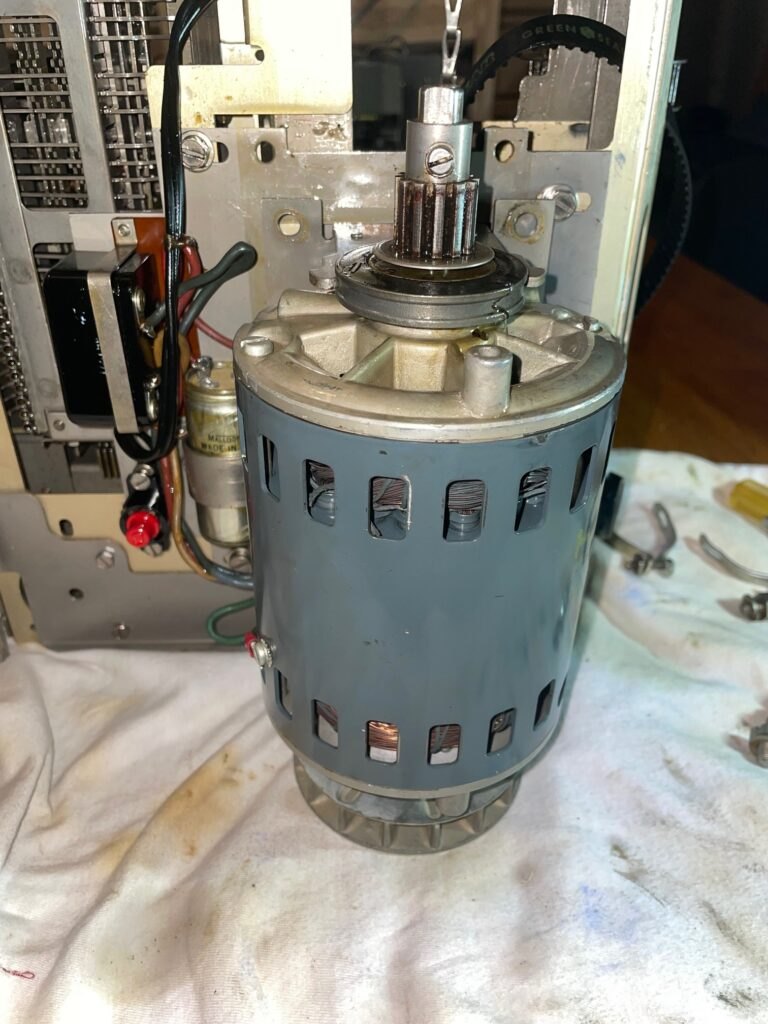
- Standard and heavy-duty motors have ball oilers, two at each end. Clean their outer surfaces first with a clean cloth dampened with petroleum spirits, “so that grit, dirty grease, or contaminated petroleum spirits do not get into the motor bearings.” Then press each oiler down with a metal point and apply six drops of KS-7470 oil (the figure marks it O6). Miniature motors have one oil hole in each end shield instead.
- The interval is 1,500 operating hours or 6 months for standard motors, and 750 hours or 3 months for miniature ones.
- “Do not use grease gun on 28, 32, 33 & 37 motor units.”
- “Whenever the motor is disassembled the bearings should be repacked with Beacon 325 grease or equivalent” (Teletype part 195298). Beacon 325 was a commercial ball-bearing grease; a modern ball-bearing grease is the practical substitute.
- Cover the exposed motor shaft with a thin film of grease against rust.
5.6.1 When oil is not enough
Stickelman’s 28 developed a squeal that was “loudest when cold.” It was not in the typing unit, which he had greased and oiled thoroughly. It was in the motor. He found that oil through the ball oilers “wont help a bit” when “the old grease is polymerized (like old cosmoline).” He split the motor (two long through-bolts, marking the orientation of each part first), picked out the old grease, which “was stiff like a tough wax,” with a plastic pick, repacked both bearings with modern grease, and the squeal stopped. The bearings themselves were fine.
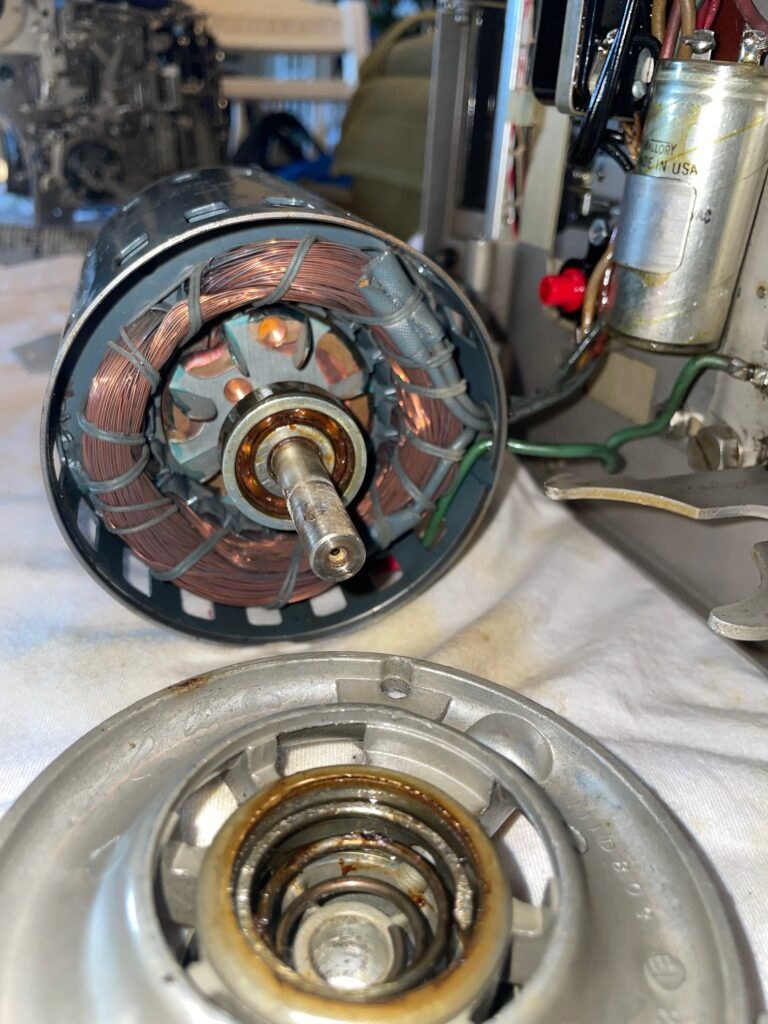
This is worth doing at the start of any 28 restoration. A motor whose grease has set will run, but it will run hot and noisy, and a seized bearing is a much bigger repair. Volume 6 covers the motor’s two electrical faults, the thermal cutout and the starting capacitor.
5.6.2 The drive gears
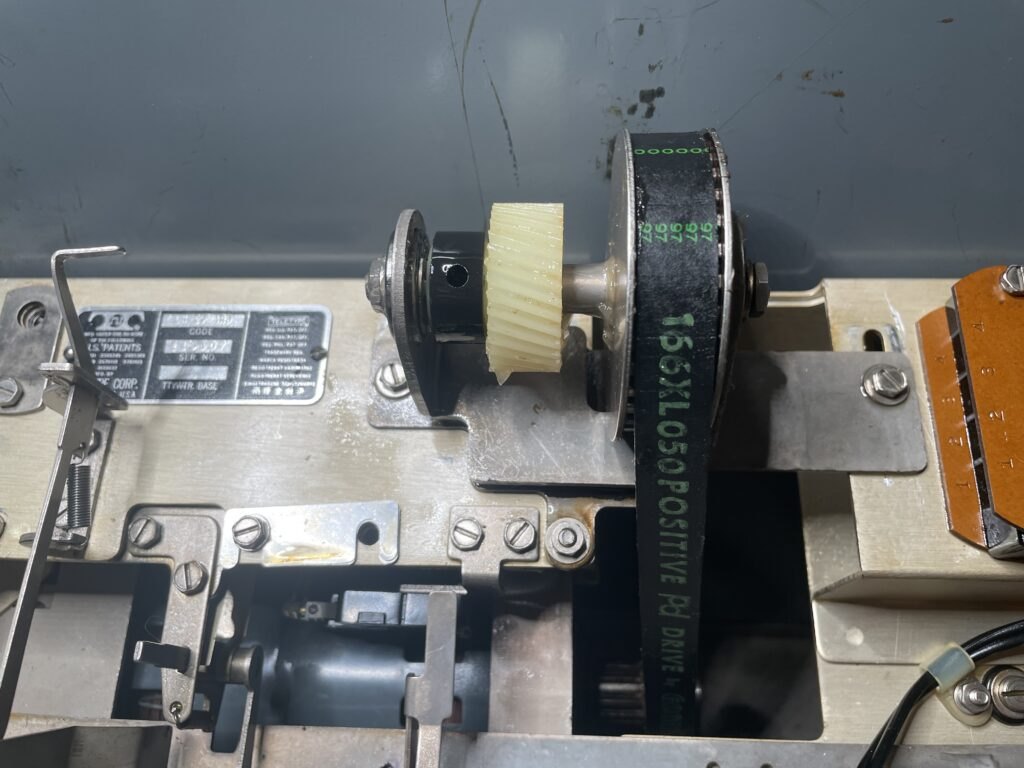
The gears between motor and machine also need attention. On a 28 KSR, power goes from a gear on the motor shaft to the intermediate shaft gear, which sets the speed, and on to the typing unit through helical gears. One of these is nylon (ivory coloured). Stickelman could read the part number of his machine’s nylon speed gear (195997, which he found in the parts section 573-116-800TC) only by removing it, and “pack[ed] the roller bearings with grease” while he had it out. The lubrication section’s instruction for gears is a thick film of grease. On a nylon gear, also check for cracks and missing teeth (Making the Parts That No Longer Exist).
5.7 Consumables
A 28 that runs needs paper and ribbon, and both are still available:
- Paper. Friction-feed 28s take a roll 8.44 inches wide and about 4½ inches in diameter (Wikipedia). Sprocket-feed typing units take continuous fan-fold forms. Stickelman notes the “modern term seems to be ‘continuous form’ paper,” which is still sold. Roll paper is widely available; Aetheric notes that most is white and “the classic yellow paper occasionally shows up on eBay.”
- Ribbon. The 28 takes a ½-inch ribbon (60 yards, per Wikipedia), the same as a standard typewriter ribbon. Aetheric recommends “1/2” Underwood typewriter ribbons,” and names the Scantracker SC-20 black for darker print and metal spools, warning against one brand that flakes ink.
- Tape. Five-level 11/16-inch tape for the ASR and tape units (Volume 4). Aetheric lists West NC as a source of 5-channel and 8-channel tape.
5.7.1 Sources (Vol 5)
- 🔴 Primary source: Teletype Corporation, BSP 573-115-701TC, 28 Typing Unit — Lubrication, Issue 3 (September 1964): lubricate before service and after a few weeks; intervals by speed (60 wpm 3,000 h or 1 yr; 75 wpm 2,400 h or 9 mo; 100 wpm 1,500 h or 6 mo); KS-7470 oil and KS-7471 grease; saturate felts and wicks; avoid overlubrication; the selector armature and contacts warning; thick film of grease on gears and the spacing clutch reset cam plate; oil all cams and clutch disc camming surfaces; the O1/O2/G/SAT symbols; the six checks at each lubrication. In NAVSHIPS 0967-173-7010 (Bulletin 311B, Vol 1, 1967). https://www.navy-radio.com/manuals/tty/0967-173-7010-6707.pdf
- Motor lubrication: BSP 570-220-701TC, Motor Units — Lubrication, Issue 4 (1964): ball oilers, six drops, petroleum-spirits cleaning, 1,500 h or 6 months (miniature 750 h or 3 months), no grease gun on 28/32/33/37 motors, repack with Beacon 325 (Teletype 195298), grease the exposed shaft. Same manual.
- Selector cleaning with paper between armature and poles; anti-freeze buttons. BSP 573-115-700TC, 28 Typing Unit — Adjustments, Issue 7, same manual.
- Section and bulletin numbers. Table of contents of Bulletin 311B Vol 1 and 312B Vol 2 (NAVSHIPS 0967-173-7010 and -6020); Hertzmail Teletype bulletin index (217B, 247B, 252B). http://www.hertzmail.com/TTY/TeletypeManuals/INDEX.TXT
- KS-7470 and KS-7471 and their modern equivalents; MIL-L-17672; NSN data; Nye 113, Starrett 1620, FMO-200 AW, Aeroshell 22, Mobilgrease 28; the cautions on mixing and on plastics. Douglas W. Jones, “About KS7470 oil and KS7471 grease,” University of Iowa. http://homepage.cs.uiowa.edu/~jones/pdp8/UI-8/ks7470oil.shtml · and Jones on Greenkeys (16 April 2014). http://www.qth.net/pipermail/greenkeys/2014-April/029890.html
- KS-7471 equivalent to Alemite No. 38. National Security Agency, “Storage of Teletype Equipment” (Friedman collection, REF ID A70961). https://www.nsa.gov/Portals/75/documents/news-features/declassified-documents/friedman-documents/patent-equipment/FOLDER_485/41719889075917.pdf
- Oiling once or twice a year against every two weeks for felt clutches. Teletype Corporation, The Teletype Story (1957). https://rtty.internet-tty.net/downloads/teletype-story.pdf
- Cleaning with Simple Green; four screws and two connectors; rust sheen; felts; Bulletin 217B; foam and adhesive removal; carpet tiles; silicone grease turning orange; motor squeal from hardened grease, Bulletin 295B oilers; the 195997 nylon gear and part section 573-116-800TC. David Stickelman, stickelman.net: “Teletype Model 28 Gets a Bath” (11 Sep 2024), “Model 28 KSR Wall Mount Progress” (12 Nov 2024), “Model 28 Teletype chasing down squealing noises” (7 Dec 2024), “Model 28 Teletype back in business” (27 Oct 2024). http://stickelman.net/
- Lubricants and quantities in practice. kb8ojh.net, “Teletype Model 28 KSR.” https://kb8ojh.net/station/teletype/ · Aetheric Message Machine Company, “Supplies” (18 April 2016). https://www.aetherltd.animats.com/supplies.html
- Paper roll and ribbon sizes. Wikipedia, “Teletype Model 28.” https://en.wikipedia.org/wiki/Teletype_Model_28
- Cross-links: Restoring a Teletype (cleaning method, quantities, the first hour); Making the Parts That No Longer Exist (rubber, felt, nylon gears); The Teletype Model 15 (https://dots-and-dashes.fubsypoly.com/teletype-model-15/), whose felt clutches need far more frequent oil.