The Teletype Model 15 · Volume 8
The Teletype Model 15 — Vol 8: A Model 15 for a Cipher Machine
Why a pair of 1940s teleprinters is the right keyboard and printer for a replica of the 1941 PURPLE machine, how they would connect, what has to change, and the other cipher replicas a Model 15 suits.
8.1 The project behind this dive
The reason I started reading Model 15 bulletins in the first place is a cipher machine.
On the Iconic Machines site I have written a twelve-volume history of PURPLE, the Japanese Foreign Ministry’s cipher machine of 1939–1945, which the US Army’s Signal Intelligence Service broke in 1940 without ever seeing one, and which it was reading on the morning of 7 December 1941. The last three volumes of that series design a working replica: telephone stepping switches wired to the published tables, input and output plugboards, a small controller, a keyboard and a printer (PURPLE, Volume 10, “Building a PURPLE — Design”). For the printer, Volume 10 specifies a 58 mm thermal receipt printer, because it is cheap, simple and needs only one wire, and adds that “a vintage teleprinter is the faithful alternative and the subject of its own project.”
This dive is that project’s groundwork. I have not bought the machines yet. What follows is the case for a pair of Model 15s, the way they would connect to the replica, and the things that would have to be decided before the first one arrives.
8.2 Why a teleprinter, and why this one
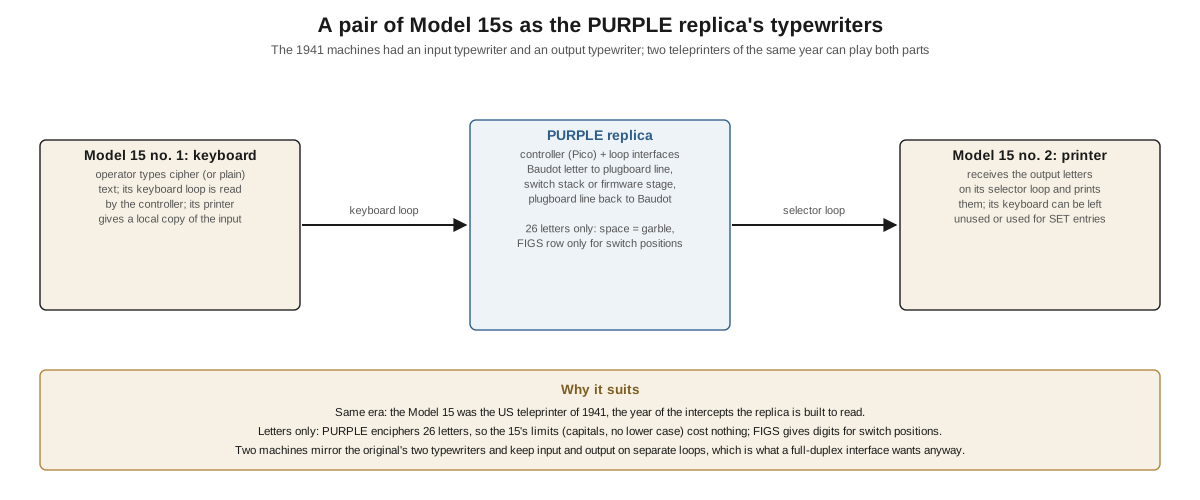
The original had two typewriters. PURPLE, like its predecessor RED, was not a self-contained machine. As the PURPLE series describes it, it was “a desk-sized unit between two electric typewriters: the operator typed on one, and the other printed the result,” with a plugboard on each side and the cipher unit between them (PURPLE, Volume 4). The American analog built by Leo Rosen and Frank Rowlett in 1940 had the same three parts: an input keyboard, a cryptographic unit of stepping switches, and a solenoid-operated output typewriter. Rowlett recorded the cost of the keyboard and typewriter as $393.68, more than the cipher mechanism itself (PURPLE, Volume 5). A replica with a separate keyboard machine and a separate printing machine has the same layout as the originals.
Model 15s were on the circuits that carried PURPLE traffic. PURPLE messages reached Washington on teleprinters. On 6 December 1941 the Navy’s intercept station on Bainbridge Island, Station S, copied the Tokyo–Washington pilot message and teletyped it east, and the Army’s SIS “had the teletype sheet by 12:05 p.m.” (PURPLE, Volume 7). On 7 December Marshall’s warning to Hawaii went by teletype to Western Union and on by RCA radio. Volume 1 of this dive shows that the Model 15 was then the standard American page printer, the machine of TWX, the press wires and the armed forces. I have no source that names the model of teletypewriter at Station S or in the SIS message centre in 1941, and I will not claim one. In 1941 the Model 15 was the typical American teleprinter.
PURPLE used only letters. PURPLE enciphered 26 letters (six “sixes” and twenty “twenties”); numbers, punctuation and spaces were handled by code words and conventions, not by the machine. A Model 15 prints capitals only, which is all PURPLE ever produced. The cipher alphabet maps exactly onto the Model 15’s 26 letter codes, and the replica needs only a few function codes beyond them (space, carriage return, line feed, and FIGURES and LETTERS for switch positions).
It is a period printing mechanism that can still be maintained. The original Japanese typewriters do not survive with the machines, which were destroyed at the embassies, and the American analog’s typewriter is a museum object. A Model 15 is a 1930s printing machine that is still common, documented, adjustable and repairable (Volumes 3 to 5).
8.3 How the pair would be wired
The replica’s controller is a Raspberry Pi Pico 2. In the design of PURPLE Volumes 10 and 11 the keyboard is a chain of shift registers and the printer hangs on a UART. Replacing both with Model 15s changes only those two interfaces; the cipher path (plugboards, sense levels, switch stack or the all-electronic fallback) stays exactly as designed.
Machine 1, the keyboard. Its keyboard contacts go on a send loop read by the controller through an optocoupler (Volume 6). Each key the operator presses arrives as a five-unit character at 45.45 baud; the controller decodes it to a letter and applies it to the typewriter-row jack exactly as a keyswitch would. Its typing unit can be wired into the same loop (half duplex) so that it prints what the operator types, a running copy of the input, which is what the original input typewriter gave its operator.
Machine 2, the printer. Its selector magnet goes on a receive loop switched by the controller. When the cipher path delivers an output letter, the controller sends that letter’s five-unit code; the Model 15 prints it. Its keyboard can be left unconnected, or wired to a second send loop and used for SET entries, as below.
Both loops can share one loop supply or have one each. The full-duplex arrangement (separate send and receive loops) is what every modern interface prefers anyway, and here it falls out naturally: machine 1’s keyboard is the send loop, machine 2’s selector the receive loop.
Timing. At 60 words per minute a character takes 163 ms on the line (Volume 2). A stepping-switch PURPLE steps in tens of milliseconds, and the replica’s controller can buffer, so a Model 15 cannot be outrun by the machine it serves. The operator’s typing speed sets the pace, as it did in 1941.
Software. On the Pico the line runs on a PIO state machine, not a hardware UART. The RP2040’s and RP2350’s UARTs cannot go that slow: their baud-rate divisor is a 16-bit integer plus a fraction, so at a 125 MHz peripheral clock the slowest rate is 125,000,000 ÷ (16 × 65,536), about 119 baud. The Lorenz and Colossus SZ42 replica already uses this approach, with “two small PIO programs” that send and receive start-stop characters and a clock divider set for 20 ms (50 baud) or 22 ms (45.45 baud) units (Lorenz and Colossus, Volume 13). The same two programs serve the PURPLE replica.
8.4 What has to change in the replica’s design
Three things in PURPLE Volume 10 assume a modern keyboard and printer, and each has a teleprinter answer.
Table 1 — What has to change in the replica's design
| Volume 10 assumes | With a Model 15 |
|---|---|
| FIGS held down while typing positions (“as on a teleprinter, the top letter row … gives the digits 1 to 0”) | On a Model 15, FIGURES is a shift character, not a held key. The operator presses FIGS, types the digits on the top row (Q = 1 … P = 0), then presses LTRS. The controller tracks shift state, as every Baudot interface does. The mapping itself is the Model 15’s own (Vol 2, keyboard figure). |
| GARBLE on the space bar | The Model 15’s SPACE key sends code 00100; the controller treats it as GARBLE. |
| RESET and SET buttons | Panel buttons stay on the panel. Alternatively, machine 2’s otherwise idle keyboard can send SET entries as FIGS-digit groups. |
| A thermal printer’s 5 V, 1.5 A supply | Replaced by the Model 15’s motor (115 V AC) and a loop supply (Volume 6). Both are mains-derived and must be fused, bonded and isolated from the logic, as PURPLE Volume 11 already requires for its own supplies. |
There is also a question of honesty in the presentation. A Model 15 at each end makes the replica look like a 1941 American setup, but neither the Japanese embassy machines nor the SIS analog used teleprinters. The display card beside the replica should say what the Volume 5 history says: the originals used typewriters. The Model 15s are a period-appropriate substitute, not a reconstruction.
8.5 Choosing the pair
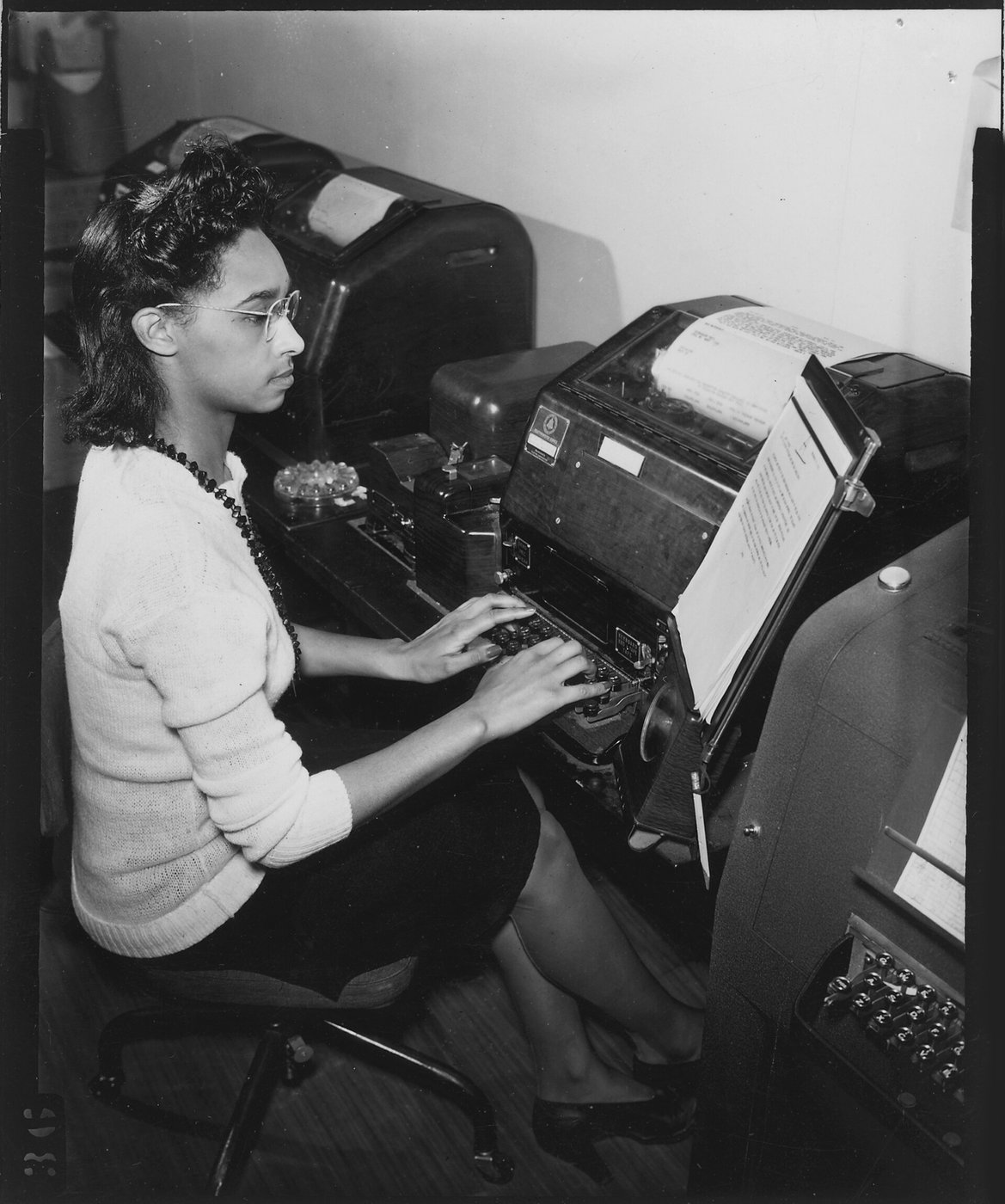
From Volume 3’s buyer’s guide, the pair would be chosen like this:
- KSR, both of them. Machine 1 needs a keyboard; machine 2 does not, but a receive-only machine with no keyboard cannot be used to test itself in local loop, and two identical KSRs can each stand in for the other.
- Communications keyboard and type, the standard military and RTTY arrangement, not weather or commercial-fractions type.
- 60 words per minute gearing on both, so that they match each other and the amateur RTTY standard. A pair geared for 66 words per minute (50 baud) would also run the Lorenz replica below at its native speed, a reason to keep a spare set of speed gears (Volume 2).
- Synchronous motors if available, which need no speed adjustment on stable mains; governed motors are equally good once set (Volume 4).
- Machines that turn freely by hand, with their covers, and ideally with tables, since a Model 15 is meant to sit on its table and the table carries the wiring.
Two machines double every cost in Volume 3: purchase, freight, lubrication, platen rubber, and two sets of adjustments to learn. They also halve the risk. With two machines, one can be checked against the other, parts can be swapped to find a fault, and the replica can keep working with one machine in KSR half-duplex while the other is on the bench.
8.6 Other cipher replicas a Model 15 suits
The same arrangement serves the other teleprinter-era machines on the Iconic Machines shelf.
The Lorenz SZ42. The German Schlüsselzusatz was a teleprinter cipher attachment: it added a keystream to the five-unit code of a Lorenz teleprinter at 50 baud. The Lorenz and Colossus replica takes five-unit characters “at 50 baud on a teleprinter current loop” and was designed for a British or German machine of the period (Lorenz and Colossus, Volume 12). A Model 15 geared for 66 words per minute runs at 404 operations per minute, which is 50 baud with Teletype’s 7.42-unit character (Volume 2). The Army’s TG-7-A was supplied for exactly those two speeds, “368 or 404 o.p.m.” The Model 15 is therefore one of the few American machines that can work a Lorenz replica at its own line speed. One difference remains: German machines used ITA2 figures and the Model 15 uses US-TTY figures, which differ on a few codes (Vol 2). For Tunny’s letter-only traffic the difference never shows.
SIGCUM and SIGTOT. America’s own teleprinter ciphers of the war were attachments for standard teleprinters. SIGCUM (Converter M-228), designed by William Friedman and Frank Rowlett, was a rotor attachment using five 26-contact rotors; its design was given to Teletype Corporation, which was also producing SIGABA. Soon after it entered service in January 1943, Rowlett showed it could be broken from an operator’s repeated transmission of one message on the same settings; it was withdrawn at once, which led to a redesign in service by April 1943 and to top priority for SIGTOT, Leo Rosen’s one-time-tape machine (Wikipedia, “SIGCUM”, citing Kelley, Cryptologia 21(4), 1997). These were five-unit, start-stop, US-TTY machines in the Model 15’s family, and a replica of either would use Model 15s as its keyboard and printer.
Vernam’s cipher. Every machine in this list descends from Gilbert Vernam’s 1917 discovery at AT&T that two five-unit teleprinter tapes could be combined element by element to encipher a message. The five-unit code and the start-stop line that the Model 15 uses were the medium for all of that work.
8.7 Before the first one arrives
The list of decisions for the PURPLE pair, carried from this dive:
- Find and read the right documents first (Volume 3 and the Library): the Model 15 description and adjustment bulletins, and TM 11-2215 if a military TT-5/FG turns up.
- Plan the space and the move. Two machines on tables are more than 400 lb of iron (JANAP 161’s TT-5/FG set weighs 200 lb), and each needs a floor, an outlet and somewhere to drain oil.
- Decide the interface: a pair of DeRamp-style regenerative loop boards, or a single conventional supply with an isolated send and receive interface on the Pico (Volume 6). The PIO code is common to both.
- Plan the first-power sequence: clean, oil, turn by hand, power with the loop open, set speed, then take a range on a known-good local loop (Volumes 4 and 5) before connecting anything to the replica.
- Keep the thermal printer path in the firmware. The replica should still run with the thermal printer, so that it works while either Model 15 is under repair.
8.8 Closing the loop
Earlier volumes covered the code, the cams, the oil and the adjustments. This one is about putting the machine back to the work it did originally: printing other people’s secrets in capitals, at sixty words a minute.
In my father’s shack the teletype printed whatever came off the receiver. A Model 15 on the end of a PURPLE replica would print the text of the Tokyo–Washington traffic of 1941, deciphered by a rebuilt machine.
8.8.1 Sources (Vol 8)
- The PURPLE replica’s design (controller, keyboard and printer interfaces, FIGS-held digit entry, GARBLE on the space bar, the thermal-printer specification and “a vintage teleprinter is the faithful alternative”) — PURPLE, Volume 10, “Building a PURPLE — Design,” Iconic Machines. https://iconic-machines.fubsypoly.com/purple/vol-10/ ⟨and Volume 11 for the controller and supplies⟩
- The two typewriters of the original; the SIS analog’s input keyboard and solenoid output typewriter and Rowlett’s $393.68 — PURPLE, Volumes 4 and 5, Iconic Machines. https://iconic-machines.fubsypoly.com/purple/vol-4/ and https://iconic-machines.fubsypoly.com/purple/vol-5/
- Station S teletyping the pilot message; the SIS teletype sheet at 12:05 p.m.; Marshall’s warning by teletype to Western Union — PURPLE, Volume 7, citing the SIS/Navy table in the NSA Friedman collection and the Joint Committee Report. https://iconic-machines.fubsypoly.com/purple/vol-7/
- The SZ42 replica’s 50-baud current loop and its PIO send/receive programs — Lorenz and Colossus, Volumes 12 and 13, Iconic Machines. https://iconic-machines.fubsypoly.com/lorenz-and-colossus/vol-12/ ⟨URL slug to verify at publish⟩
- TG-7-A at 368 or 404 o.p.m. — PE1NGZ, “US Army telegraph equipment.” https://www.qsl.net/pe1ngz/army/army-us/us-telegraph.html; TT-5/FG weight — JANAP 161, Change 1 (1956), Part 2, p. 162.
- SIGCUM (Converter M-228) and SIGTOT — Wikipedia, “SIGCUM,” citing Stephen J. Kelley, “The SIGCUM Story: Cryptographic Failure, Cryptographic Success,” Cryptologia 21(4), October 1997, pp. 289–316. https://en.wikipedia.org/wiki/SIGCUM
- RP2040/RP2350 UART minimum baud — computed from the PL011 baud-rate divisor (16-bit integer part, 6-bit fraction; baud = UARTCLK ÷ (16 × divisor)), Raspberry Pi RP2040 Datasheet, UART chapter.
- Cross-links: Volumes 2 (timing, keyboard), 3 (buying), 6 (interfacing); RTTY on the Air; Making the Parts That No Longer Exist (the DeRamp regenerative interface).