The Teletype Model 15 · Volume 3
The Teletype Model 15 — Vol 3: Models, Variants and What to Buy
Reading the codes on the units, telling a TG-7 from a TT-5/FG from a news-wire RO, what turns up for sale today, the checks to make before paying for one, and how to move two hundred pounds of cast iron without breaking it or yourself.
3.1 One design, many machines
The Model 15 was sold for thirty years to the Bell System, the press associations, the telegraph companies, railways, the weather services and all the armed forces, and Teletype built each customer what it ordered. The result is one basic design in dozens of configurations. Two Model 15s can differ in keyboard, type, motor, selector, speed, base wiring, paper feed, functions and cabinet, and still both be “a Model 15.”
That matters to a buyer because it decides which documents apply, which parts fit, and whether a machine that seems to misbehave is actually broken. This volume is a field guide: how to read a Model 15’s identity, what the main variants are, what the military called them, and what to check before buying one. I am working through it myself, with a pair of machines in mind for the PURPLE replica (Volume 8), so the checklist at the end is the one I intend to use.
3.2 Reading the codes
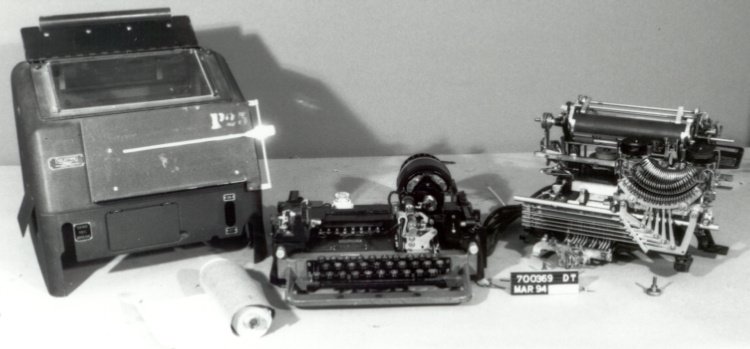
Teletype identified every unit of a set by a code: a letter prefix for the kind of unit, then digits and letters for the particular build. The 1946 general description sheet for the Model 15 sending-receiving set lists them (Teletype Equipment List, 1948, sheet 2.D1-1):
Table 1 — Teletype identified every unit of a set by a code: a letter prefix for the kind of unit, then digits and letters for the particular build. The 1946 general description sheet for the Model 15 sending-receiving set lists them (Teletype Equipment List, 1948, sheet 2.D1-1)
| Prefix | Unit | What the rest of the code tells you |
|---|---|---|
| BP | typing unit | type arrangement, paper feed (friction or sprocket), selector type, functions |
| BK | keyboard | keytop arrangement, contacts, line-test key |
| BB | base | terminal and relay arrangement: this is the code that selects the wiring diagram |
| MU | motor unit | synchronous or governed, voltage and frequency |
| RY | line relay | polar or neutral relay type |
| C | cover | send-receive or receive-only front plate |
| XRT | table | |
| REC | rectifier | loop supply |
Jim Haynes’s notes on Teletype history, posted to the Greenkeys list, say that the Model 15’s units carry B-prefixed codes (and the Model 14’s F-prefixed ones), and cite Ransom Slayton for the reading that “B” stood for Bell (Haynes, secondary). A unit’s code is on its data plate or stamped on the casting, usually with its serial number.
Each unit has its own serial number. A collector who documented his Model 15 KSR found five different numbers on one machine: a base (s/n 213102), a motor unit (129489), a typing unit (167037), a keyboard (66805, probably not original to the machine) and the cover (circuitousroot). Model 15s were maintained by swapping units, in the Bell System and in the services, so a machine assembled from units of different ages is normal. It also means there is no single serial number that dates a Model 15, and I have found no published serial-to-year table. The circuitousroot owner dated his units from the patent dates stamped on them (the latest patent on a unit gives the earliest date it can have been made) and from details such as the maker’s name on the plate and fungus-proofing stamps, which mark wartime military work. That is the best method available.
3.3 The main variants
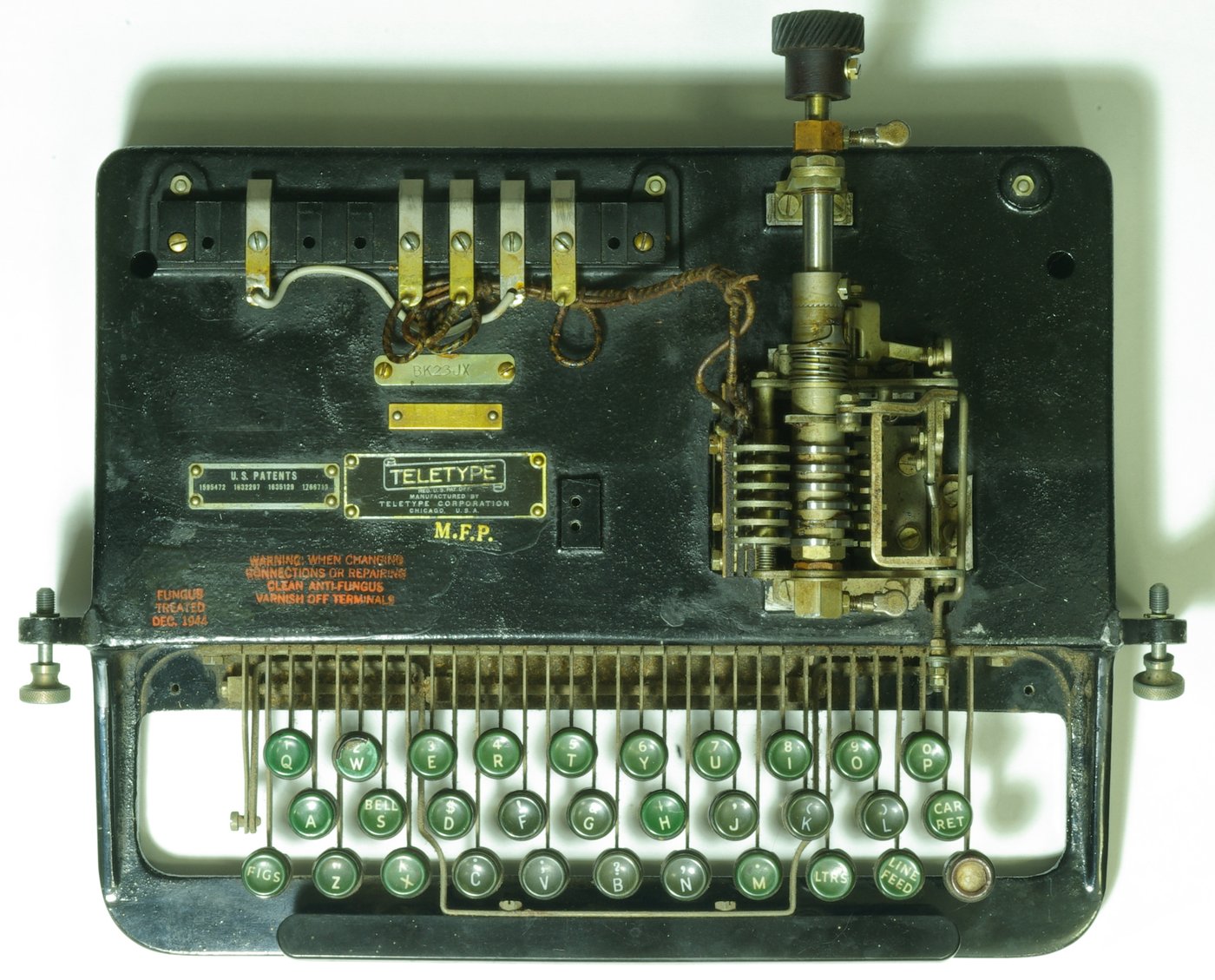
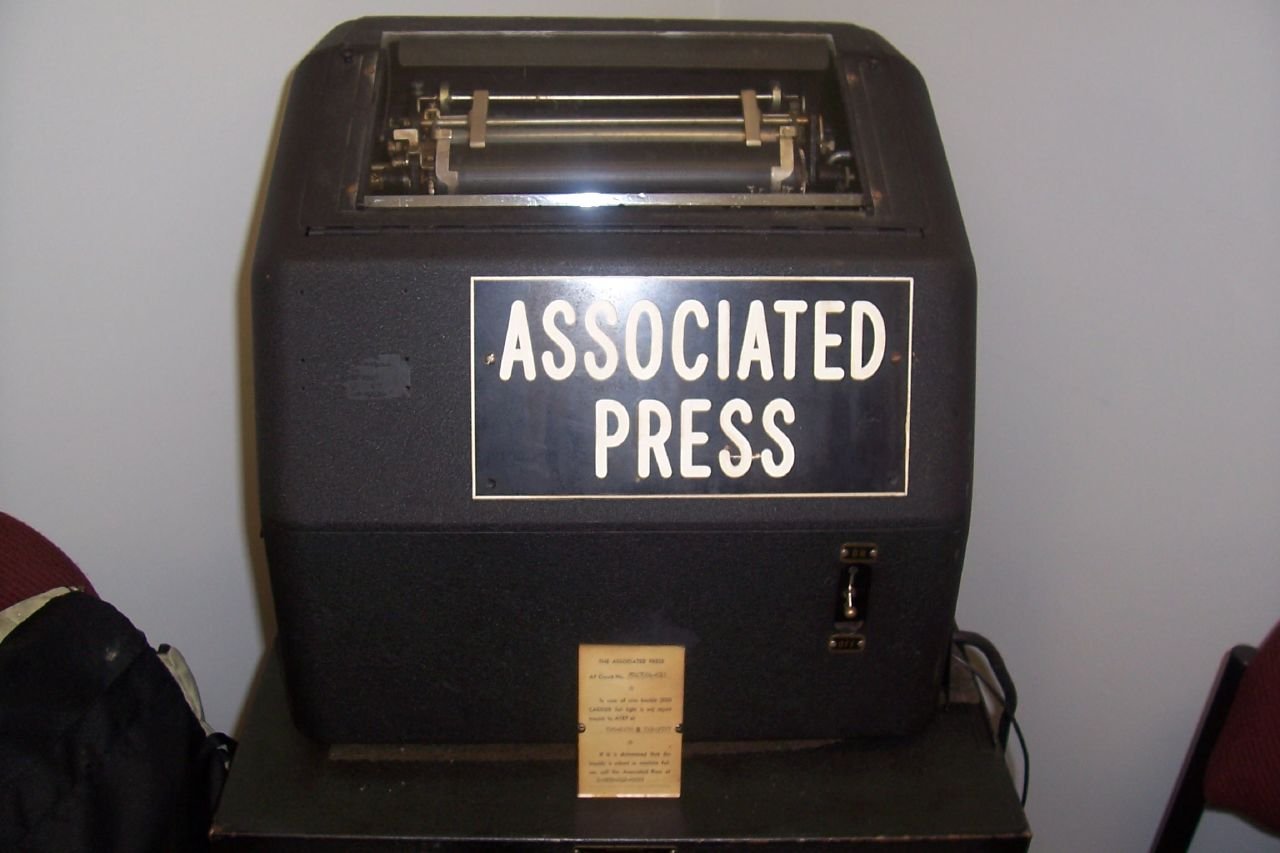
Send-receive or receive-only. The KSR (keyboard send-receive; Teletype’s sheets say “sending-receiving”) has a keyboard and prints. The RO (receive-only) has no keyboard and a blanking plate where it would be; it was the press-wire and broadcast machine. Teletype offered both “with table” and “with console,” a deeper cabinet enclosing the base (1948 index, sheets 2.D1 to 2.D5).
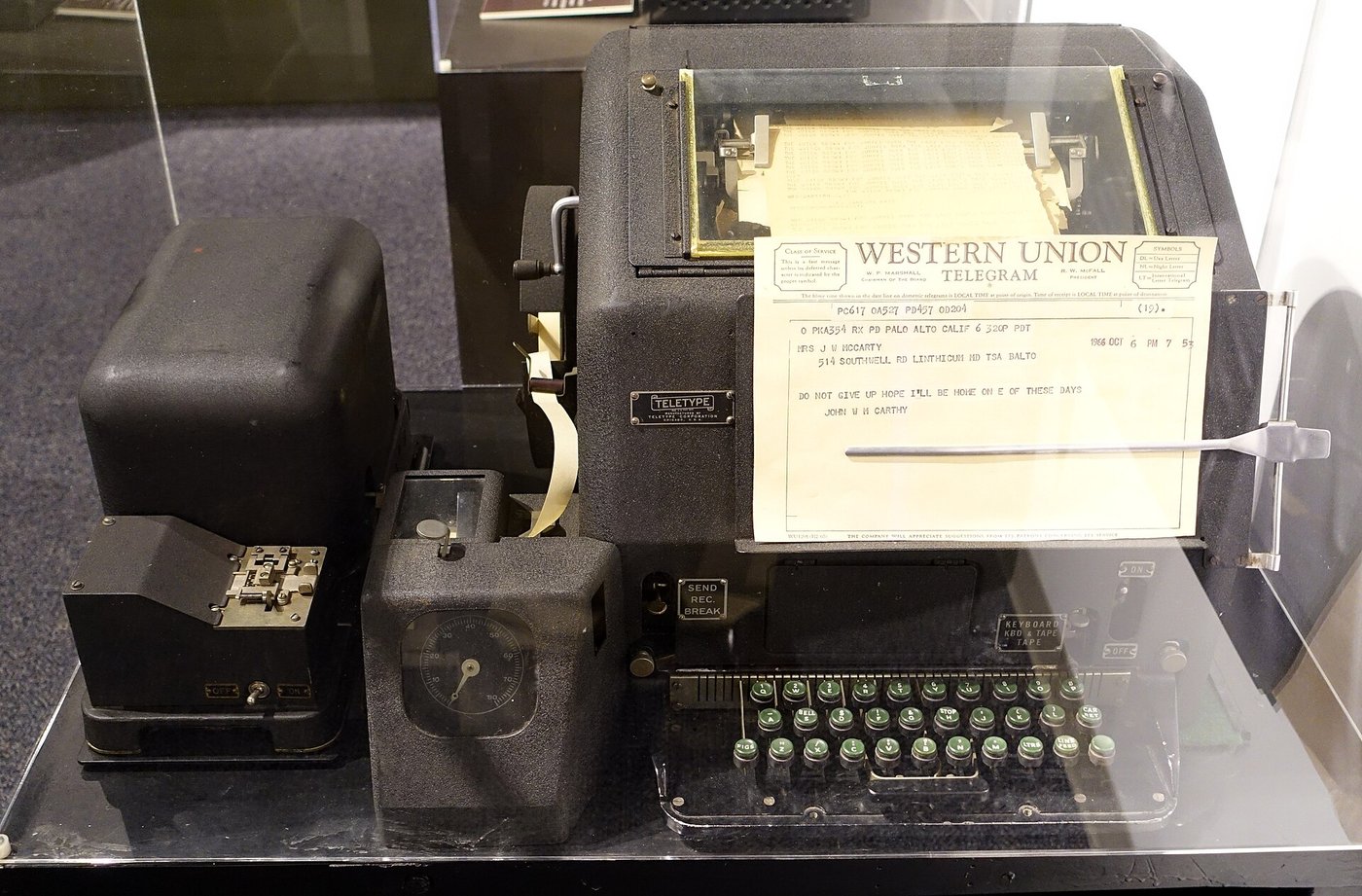
Sets built around the 15. Besides the plain KSR and RO, the same binder lists a KSR with a perforator-transmitter keyboard, which punches tape as it sends; tape transmission duplex sets combining a Model 15 with Model 14 tape equipment; and the Model 19, a Model 15 with a perforator-transmitter keyboard and a Model 14 transmitter-distributor on one table (Volume 7).
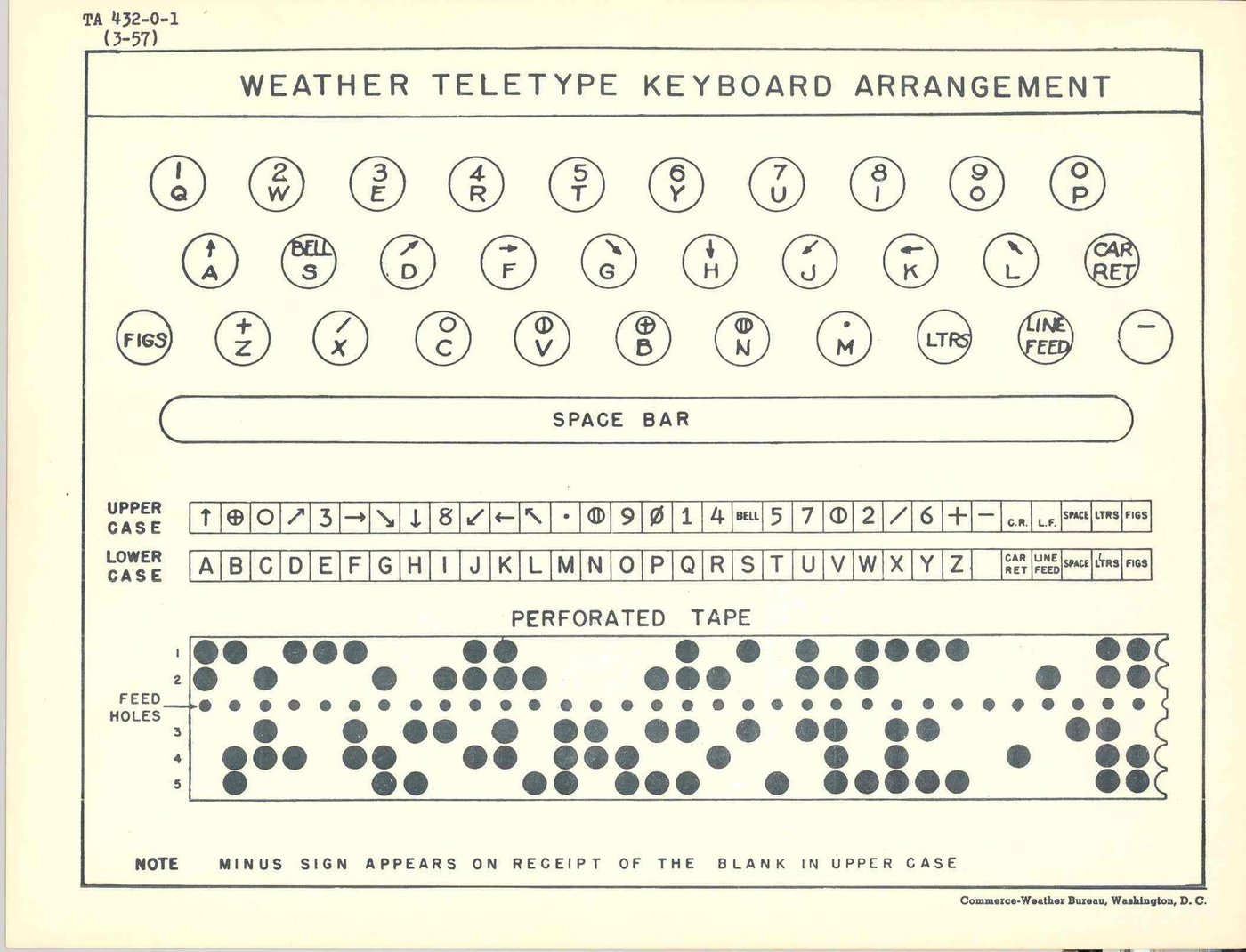
Keyboard and type. The communications arrangement (keytop sheet FX, type arrangement 97) is the standard military and amateur machine, with figures such as $ ! & # ' ( ) " / : ; ? , . and the bell on FIGS-S. Commercial arrangements put fractions in the figures case; the amateur notes reproduced on rtty.com describe fractions “in upper case on B, C, F, J, K, L, N, and V,” with soft-soldered pallets that can be changed to communications type (rtty.com). Weather arrangements (FD, KQ) carry weather symbols. Some commercial machines also have a tab function, on upper-case G according to the same notes.
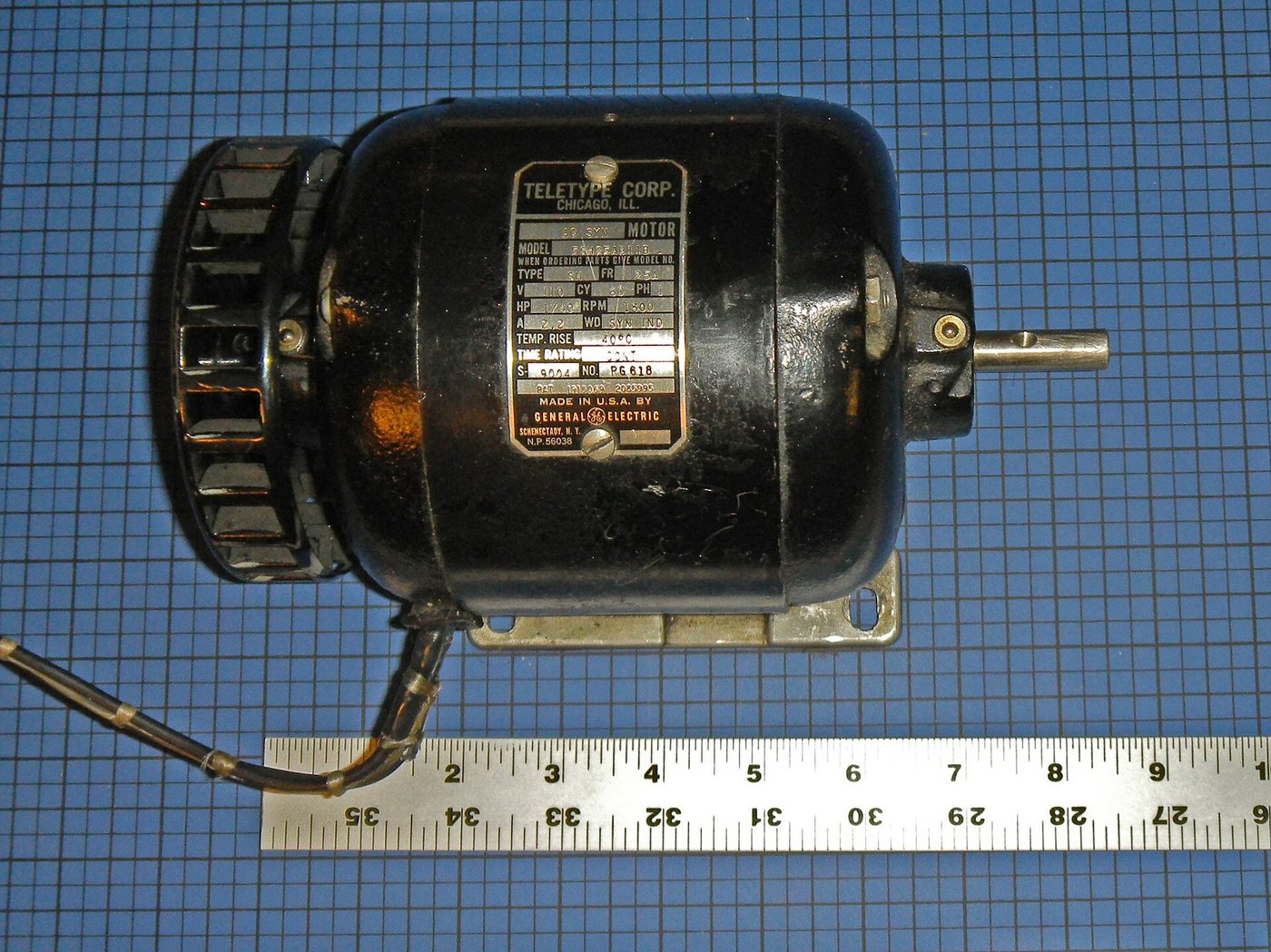
Motor. Synchronous (MU4, “15D”) or governed (MU1, “15A”), each with its own gear pair (Volume 2). Synchronous motors suit regulated AC mains; governed motors run on AC of almost any frequency and on DC, and need a speed indicator to set.
Selector. Pulling-magnet (the original) or holding-magnet. Teletype’s 1958 speed-change specification requires the holding-magnet selector (conversion kit 95380) before a machine can be geared for 75 or 100 words per minute (5482S), so a holding-magnet machine may have been a faster one. The RTTY Inc. notes describe the holding type as the later of the two.
Speed. 60 words per minute is standard; the military also used 66 (50 baud); commercial circuits used 75 and later 100. Teletype’s 1958 kits for 75 wpm are 96535 (synchronous: 7-tooth pinion, 24-tooth gear) and 96536 (governed: 8/32), and for 100 wpm 110891 (synchronous: 16/42) and 110892 (governed: 14/43), the 100-wpm kits also bringing a new printing cam, clutch spring, trip latch, range scale and a yield-type pull bar bail. Teletype warned that “increased maintenance and reduced operating margins can be expected of units operating at 100 W.P.M.” (5482S). Count the teeth on a machine of unknown history before assuming it is a 60-speed machine.
Paper feed. Friction (plain roll paper) or sprocket (pin-feed forms). Teletype specification 5026S converts a friction machine to sprocket feed.
Base. P70.013 notes that 15A and 15B bases provide a mounting for a line relay. Bases also differ in their motor-control arrangement, their send-receive-break mechanism, and their terminal wiring, which is why the base code decides the wiring diagram.
Functions. Mechanical motor stop (FIGS-H on message machines; FIGS, BLANK, H on the weather machines), unshift on space, automatic carriage return (which the rtty.com notes call user-installable), single/double line feed, bell position, and keyboard lockout on two BLANKs (Volume 2).
3.4 The military names
Most surviving Model 15s passed through military hands at some point. The names on their plates are a reliable guide to what they are.
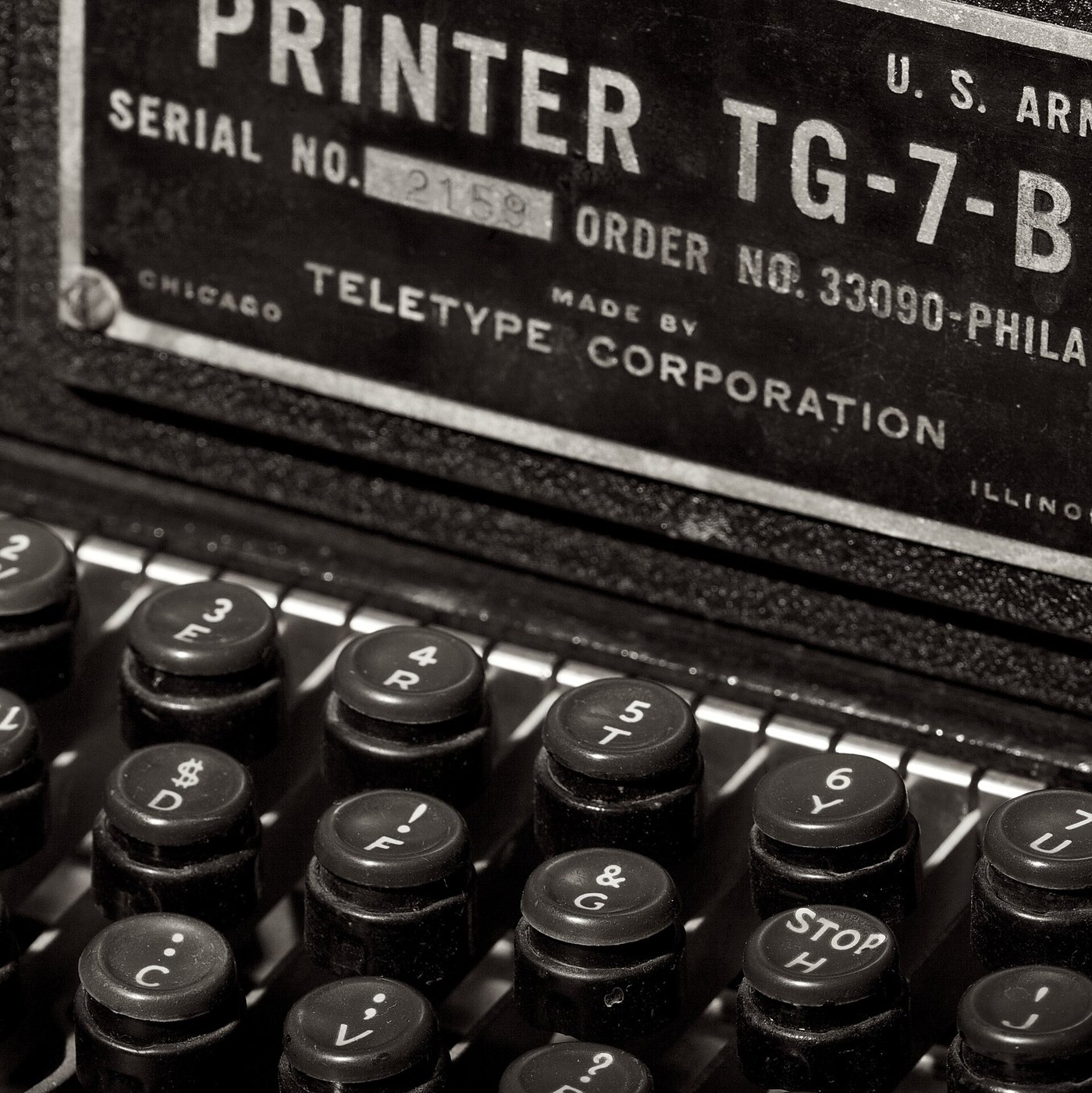
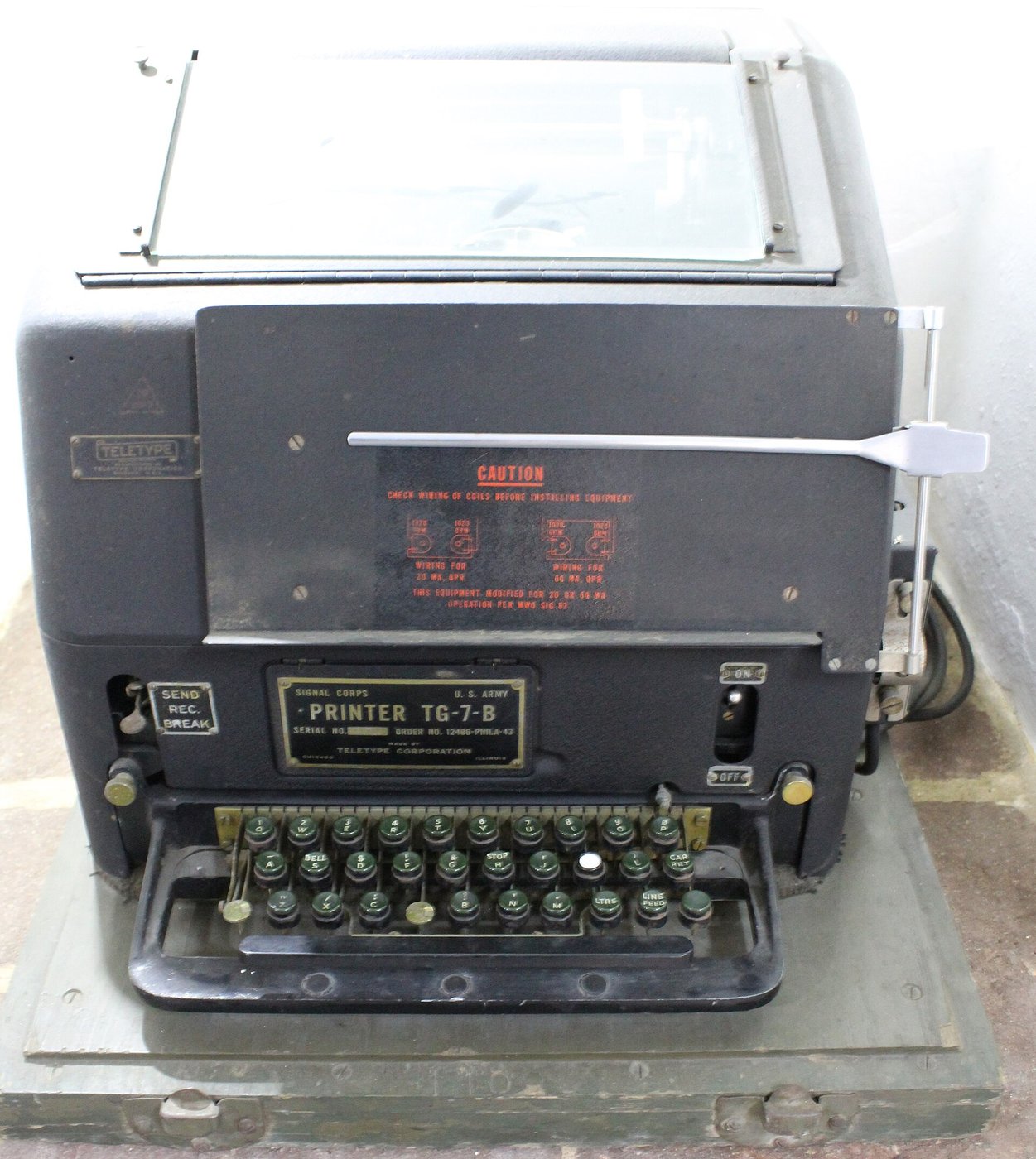
TG-7-A, TG-7-B, TG-37-B. The War Department’s manual TM 11-352 (December 1943) covers all three (TM 11-352). Each is “a Teletype Model 15 printer” (base, keyboard with radio filter, typing unit, motor unit with radio filter, and cover) packed in two transit chests: CH-50 for the base, keyboard, motor and cover, and CH-62 for the typing unit. The TG-7 printers are message machines printing 72 characters a line with upper-case H motor stop. The TG-37-B is the weather machine, 76 characters a line, weather symbols in upper case, stopping on FIGS, BLANK, H. The TG-7-B omits several TG-7-A features not needed in tactical service: the motor-control relay, the polar-neutral key, the line-relay mounting with its resistors and filters, and the tuning fork. A resistor-and-switch assembly lets the TG-7’s governed motor run on 115 V DC or on AC of 25 to 60 cycles.
The joint (post-1947) names. JANAP 161 (Change 1, 1956) lists the joint-service nomenclature in use after the war (JANAP 161):
Table 2 — The joint (post-1947) names. JANAP 161 (Change 1, 1956) lists the joint-service nomenclature in use after the war ([JANAP 161](https://navy-radio.com/manuals/janap161-5610-Part2.pdf))
| Nomenclature | What it is | Notes |
|---|---|---|
| TT-5/FG | Model 15 KSR station, message | table XRT115, rectifier REC 29; TM 11-2215; 200 lb |
| TT-6/FG | Model 15 KSR station, weather | same components |
| TT-7/FG | Model 19 set | TM 11-2216 |
| TT-8/FG | Model 19 set, weather | |
| TT-51/FG | Model 15 RO, Navy shore stations | governed series motor |
| TT-52/FG | Model 14 transmitter-distributor | part of AN/TGC-3 |
| TT-53/FG | Model 14 reperforator, receive-only | TM 11-2223 |
| TT-74/FG | Model 14 send-receive typing reperforator | for torn-tape relay |
The RadioNerds nomenclature list adds the Navy’s TT-49/UG and TT-50/UG, “Teletype Model 15 modified for shipboard service” (RadioNerds). A later change to TM 11-352 is reported to extend it to a TT-55/MGC, equivalent to the TG-7-B; I have seen that only in search results and have not verified it.
What the military plates mean for a buyer. A TG-7 or TT-5/FG is a standard communications machine with a governed motor (so it needs its speed set) and probably fungus-proofing varnish on its wiring. Military machines were maintained to a schedule and often rebuilt, which is in their favour; they were also stored in damp depots and sold as surplus by the pallet, which is not. The TG-7 chests are a real advantage when it comes to moving one.
3.5 What turns up today
From the listings, forum posts and restoration accounts cited in this dive, the machines found today fall into a few groups.
- KSRs on their tables, ex-Bell System, ex-military or ex-amateur, often already wired for RTTY by a previous owner. The most common kind, and the one to look for.
- Receive-only machines from newsrooms and broadcasters, sometimes in press-association covers. Fine printers, but no keyboard, so they cannot be tested in local loop by themselves.
- Model 19 sets, which include a Model 15 and are larger and heavier (Volume 7).
- Military TG-7s in their chests, now less common.
- Odd cabinets. A Model 15 offered on the Antique Radio Forums in December 2024 was housed in a Western Union letter-box cabinet with a synchronous motor; the seller offered it to Greenkeys members first (Antique Radio Forums).
- Parts machines and loose units: keyboards, typing units, motors, covers, gears and manuals sold separately on auction sites.
Prices. I have not found enough dated sales to give a reliable price range, and asking prices for scrap-condition and restored machines differ widely. The evidence points one way. Unrestored Model 15s change hands for very little: the Western Union cabinet machine was offered at $50, pickup only (December 2024), and an older forum post judged that an un-rusted 15 “probably could get $100,” adding that 15s and 19s “are getting hard to find in an un-rusted condition” (Antique Radio Forums). Shipping, documentation, lubricants, a new platen and an interface (Volumes 4–6) will then cost more than the machine. Restored, running machines with tables are another matter, and I have no good figures for them. An open question for my own search is what a known-good pair sells for.
3.6 Before you pay: the inspection checklist
A Model 15 should be inspected without power, and, if the seller agrees, with the cover off. Restoring a Teletype explains why the first hour is the dangerous one. The checklist:
- Does it turn by hand? With the motor disconnected, turn the main shaft (or the motor fan) and watch the mechanism cycle. A machine frozen with old grease is common and usually curable (Volume 4). One that binds at one point in its rotation may have a broken or bent part.
- Rust. Surface rust on covers and tables is cosmetic. Rust on the type bars, the selector, the code bars, the carriage tracks or the main shaft is not. Look under the typing unit and at the bottom of the base, where water collects.
- The selector and range finder. Is the range-finder scale and its index arm present and free? Is the selector magnet intact, with sound leads? Note whether it is pulling or holding type.
- The type bars. All present, none bent, the fan even. A bent type bar prints out of line and can usually be straightened; a missing one is harder.
- The carriage return. Is the dashpot there? Is the carriage return drum spring intact? Push the carriage to the right by hand and watch it return when released (Volume 2).
- The platen. Is the rubber hard, cracked or flat-spotted? Most are, and it is a routine replacement (Making the Parts That No Longer Exist).
- The motor. Identify synchronous or governed. If governed, is the governor target present, and the speed indicator or tuning fork? Check the motor leads for brittle insulation and the frame for evidence of overheating.
- The gears. Count the teeth on the motor pinion and main shaft gear and compare with Volume 2’s tables. A 75- or 100-speed machine will need a different gear pair for amateur use.
- The keyboard. All keytops present? (The circuitousroot machine arrived without the green BLANK keytop.) Do the keys move freely and the space bar repeat?
- The base. Data plate and code, terminal blocks, line relay socket, any relay fitted, and evidence of rewiring.
- The cover. Present? Original glass or a Plexiglas replacement? A missing cover is a serious loss: they are bulky, rarely sold separately, and the machine is noisy and unprotected without one.
- Paperwork. Any manuals, wiring diagrams or tuning forks that come with it are worth having.
- History. Ask where it has been stored, when it last ran, and what has been done to it. A machine that ran recently on an amateur station is worth more than one that has sat in a barn since 1975.
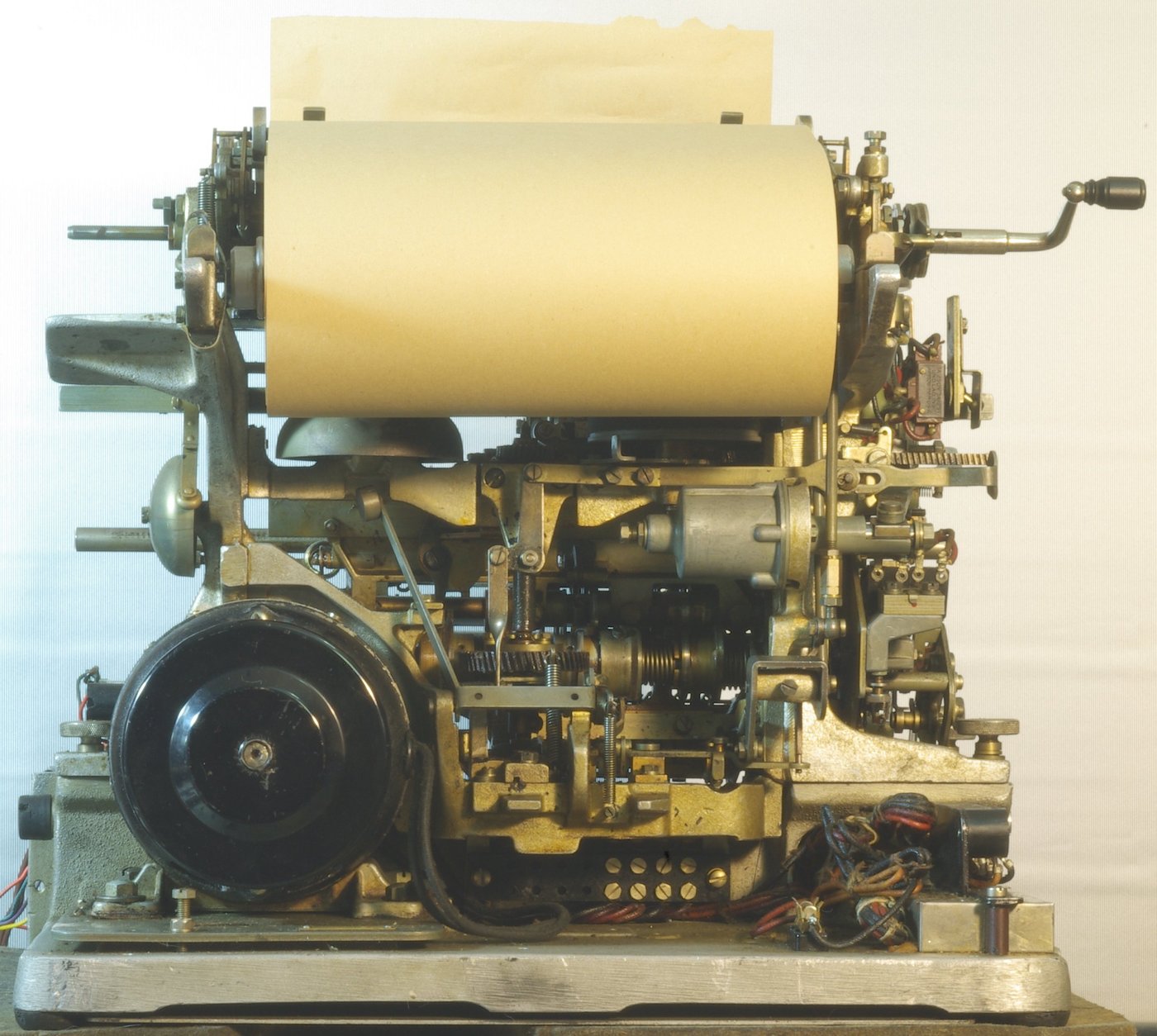
3.7 Moving one
A Model 15 is heavy and awkward, and its value lies in mechanisms that a drop or a strap in the wrong place will bend.
The weights. Teletype’s sheet gives the complete KSR set with its table as 166 lb net, 228 lb packed, and the table alone as 45 lb (1948 sheet 2.D1-1). JANAP 161 gives the military TT-5/FG set as 200 lb net, of which the printer is 112 lb, the table 39 lb and the rectifier 46 lb, shipping in four packages at 255 lb. A Model 19 set with its table is listed by Teletype at 286 lb net.
Take it apart first. The Army’s answer was to carry the typing unit in one chest and the rest in another, and a buyer can do the same:
- Remove the cover.
- Lift the typing unit off the base. It is held by thumb screws; it lifts straight up off its slip connections and gear mesh. Carry it upright, by its frame, never by the carriage or the type bars, and set it on a padded board.
- Remove the keyboard from the base (it slides out of its connections) and the motor unit if it is to be shipped separately.
- Pack the typing unit on its own, upright, wedged so that the carriage cannot run, with the platen protected. It is the most fragile and the most valuable part of the machine.
- Move the base and table as one or separately. A base with no units on it is a manageable lift for two people.
Freight or a van. For a long distance a palletized freight shipment with each unit boxed is the safe choice; for a short one, a van with two people. Never let a Model 15 travel assembled on its table in the back of a vehicle: the typing unit’s weight on its mountings will do damage over every bump.
3.8 Documents to collect first
Volume 1’s point bears repeating here: the documentation is the most valuable thing a Model 15 owner can have. The documents staged for the Library with this dive are the core set:
- Bell System Practices P70.013 (1951) or its earlier issue AB84.139 (1941), Description of Operation of No. 15 Teletypewriter, the clearest explanation of how it works.
- Teletype Bulletin 144, Description, Type Bar Page Printer (Model 15) (issue 2, 1944).
- Teletype Bulletin 138, Adjustments (issue 5, 1944), with the lubrication chapter: the bench reference for Volumes 4 and 5.
- TM 11-352 (1943) for TG-7s and TG-37s.
- Specifications S-5321 (motor interchange) and 5482S (speed change).
- The Bell lubrication sections for the base and keyboard (572-204-701, 572-203-701) and the general lubrication section (570-004-701).
- The wiring diagram for the actual base code, which has to be found for the specific machine; navy-radio.com keeps an index of Teletype wiring diagrams.
3.8.1 Sources (Vol 3)
- Set components and unit codes (BP, BB, MU, BK, RY, C, XRT, REC); weights; sets with table and console; Model 19 set weight; keytop and type arrangements — Teletype Corporation, Teletype Equipment List (General Description Sheets), index issue 2 (June 1948), sheets 2.D1-1 to 2.D6-1, 4.D1-1 and the 1943 keytop/type sheets. ⟨staged for the Library⟩
- B-prefix codes (“B” for Bell, after Slayton); the Model 15 on AP and UP wires — Jim Haynes, “Some Notes on Teletype Corporation,” Greenkeys posts as archived at deramp.com. ⟨secondary; staged⟩
- Per-unit serials and dating by patent dates — circuitousroot, “Teletype Model 15 KSR, Base 213102.” https://www.circuitousroot.com/artifice/telegraphy/tty-stuff/cr-tty/tty-15-ksr-213102/intro/index.html
- Fractions type, tab on upper-case G, automatic carriage return, pulling vs holding selectors — RTTY Inc. Model 15 notes, rtty.com. https://rtty.com/development/teletype/model-15/index.html
- 75 and 100 wpm kits and the holding-magnet prerequisite — Teletype specification 5482S, issue 15 (September 1958). ⟨staged⟩
- TG-7-A, TG-7-B, TG-37-B (chests CH-50 and CH-62; 72 and 76 characters per line; motor stop codes; features omitted from the TG-7-B; DC/AC motor switching) — War Department TM 11-352, Printers TG-7-A, TG-7-B and TG-37-B (December 1943). ⟨staged⟩
- TT-5/FG to TT-74/FG — JANAP 161, Change 1 (1956), Part 2. https://navy-radio.com/manuals/janap161-5610-Part2.pdf; TT-49/UG, TT-50/UG — RadioNerds. https://radionerds.com/index.php/TT_-_Teletype
- 15A and 15B bases with line-relay mounting — BSP P70.013 (1951), p. 24.
- Market evidence — Antique Radio Forums, “SOLD: Teletype Model 15” (December 2024). https://antiqueradios.com/forums/viewtopic.php?t=443410; “Anyone else here into mechanical teletype?” https://antiqueradios.com/forums/viewtopic.php?f=2&t=314022
- Wiring diagram index — navy-radio.com, “Teletype Wiring Diagrams and Schematics.” https://navy-radio.com/tty/tty-wd-list.htm
- Cross-links: Restoring a Teletype (the first hour; finding the right manual); Making the Parts That No Longer Exist (platens); Volumes 2, 4, 5 and 7 of this dive.