The Teletype Model 15 · Volume 4
The Teletype Model 15 — Vol 4: Oil, Grease and Old Varnish
What the Bell System put in a Model 15, what to use now, where it goes and how much, how to get eighty years of hardened lubricant out first, and how to set the speed of a governed motor once it runs.
4.1 Why lubrication is most of the job
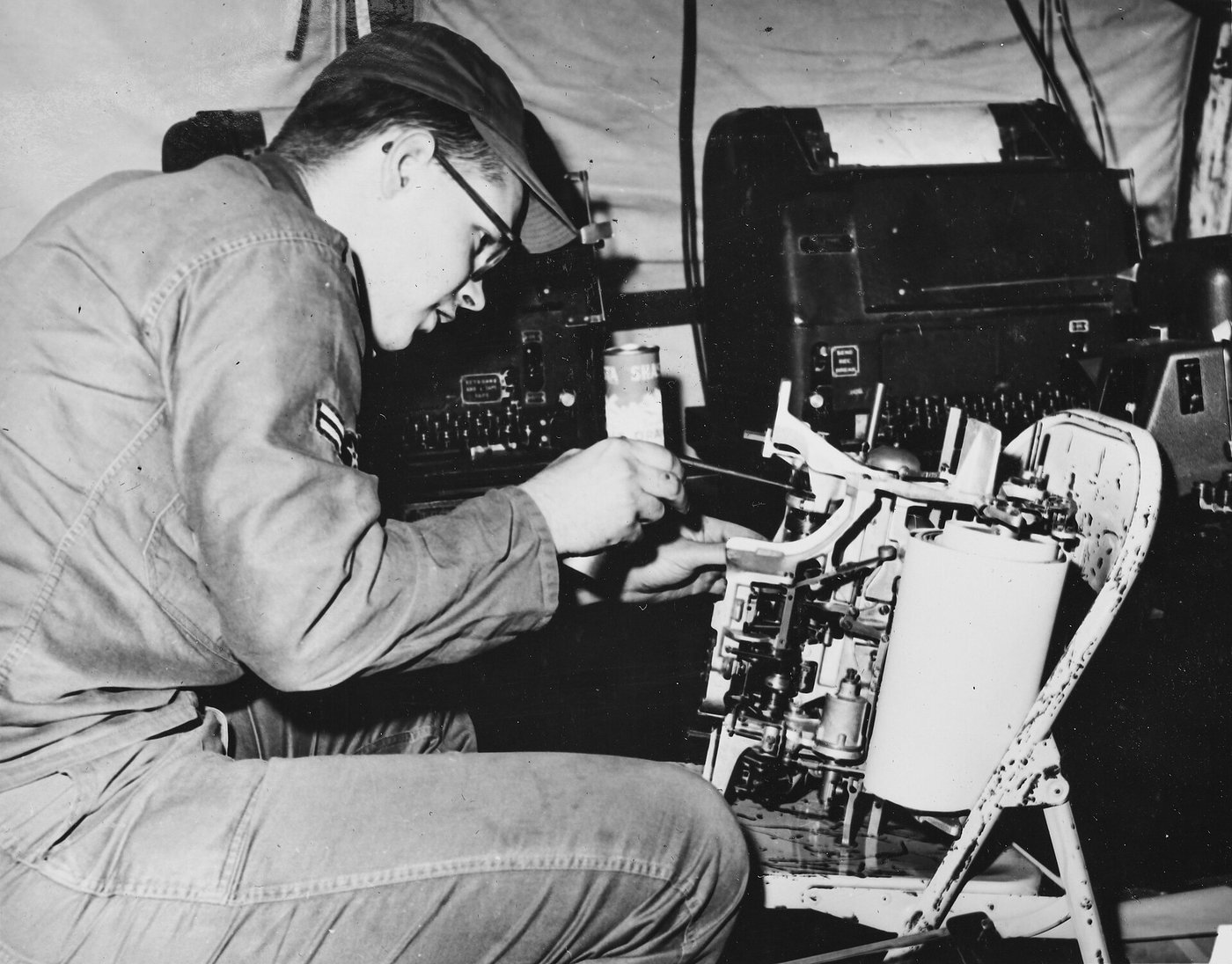
A Model 15 is a machine of sliding and pivoting steel, and nearly every fault in an old one starts as a lubrication fault. The original oil and grease, after decades in a shed or a basement, turn to a brown varnish that glues pivots, slows springs, and stops the light levers of the selector and function mechanisms from moving in the few milliseconds they are given. John Nagle’s account of refurbishing his Model 15 is typical: “congealed lubricants” had jammed key parts and the machine did not work at all until it had been bathed, oiled and run (Aetheric, “Refurbishing a Model 15”).
Restoring a Teletype, Vol 1, gives the general method: clean before adjusting, rinse, dry and oil the same day, and do not over-oil (about 3–4 cc of oil and 1 cc of grease for a whole machine). This volume is the Model 15’s own version, from Teletype’s adjustment bulletin, the Bell System lubrication sections, and modern work on what to use in place of the original lubricants.
4.2 What Teletype specified
In January 1941 Teletype standardized two lubricants “for use on all types of Teletype apparatus,” in specification S-5288, which was bound into every Model 19 manual (Teletype 5MA, p. 9) and repeated in later bulletins such as 141B:
Table 1 — In January 1941 Teletype standardized two lubricants "for use on all types of Teletype apparatus," in specification S-5288, which was bound into every Model 19 manual (Teletype 5MA, p. 9) and repeated in later bulletins such as 141B
| Lubricant | Western Electric spec | Teletype part numbers |
|---|---|---|
| Oil | KS-7470 | 88970 (quart), 88971 (gallon) |
| Grease | KS-7471 | 88973 (pound), 97116 (4-oz tube) |
| Grease gun | KS-8319 | 88975 |
The same part numbers survived, with a TP prefix, into Teletype’s 1976 general lubrication section, which lists TP88970 oil for general lubrication and TP97116 grease for general grease work, and names commercial alternates for some of its other greases: Mobil No. 2, Lubriplate 105 and, for ball-bearing motors, Beacon 325 (Teletype 570-004-701TC). A US government memorandum on storing Teletype equipment, among the Friedman papers at the NSA, notes that KS-7471 grease “is equivalent to Alemite No. 38 lubricant” and considered both satisfactory for long-term storage (NSA, “Storage of Teletype Equipment”).
4.3 What to use now
Neither KS lubricant has been made under that name for decades. Douglas W. Jones of the University of Iowa, a long-time Greenkeys contributor, tracked down what they were and what matches them (Jones, “KS7470 oil and KS7471 grease”).
KS-7470 oil came from the American Oil and Supply Co. of Newark, New Jersey. It corresponds to military specification MIL-L-17672, a noncorrosive light turbine and hydraulic oil sold as “Lubricating Oil, Instrument.” The data Jones found give a viscosity of about 40 cSt at 100 °F, a viscosity index over 100, a pour point of −10 °F or below and a flash point of at least 400 °F. He concludes that it is an ISO viscosity grade 46 oil, and rates the modern candidates:
Table 2 — KS-7470 oil came from the American Oil and Supply Co. of Newark, New Jersey. It corresponds to military specification MIL-L-17672, a noncorrosive light turbine and hydraulic oil sold as "Lubricating Oil, Instrument." The data Jones found give a viscosity of about 40 cSt at 100 °F, a viscosity index over 100, a pour point of −10 °F or below and a flash point of at least 400 °F. He concludes that it is an ISO viscosity grade 46 oil, and rates the modern candidates
| Oil | Viscosity | Jones’s verdict |
|---|---|---|
| Nye Delicate Machinery Oil 113 | 40 cSt at 40 °C | close match |
| Starrett 1620 tool and instrument oil | — | reportedly a rebranded Nye oil |
| Lubriplate FMO-200 AW white mineral oil | 47 cSt | ”a bit heavy” |
| Sonneborn LP-200 white mineral oil | 45 cSt | ”a bit heavy” |
| Nye NyOil | 36.5 cSt | ”a bit light” |
| Clarion food-grade white mineral oil 200 | 37.5 cSt | ”a bit light” |
| 3-in-One motor oil | 68 cSt | not recommended: “significantly too heavy,” and contains up to 2 % naphtha |
| Anderol 456 synthetic ester | — | not recommended: incompatible with the acrylic and ABS parts of later Teletypes |
In a 2014 Greenkeys post Jones said that, given the choice, he would “go for the real thing, … Nye 113, and not the Lubriplate FMO-200,” and that he had ordered Starrett 1620 (Greenkeys, April 2014).
KS-7471 grease was made by the General Bearing Cleaning Co. of Trenton. Its original national stock number was cancelled; the replacement is a grease to MIL-G-81322, and Jones names AeroShell Grease 22 and Mobilgrease 28 as the widely available greases under that specification. He also warns that the Teletype manuals sometimes call for oil and grease at the same point, and that lithium-soap greases should not be mixed with clay- or microgel-thickened ones, so a new grease should be tested before it goes everywhere.
What restorers actually use. Practice varies more than the specifications suggest. Nagle used synthetic multigrade motor oil because it “should not congeal over time,” and white lithium grease on the large gears and contact rails. That works, but it departs from Teletype’s specification. A detergent motor oil is not an instrument oil, and the instrument oils above are inexpensive. The Model 15 is almost all metal, so the plastic-compatibility warnings that matter on a Model 33 matter much less here. The rule I intend to follow on my own machines is an ISO 46 instrument oil (Nye 113 or Starrett 1620) and a MIL-G-81322 grease, the closest match to what the machine was designed around.
4.4 The rules
Teletype’s lubrication rules are short and consistent from the 1944 bulletin to the 1964 Bell sections.
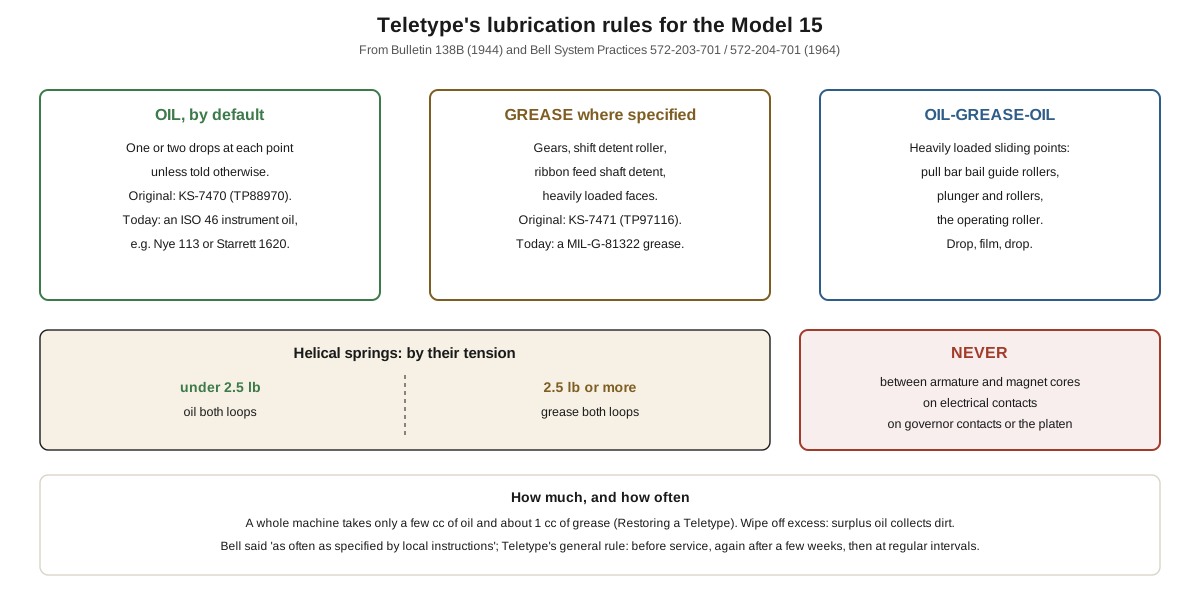
- Quantity. “Unless otherwise specified, one or two drops of oil at each of the places indicated will be sufficient” (Bulletin 138B, p. 65).
- Oil by default. “Use oil for lubrication at all of the places listed … except where the use of grease or oil-grease-oil is specified.”
- Springs. “Oil both loops of all helical springs that exert a nominal tension of less than 2-1/2 lbs. Apply grease to both loops of all helical springs that exert a nominal tension of 2-1/2 lbs. or more.” The same note heads the 1964 Bell sections for the base and keyboard (BSP 572-204-701; 572-203-701).
- Oil-grease-oil at heavily loaded sliding points: a drop of oil, a film of grease, and another drop of oil, so that the grease is carried into the surface.
- Never between the selector armature and its magnet cores, or on any electrical contact: “avoid getting oil between the armatures and the magnet cores” (572-204-701). Oil on the pole faces makes the armature stick, which shows up as a narrow or lopsided range (Volume 5).
- Interval. The Bell sections give none: the Model 15 base and keyboard “should be lubricated as often as specified by local instructions.” Teletype’s general section is more helpful: lubricate before the machine goes into service or storage, again one to several weeks after installation, and then at intervals set by the type of equipment, its speed and how many hours a day it runs (570-004-701TC). For a hobby machine that runs a few hours a month, that means after restoration, after the first few weeks, and then once a year, plus a check whenever it starts to sound or behave differently.
4.5 Where it goes
Bulletin 138B’s lubrication chapter lists every point on the typing unit, keyboard and base. It is the document to have open at the bench (it is staged for the Library with this dive). A summary shows the pattern.
The type-bar carriage. Type bars at their segment slot; code bars at their posts; code-bar bell cranks on their wearing surfaces; the pull bar bail’s guide rollers and guide surface (oil-grease-oil); the plunger surface and rollers and the pull bar bail guide post (oil-grease-oil); the operating roller (oil-grease-oil); the three carriage support rollers; the whole ribbon mechanism (reverse bail, feed shaft bearings with three oil holes, feed pawl and its lever, ratchet teeth, gears, spool shaft bushings with the spools removed, reverse shafts and levers, oscillator lever screw and slot); the margin bell pawl; the carriage rack and spacing-shaft pinion; and the ribbon feed shaft detent (grease).
The platen unit. Shaft bearings (one in each hub); the line feed detent lever screw and roller; the single-double line feed lever and its cam; the line feed pawl and operating lever screws; the shift detent roller (grease); the platen unit’s pivot bearings; the upper ends of the line feed and shift vertical links; the paper guides, straightener and pressure-roller shafts.
The main shaft. The main shaft carries its own oil inside. Teletype’s motor-interchange specification has the fitter “remove 74101 oil plug from end of main shaft” to change the drive gear (S-5321), and Nagle oiled the main shaft’s felt wick by removing the right-hand end cap, tilting the machine to the left and adding oil “until it ran out the left end.” The friction clutches on the shaft (the selector cam sleeve’s and the spacing gear’s) depend on felt washers that must be oiled but not flooded; a dry one grabs, and a soaked one slips.
The keyboard. The Bell section for the Model 15 keyboard shows an oil fill cup on the left side, oil on the high parts of the cams, all the key-lever slots, both ends of the key levers, the five locking levers, the five selector-bar rollers and their slots and the serrations in the selector bars; and, out of sight, the universal-bar pilot-screw bearings, the contact-lever pivoting shaft and guide comb, and the repeat-space rod at each end (572-203-701).
The base. On bases with electrical motor control, the start-magnet locking lever and the stop-magnet armature bearings, with the warning about pole faces (572-204-701).
The motor. Teletype’s ball-bearing motors were packed at the factory and, according to S-5288, needed no grease for about two months of ordinary service, then one or two strokes of the grease gun per bearing at intervals, without overfilling, which pushes grease into the windings. The Model 14 transmitter-distributor’s bulletin gives its motor two drops of KS-7470 every four months. A governed motor’s governor contacts are never oiled; they are cleaned and dressed (Volume 5).
4.6 Getting the old varnish out
Fresh oil on top of old varnish does little. The old lubricant has to come out first, and there are three approaches, from gentlest to most thorough.
Wash in place. For a machine that turns freely and is merely sluggish, flood the mechanism with oil or a light solvent from a squeeze bottle, run it by hand, wipe, and repeat. This is slow but disturbs nothing.
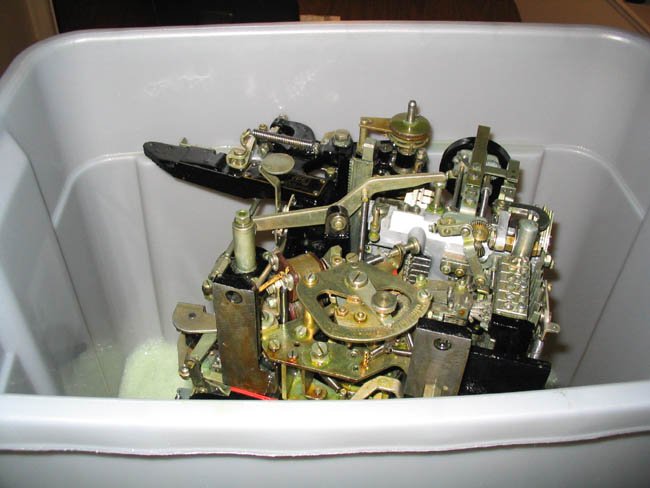
The bath. For a machine that is gummed solid, the typing unit comes off the base and goes into a bath. Nagle stood his typing unit on its right end in a large plastic tub of Simple Green, “a mild biodegradable nonflammable degreasing solvent,” which he preferred to kerosene as the lower-risk choice, keeping the selector magnet, the unit’s only electrical part, out of the liquid as far as possible. The keyboard soaked overnight in a flat container with only its base submerged. Stubborn deposits came off with a brass wire brush, never steel; the sliding contacts were brushed bright; and the outer surfaces were cleaned with furniture polish (Aetheric).
Then dry and oil the same day. Water-based degreasers leave bare steel that will flash-rust within hours. Restoring a Teletype gives the routine: rinse, dry thoroughly (compressed air, a warm room, time), and oil every point the same day. Do not let a cleaned machine sit dry overnight.
What not to use. Nothing abrasive on bearing or timing surfaces; no steel wool; no penetrating sprays left in the mechanism as a lubricant, because they evaporate and leave the machine dry; and no solvent on the platen or other rubber parts, which it swells or cracks. Keep solvent and water off the wiring. Nagle left his machine’s wiring alone because its original Deltabeston insulation contains asbestos, a hazard worth knowing about before scrubbing or cutting old wire.
Run it in. A freshly cleaned and oiled Model 15 often prints badly at first and improves as the oil spreads. Nagle’s machine was about 90 per cent accurate at first and passed 98 per cent after running; after about an hour of operation the typing-unit errors were gone. Take the range (Volume 5) after the run-in, not before.
4.7 Setting the speed of a governed motor
A synchronous motor needs no speed setting. A governed motor does, and Teletype’s bulletin describes how.
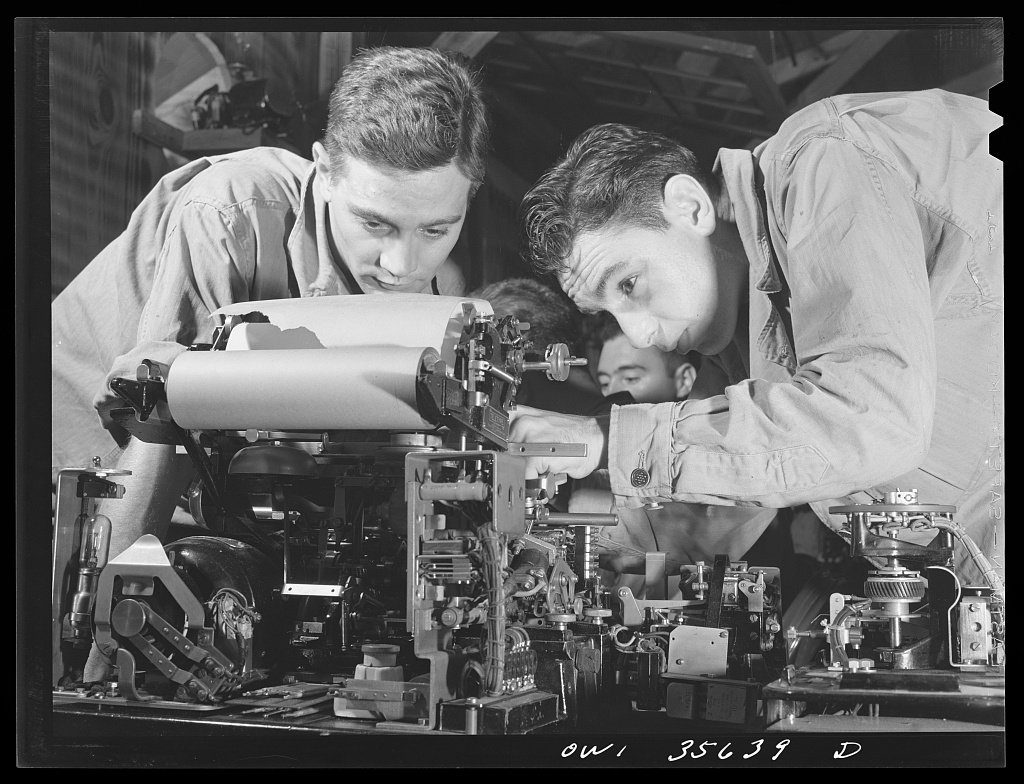
The governor carries a target, a disc of spots on the end of the motor. Its speed is checked “by viewing the target on the motor governor through the vibrating shutters of a speed indicator (tuning fork) provided for this purpose.” With the motor running and the target well lit, the fork is struck and the target watched through its shutters: “If the motor is running at the correct speed, the target will appear stationary.” If it drifts with the rotation, the motor is fast; against it, slow. To raise or lower the speed, the speed adjusting lever or the governor adjusting bracket is pressed momentarily against the turning speed adjusting wheel, which screws the governor spring in or out (138B, p. 9). The Army’s TG-7-A came with its own fork; Teletype’s Model 14 transmitter-distributor manual gives fork frequencies of 87.6 vibrations per second for 368.1 operations per minute and 96.19 for 404 (TM 11-2222).
Bulletin 138B adds a warning that applies to any stroboscopic check: “There is a possibility of setting the speed incorrectly, due to getting a speed multiple; i.e., the speed could be half the desired speed, or two-thirds the speed, or some other multiple, even though the spots appeared to be stationary.” Start from the approximately right speed and make small adjustments.
Without a tuning fork. Inside the Teletype Mechanism describes the alternative from P70.013: a mains-powered lamp lighting the target, so that the correct ring stands still under the flicker. Restorers today also use an LED driven at the right frequency, or simply take a range (Volume 5) against a known-good signal and adjust for the widest range. A governed machine whose speed will not hold is a governor problem: dirty or pitted contacts, a weak spring or a failed resistor (Volume 5).
4.8 A maintenance routine for a hobby machine
Drawn from the documents above, this is the routine I plan to use:
- After restoration: full lubrication per 138B; run in for an hour; take a range; record it.
- After the first few weeks: lubricate again, lightly; retake the range.
- Yearly, or every few dozen hours of running: a drop of oil at each point in 138B’s list; grease where specified; check the main-shaft wick; wipe away excess; check governor contacts on a governed motor; retake the range.
- Before storage: lubricate, cover, and store dry and warm. KS-7471-type grease was judged suitable for long-term storage; damp is the enemy.
- Whenever it sounds different: stop, look and lubricate before adjusting anything.
4.8.1 Sources (Vol 4)
- S-5288 (January 1941): KS-7470 oil and KS-7471 grease standardized for all Teletype apparatus; part numbers; motor bearing greasing — Teletype Corporation, 5MA, Model 19 Set manual (September 1942), p. 9; repeated in Bulletin 141B (Model 14 TD), change 2 (1964), p. 48, with two drops on TD motor bearings every four months. ⟨both staged for the Library⟩
- TP-numbered lubricants and commercial alternates; when to lubricate — Teletype Corporation, 570-004-701TC, Teletypewriter Equipment, General Lubrication, issue 1 (1976). ⟨staged; OCR⟩
- The lubrication rules and the typing-unit list; speed setting by tuning fork and the false-standstill warning — Teletype Corporation, Bulletin 138B, Adjustments, Type Bar Page Printer (Model 15), issue 5 (October 1944), pp. 9, 65–68. ⟨staged⟩
- Base and keyboard lubrication; spring rule; pole-face caution; “as often as specified by local instructions” — Bell System Practices 572-204-701 and 572-203-701, issue 1 (December 1964). ⟨staged⟩
- Main shaft oil plug 74101 — Teletype specification S-5321, issue 2 (1941). ⟨staged⟩
- Tuning-fork frequencies 87.6 and 96.19 vps — War Department TM 11-2222 (1951), Model 14 transmitter-distributors. ⟨staged⟩
- KS-7470/KS-7471 specifications and modern equivalents — Douglas W. Jones, “KS7470 oil and KS7471 grease: Modern equivalents for Teletype lubricants,” University of Iowa. http://homepage.cs.uiowa.edu/~jones/pdp8/UI-8/ks7470oil.shtml; and his Greenkeys post of 16 April 2014. http://www.qth.net/pipermail/greenkeys/2014-April/029890.html
- KS-7471 equivalent to Alemite No. 38; long-term storage — “Storage of Teletype Equipment,” NSA Friedman collection (REF ID A70961). https://www.nsa.gov/Portals/75/documents/news-features/declassified-documents/friedman-documents/patent-equipment/FOLDER_485/41719889075917.pdf ⟨read via search excerpt; the NSA host refused a direct fetch⟩
- A Model 15 refurbished: Simple Green bath, brass brush, synthetic motor oil and lithium grease, main-shaft wick, Deltabeston insulation, run-in accuracy — John Nagle, Aetheric, “Refurbishing a Model 15.” https://www.aetherltd.animats.com/refurbishing15.html
- Cross-links: Restoring a Teletype (cleaning and quantities); Inside the Teletype Mechanism (the governor and lamp strobe); Volume 5 (range, governor contacts).