The Teletype Model 15 · Volume 1
The Teletype Model 15 — Vol 1: The Machine That Ran the Wires
From a salt fortune and a cold-storage engineer's experiments to roughly two hundred thousand cast-iron page printers: how the Model 15 came to carry the news, the weather, a world war and, afterwards, the amateur radio teletype hobby.
1.1 Why one machine gets its own dive
The other teletype dives on this site treat the teleprinter as a family. Teletype Machines walks through the line from the Model 15 to the Model 33; Inside the Teletype Mechanism takes the receiving and printing paths apart; Restoring a Teletype and Making the Parts That No Longer Exist deal with bringing any of them back. This dive is narrower and deeper. It is about one machine: the Teletype Model 15, the cast-iron page printer that Teletype Corporation introduced in 1930 and was still building, by the usual account, in 1963.
There are three reasons for giving it eight volumes of its own.
The first is scale. Teletype’s own company history puts Model 15 sales at about 200,000 through 1954, and calls it the company’s “bread and butter” unit, with output peaking during the Second World War (House 2001). No other teleprinter of its generation was made in anything like those numbers, and the survivors are the ones collectors and radio amateurs actually find.
The second is that it is the machine of its moment. The Bell System built its teletypewriter exchange service, TWX, on Model 15-type stations; the Army and Navy standardized on it; the press associations ran their wires through receive-only versions of it; and after the war it was the machine that radio amateurs carried home and put on the air.
The third is personal. The teletypes I watched as a boy in my father’s ham shack, in the late 1960s and early ’70s, were the clattering cast-iron kind, and the Model 15 is the machine that phrase describes.
I do not own one yet. I am considering a pair of them for a project of my own, a working replica of the Japanese PURPLE cipher machine of 1941 (Volume 8), and this dive is the research I wanted in one place before buying: what the machine is, how it works, which versions exist, what goes wrong with them, how to keep one running, and how to connect a ninety-year-old teleprinter to a modern controller without hurting it or anyone standing near it.
This volume is the history. Volume 2 takes the machine apart, unit by unit. Volume 3 is a buyer’s guide to the variants and their military names. Volumes 4 and 5 are maintenance and repair. Volume 6 is the electrical interface, Volume 7 the paper-tape companions, and Volume 8 the cipher-machine project.
1.2 Salt money and a start-stop idea
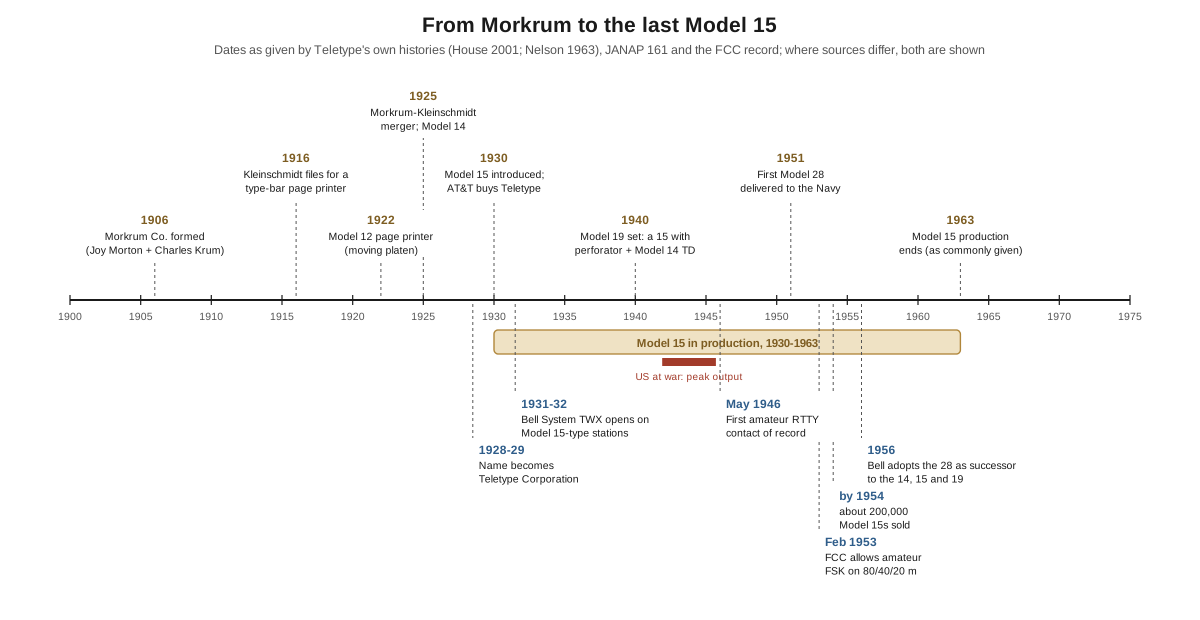
The Model 15’s family tree begins with two partners from Chicago. Teletype Corporation’s own synopsis dates the start to 1902, when Charles Krum, a cold-storage engineer, began experimenting with printing telegraphs with financial backing from the Morton family of Morton Salt. The Morkrum Company, its name made from Morton and Krum, followed in 1906, owned jointly by Krum and the Mortons (House 2001; Wikipedia, “Teletype Corporation”).
The idea that made the business work came from the next generation. R. A. Nelson’s company history of 1963 credits Howard L. Krum, Charles’s son, with “the start-stop method of synchronization for permutation code telegraph systems,” and calls it the achievement that “more than anything else put printing telegraphy on a practical basis” (Nelson 1963). Earlier printing telegraphs had needed sending and receiving machines to run in lockstep, with elaborate arrangements to keep them there. Start-stop framing removed the problem. Each character is preceded by a start element that sets the receiver running and followed by a stop element that brings it to rest, so the receiver only has to keep time for one character at a time. Every teleprinter in this dive, and every UART in a modern computer, works on that principle. Inside the Teletype Mechanism shows how the Model 15 does it in steel.
A myth worth correcting. Teletype’s 2001 synopsis says that Charles Krum “perfects the 5-unit ITA-2 code.” He did not. The five-unit code that became ITA2 descends from Émile Baudot’s code of the 1870s by way of Donald Murray’s rearrangement of 1901, and was standardised internationally by the CCITT. What Morkrum contributed was the start-stop method for sending such a code, not the code itself. Teletype Machines tells the code’s lineage in full.
Morkrum’s early machines were not commercial successes. The synopsis records a field trial on the Alton Railroad in 1908 that produced no order; sales to Postal Telegraph in 1910 and Western Union in 1912 of machines that worked mechanically but did not pay; and then, in 1915, the Associated Press adopting Morkrum printing telegraph equipment to serve competing New York newspapers simultaneously. The press wire would remain one of the Teletype’s defining jobs for the next half century (House 2001).
1.3 Kleinschmidt, the merger, and a name
The other line of descent ran through Edward E. Kleinschmidt, a German-born inventor who had been building printing telegraphs in New York since the 1900s. In 1916 he filed a patent application for a type-bar page printer (Wikipedia, “Teletype Corporation”, citing US Patent 1,448,750). Morkrum and Kleinschmidt held patents that overlapped, and Nelson’s history says plainly that the conflict “eventually led to a merger of the two interests” (Nelson 1963). The Morkrum-Kleinschmidt Company was formed in 1925. The cumbersome name was dropped in favour of Teletype Corporation at the end of the decade. Teletype’s synopsis dates the change to 1929 and Wikipedia to 1928; the name “Teletype” itself, with its scroll logotype, had already been in use as an advertising name since the Model 11 of 1921 (House 2001).
The machines of those years set up the Model 15’s design:
Table 1 — The machines of those years set up the Model 15's design
| Model | Introduced | What it was | Sold |
|---|---|---|---|
| 11 | 1921 | Type-wheel tape printer; the first commercially successful Morkrum machine | 883 through 1927 |
| 12 | 1922 | Type-bar page printer with a moving platen, like an office typewriter | 11,899 (some as late as 1943) |
| 14 | 1925 | Type-bar tape printer, later a whole family of tape punches and readers | about 60,000 by the late 1950s |
| 15 | 1930 | Type-bar page printer with a stationary platen | about 200,000 through 1954 |
Source: Teletype Corporation history as summarised by Don Robert House (2001). The Model 14’s numbers and family are the subject of Volume 7.
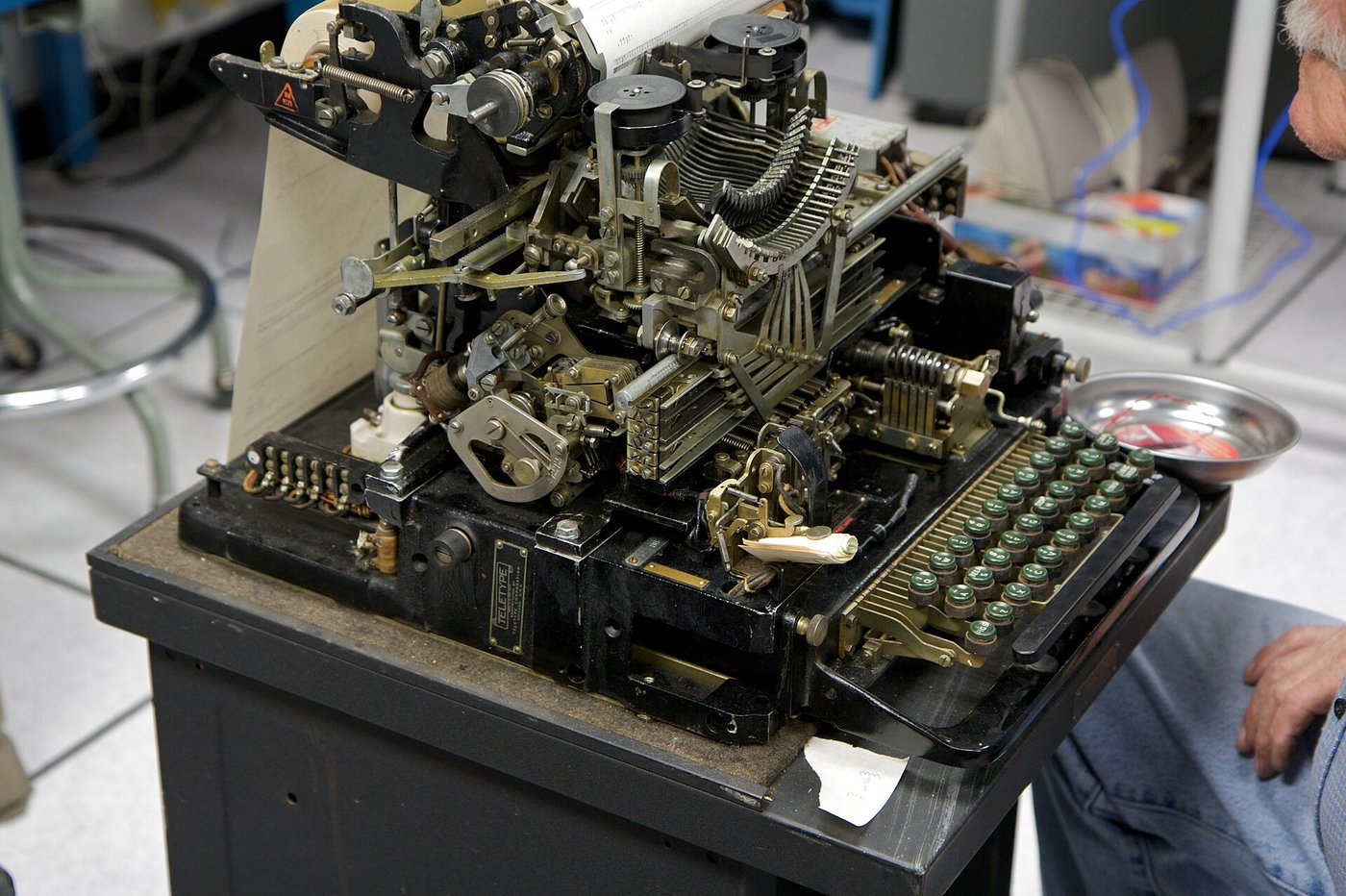
The difference between the Model 12 and the Model 15 is in the last column of the second row. A Model 12 printed the way an office typewriter does: the type bars stay put and the platen carriage, carrying the paper, slides across in front of them, so the whole weight of the paper roll and platen is thrown back and forth on every line. The Model 15 turned this inside out. Its platen stays still and the type-bar carriage travels across the page, so the moving mass is a compact basket of type bars rather than the paper. The RTTY Inc. notes for amateur buyers put it simply: the paper roller does not move side to side; the type basket travels left to right as copy is received (RTTY Inc. Model 15 notes, reproduced at rtty.com).
1.4 1930: the Model 15 and the Bell System
Two things happened to Teletype in 1930, and they are connected.
The first was the Model 15 itself. The patent covering its commercial form, US 1,904,164, Signaling system and apparatus therefor, was filed on 11 July 1930 in the names of Sterling Morton, Howard L. Krum and Edward E. Kleinschmidt and granted on 18 April 1933 (Google Patents, US1904164A). Its three names are the history of the company in one line: the Morton money, the Krum start-stop principle and the Kleinschmidt type-bar page printer. Teletype’s first descriptive bulletin for the machine, Description, Typebar Page Printer (Model 15), Bulletin No. 144, followed in 1931 (Wikipedia, “Teletype Corporation”, citing the bulletin).
The second was the sale of the company. In 1930 the American Telephone and Telegraph Company bought Teletype for $30,000,000 in stock, and it became a wholly owned subsidiary of Western Electric (Fortune, March 1932, as cited by Wikipedia). The reason, according to Teletype’s own synopsis, was that the Bell System was planning a switched teletypewriter service and wanted a captive manufacturer to equip it. That service, TWX (Teletypewriter Exchange Service), opened in 1931 (Teletype’s synopsis says 1932), and its terminals were Model 15-type machines; the synopsis adds that a large share of TWX stations were still Model 15s in the 1950s (House 2001).
Bell ownership shaped the machine’s whole life. Teletype’s job, as House puts it, was to supply the Bell System with whatever terminal equipment its customers needed. Western Electric’s KS specifications for lubricants (Volume 4) and the Bell System Practices sections that describe the machine (the BSP P70.013 description is the main source for Inside the Teletype Mechanism) are artefacts of that ownership.
1.5 What the Model 15 did for a living
A machine sold in those numbers was put to a great many uses. The main ones, and the versions they produced, are these.
Private wire and TWX. Railways, brokerages, newspapers and large companies leased private lines between offices and put a Model 15 at each end; TWX let any subscriber dial any other. This is the keyboard send-receive (KSR) machine in its office form.
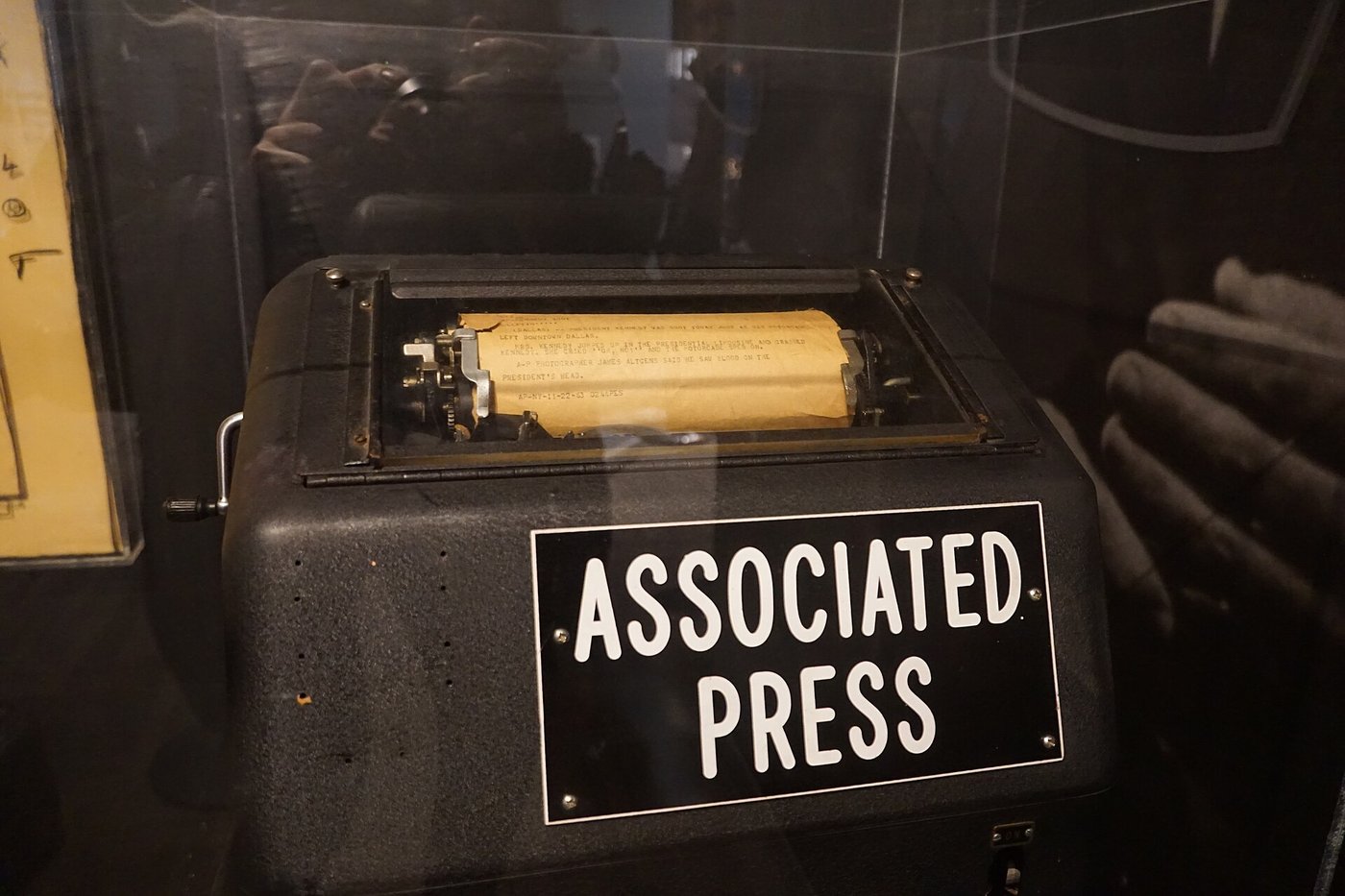
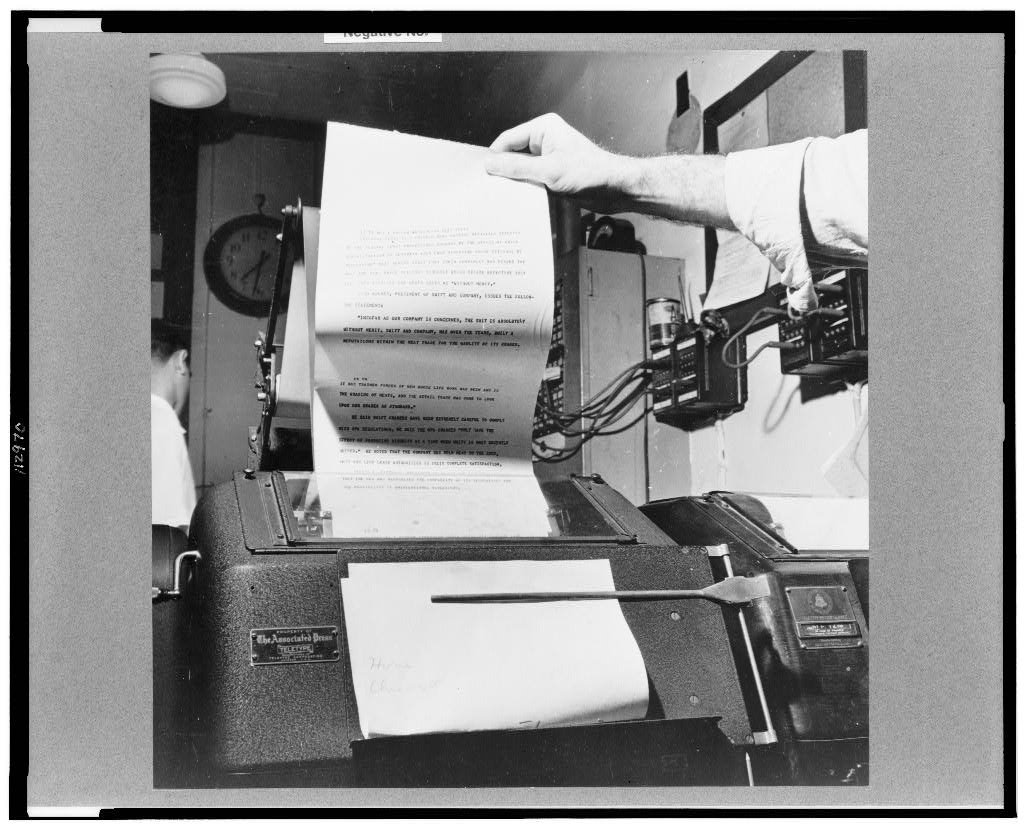
The news wire. The receive-only (RO) Model 15, with no keyboard, became the “news Teletype” of newspaper and radio-station newsrooms, printing the AP, UP and INS wires around the clock. Its bell signalled a bulletin. Wikipedia calls it the classic “news Teletype” (Teletype Corporation).
Weather. Weather networks needed symbols that ordinary keyboards lacked, so the Model 15 was built with weather keyboards and type as well as the communications and commercial arrangements. JANAP 161 lists a separate military nomenclature for the weather version (Volume 3).
Telegraph companies. Western Union and Postal Telegraph had been Morkrum customers from 1910 and 1912 (House 2001). The Model 15 and its tape relatives served in their message networks alongside equipment of the telegraph companies’ own design.
The armed forces. This is where most of the 200,000 went.
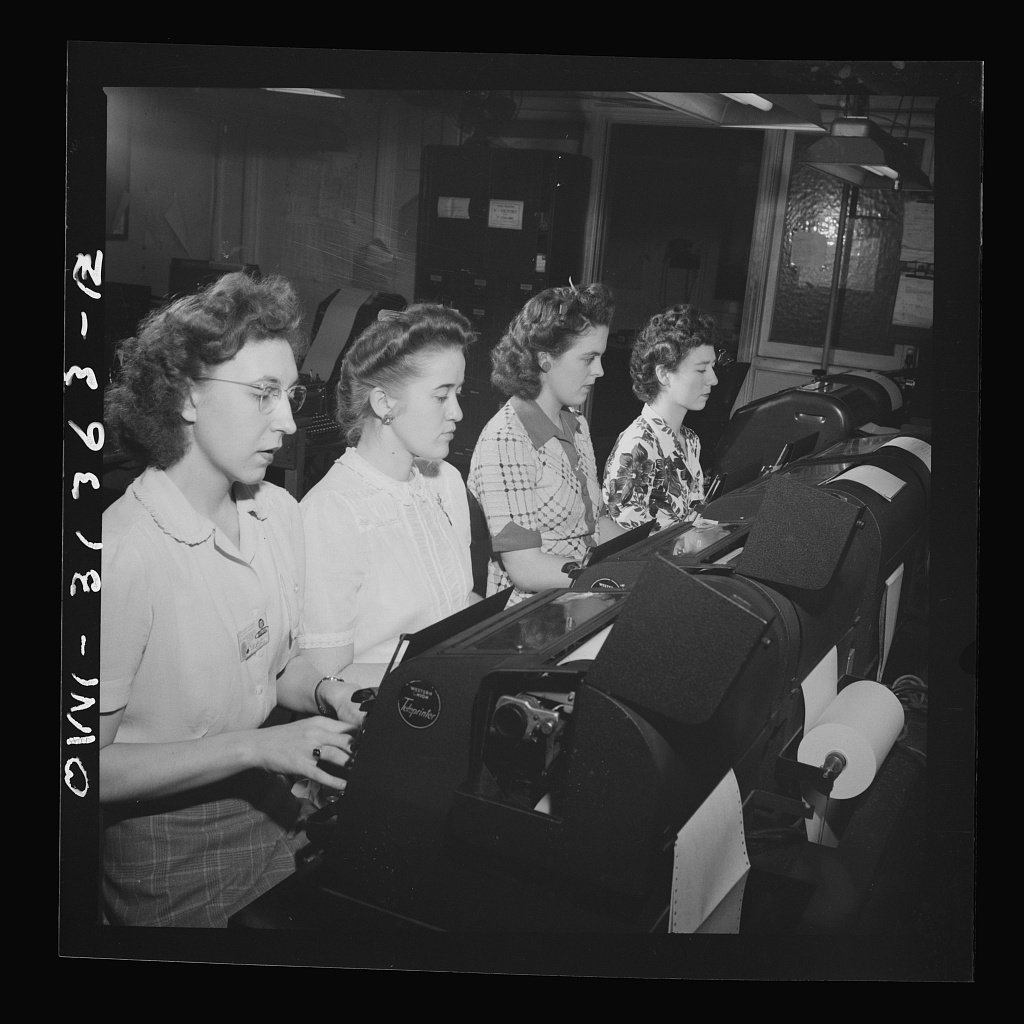
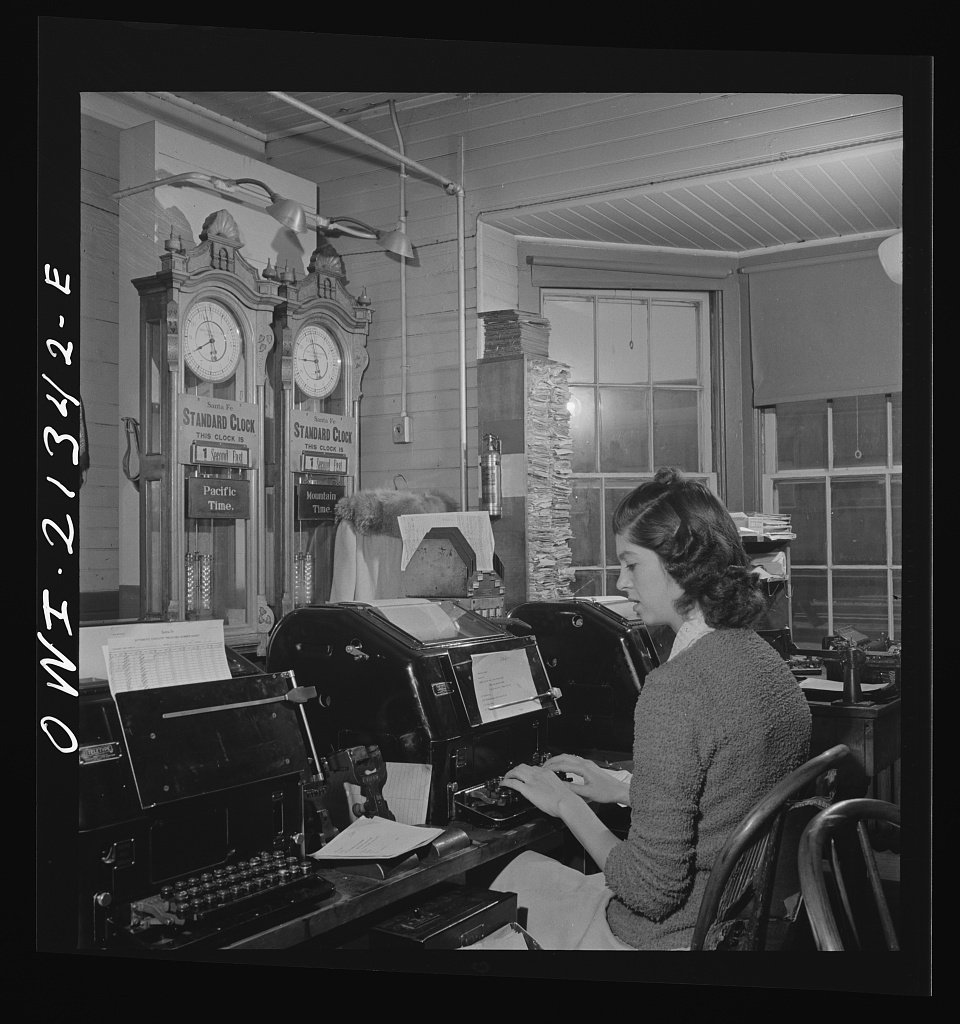
1.6 The war
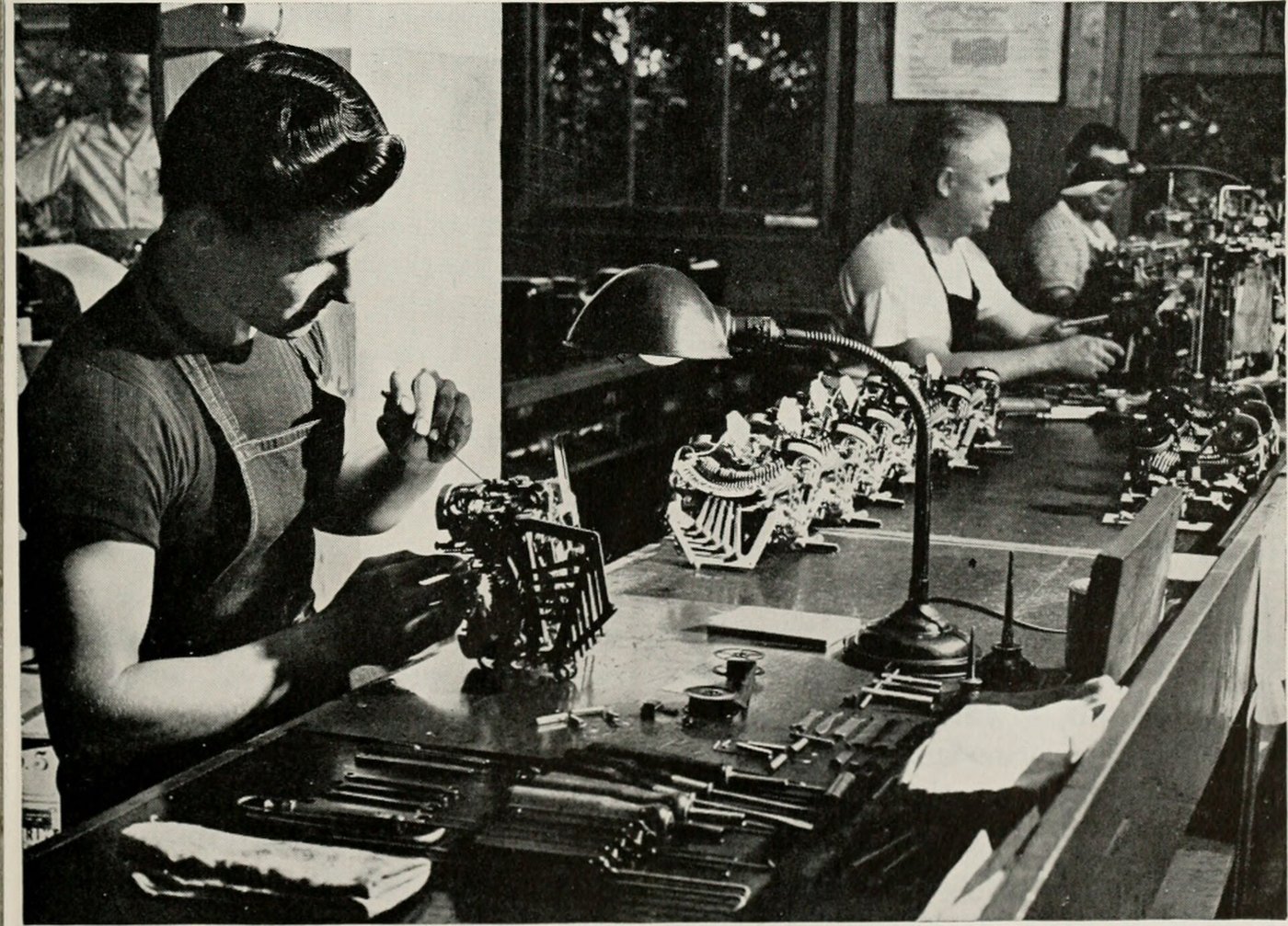
Teletype’s synopsis says that by 1941 “about 90% of all effort at Teletype was devoted to the war” (House 2001), and Wikipedia calls the Model 15 “the mainstay of U.S. military communications in World War II,” citing the Queensland Telecommunications Museum (Teletype Corporation). It was not a specialised military design. The Army and Navy bought the commercial machine, with commercial part numbers, and gave it their own names.
The Army Signal Corps called the keyboard machine Teletypewriter TG-7-A (or TG-7-B, which omitted some features not needed in tactical service). A Dutch collector’s listing of US Army telegraph equipment, drawn from period Signal Corps data, describes the TG-7-A as a page-receiving and keyboard-sending teletypewriter with the standard communications keyboard and type, a pulling-magnet selector and no line relay, and a series AC governed motor that would run on 25, 40 (TG-7-B only), 50 and 60 cycle mains at 115 V, or on 115 V DC, adjusted to 368 or 404 operations per minute with the proper tuning fork (PE1NGZ, “US Army telegraph equipment”). The same listing gives the TG-37-B as the weather version and a receive-only “TG-7 special.” The motor’s tolerance of almost any supply was the point: a field set had to run from whatever power the Army could find.
After the war the joint (Army-Navy) system renamed the sets. JANAP 161, the joint services’ Directory of Communication-Electronics Equipment, lists in its October 1956 change:
Table 2 — After the war the joint (Army-Navy) system renamed the sets. JANAP 161, the joint services' Directory of Communication-Electronics Equipment, lists in its October 1956 change
| Nomenclature | What it is | Manual |
|---|---|---|
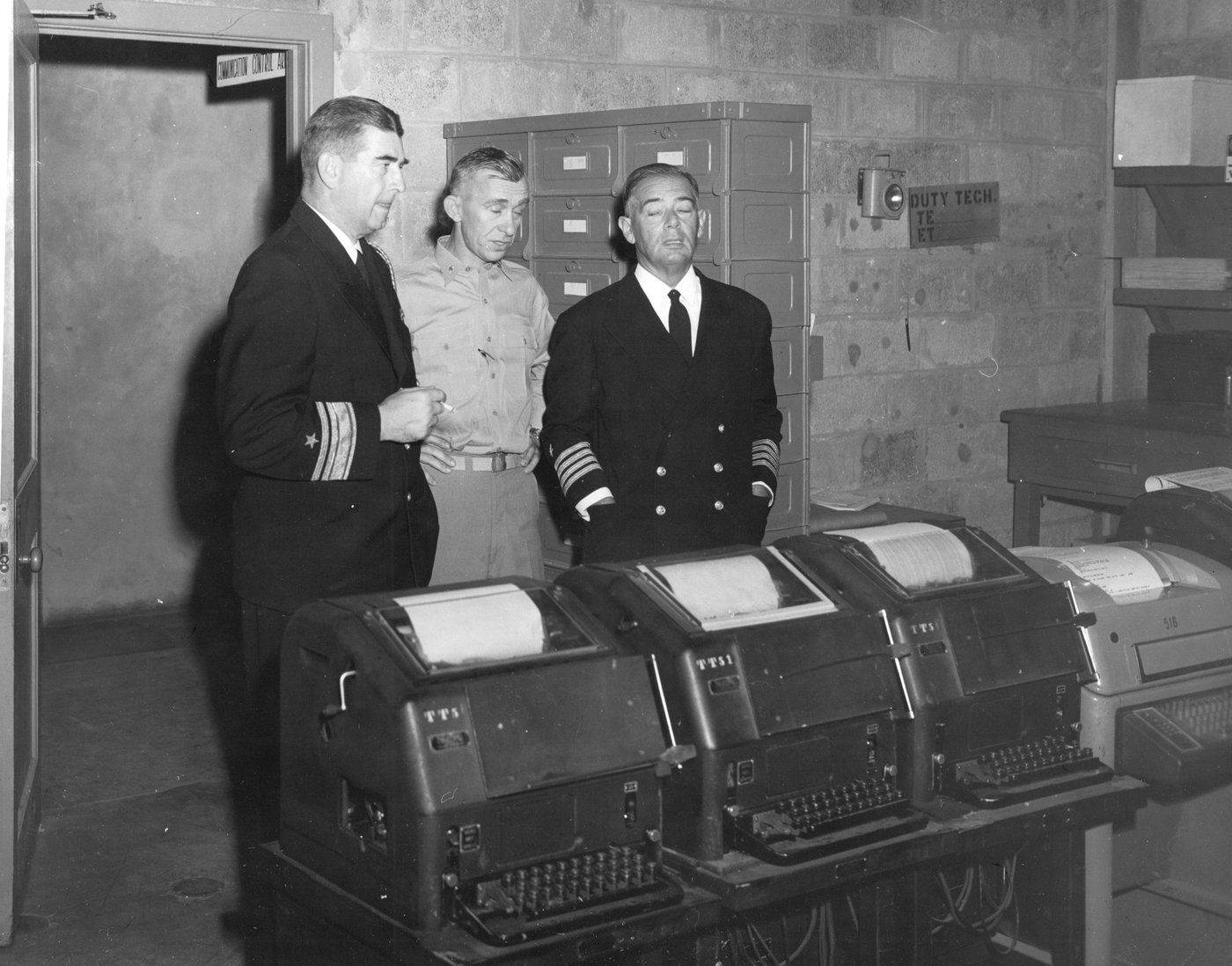
| TT-5/FG | Model 15 KSR station: printer, table XRT115, rectifier REC 29 | TM 11-2215 |
| TT-6/FG | The same with weather keyboard and type pallets | TM 11-2215 |
| TT-7/FG | Model 19 set (Model 15 with tape perforator and a Model 14 TD) | TM 11-2216 |
| TT-8/FG | Weather version of the TT-7/FG | TM 11-2216 |
| TT-51/FG | Model 15 receive-only page printer, Navy shore stations | not listed |
Source: JANAP 161, Change 1, October 1956, Part 2, pp. 161–168 and 191. Other Model 15 shipboard variants, the TT-49/UG and TT-50/UG, appear in the RadioNerds nomenclature list as “Teletype Model 15 modified for shipboard service” (RadioNerds).
The JANAP sheet for the TT-5/FG is the best single description of a military Model 15 that exists in print, and its numbers are worth having: 368.1 and 404 operations per minute (60 and 66 words per minute); an AC series-governed motor at 2,100 rpm; a set weight of 200 lb net, of which the printer alone is 112 lb, the table 39 lb and the rectifier 46 lb; and 255 lb packed for domestic shipment in four packages. The “remote control motor stop on upper case H” it lists among the operating functions is the feature that let a distant station shut down an idle printer by sending FIGS-H.
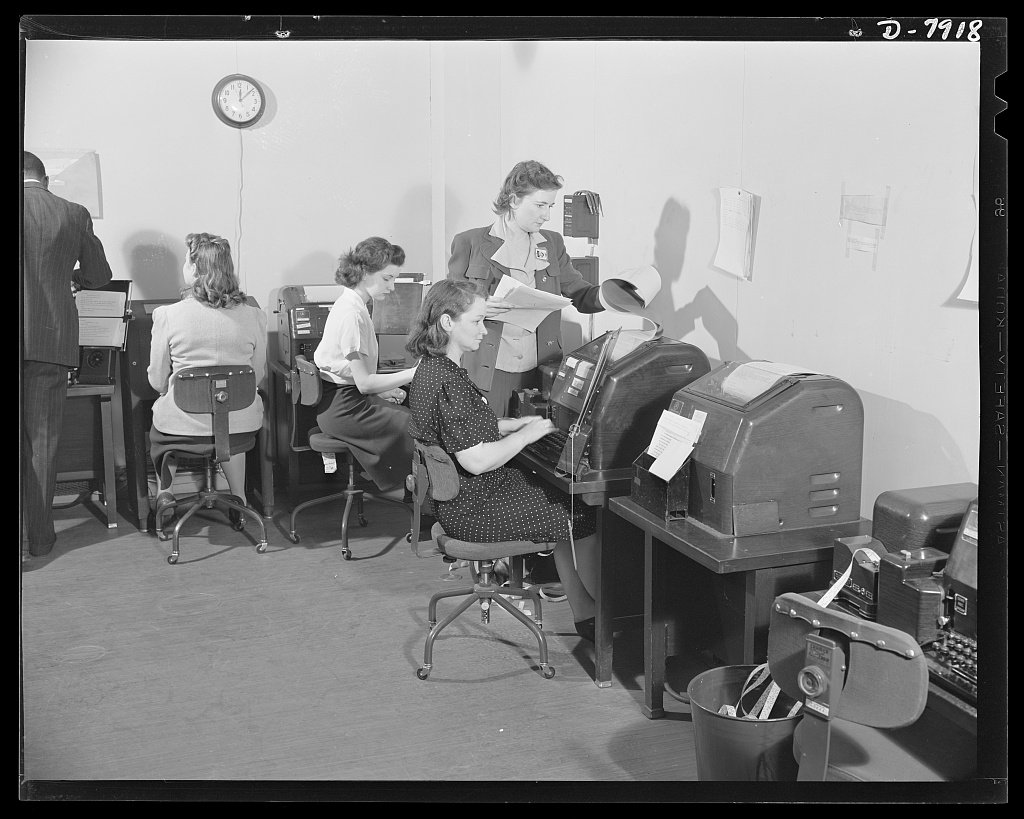
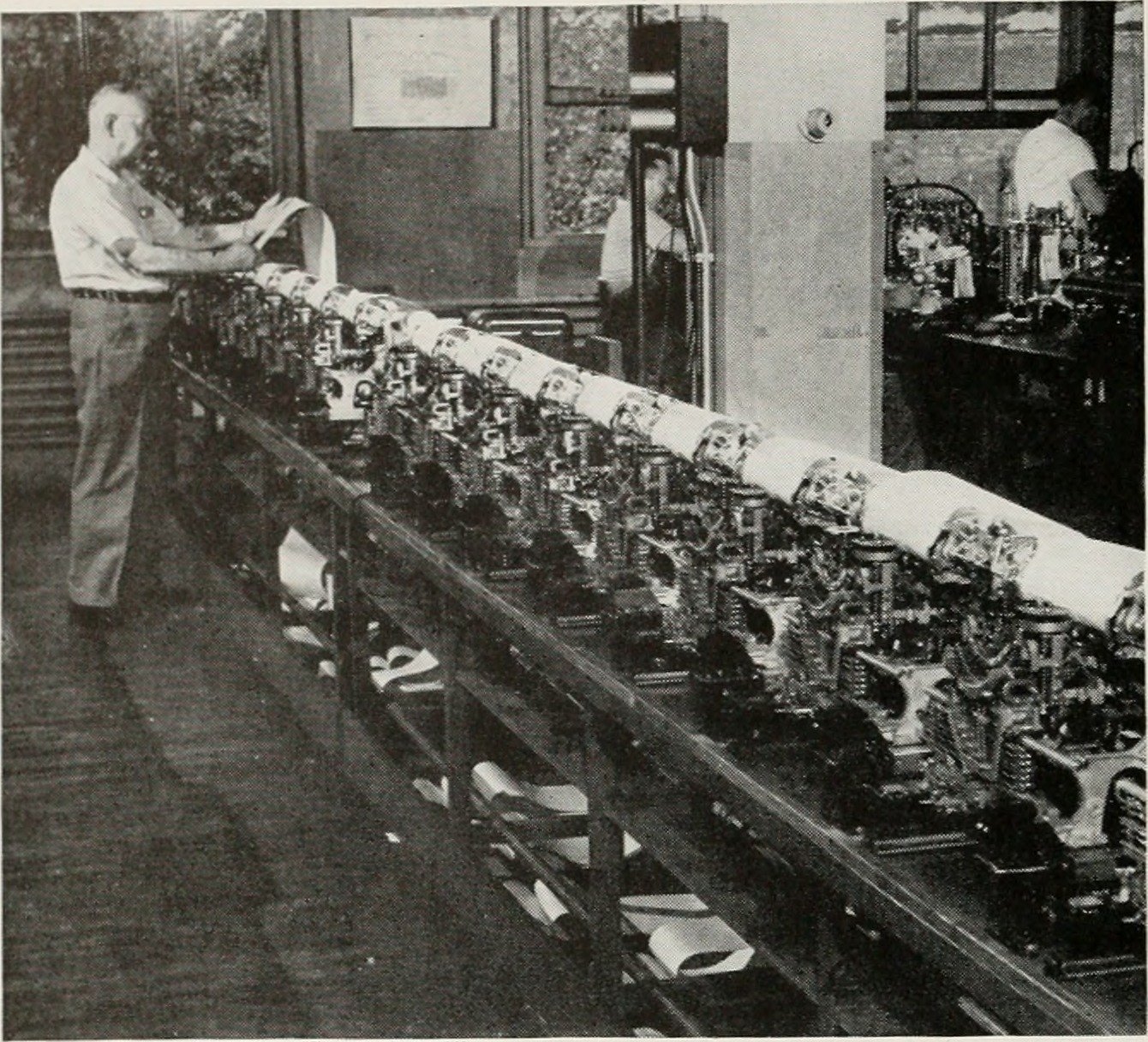
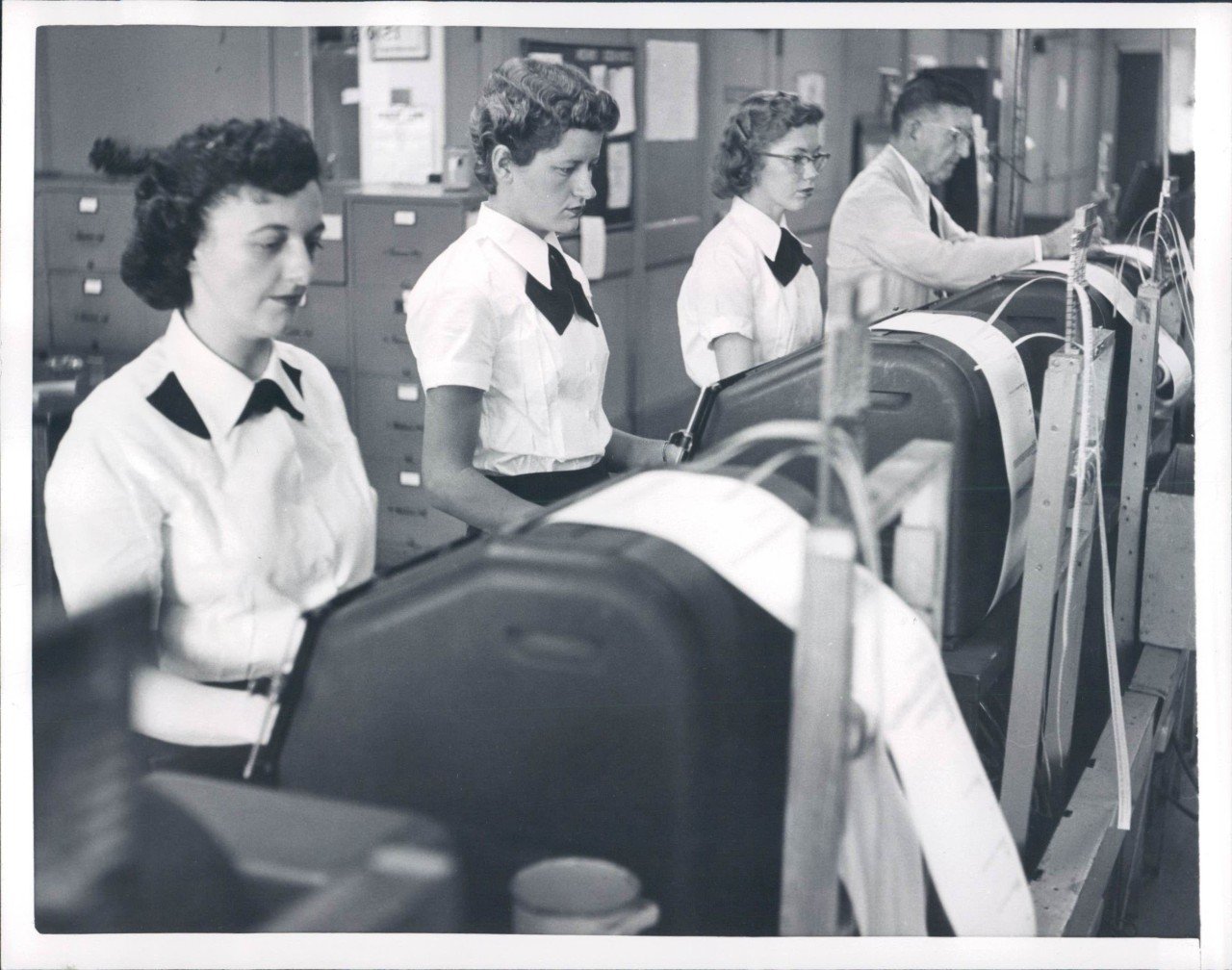
The military Model 15 outlived the war that made it. It served through Korea and into Vietnam (the Taipei Signal Army history’s title for it is “the machine that was used in two wars”), and navy-radio.com’s collection includes a 1956 photograph of Navy WAVES with teleman ratings working a room of Model 15s in the 3rd Naval District communications centre in New York (navy-radio, “US Navy Teletype Equipment”).
1.7 The successor
Teletype’s synopsis dates the first Model 28 to 1951, delivered to the Navy after roughly twelve years of development, and records that in 1956 the Bell System accepted the 28 as the successor to the 14, 15 and 19 lines (House 2001). Inside the Teletype Mechanism compares the two designs. The Model 15 nonetheless went on being made. The usual end date is 1963, which gives the oft-quoted figure of 33 years of continuous production; Wikipedia states it without a citation, and I have not found a primary source for the exact year. The synopsis’s 200,000 figure stops at 1954, so the true total is somewhat higher, by an unknown amount.
1.8 After the war: the hams
The Model 15’s second career began when it became surplus.
Radio amateurs were not allowed to use teleprinters at all before the war. The first two-way amateur radioteletype contact on record took place in May 1946, reported in QST in October 1948. The FCC amended its rules effective 20 February 1953 to permit frequency-shift keying in the non-voice parts of the 80, 40 and 20 metre bands; the original rules specified a wide 850 Hz shift, and in 1956 the FCC allowed any shift of 900 Hz or less, which opened the way to the narrow 170 Hz shift that became the amateur standard (Wikipedia, “Radioteletype”, citing Kretzman’s New RTTY Handbook and QST). The RTTY Society of Southern California ran the first RTTY contest from 31 October to 1 November 1953, and the magazine RTTY, later RTTY Journal, carried the hobby’s news and its first callbooks.
The machines came from wherever amateurs could get them. Wikipedia says US hams started with obsolete Model 26 equipment, and the Model 12, already out of date, was common; as the military and the Bell System retired their Model 15s, those followed. A sales notice reproduced on rtty.com records that the telephone company released a number of Model 15s to RTTY, Inc. “to sell to licensed amateurs,” and goes on to explain to the new owner how to wire the selector for 60 mA, set the speed gears for 60 words per minute (gears 74912 and 74913), use the unshift-on-space lever to stop static from leaving the printer stuck in FIGURES, and reach the range finder through a small door on the left of the cover (rtty.com, “Model 15 Teletype”). The notes are kept on RTTY.COM, the non-commercial radio-teletype archive founded by George Hutchison W7TTY in 1998, which Volume 5 describes. That document is the hobby in miniature: a heavy machine built for the telephone company, a terminal unit built at home, and an operator learning the machine’s adjustments one at a time.
RTTY on the Air tells the operating side of that story: the terminal units, the tones and the crossed-banana tuning scope. The rest of this dive is about the machine on the end of the loop.
1.9 A note on names
The machine is often called a “Model 15 teletype,” with a small t. Teletype was the company’s trademark, and the generic word is teleprinter (the British and international usage) or teletypewriter (the Bell System and US military usage, abbreviated TTY). Teletype’s own literature calls a complete machine a teletypewriter and the printing mechanism a typing unit; the military calls a station set a teletypewriter and gives it a TT- or TG- nomenclature. This dive uses Model 15 for the machine, typing unit, keyboard, base and motor unit for its parts, and the TT- and TG- names where a document uses them.
1.10 Where this leaves a would-be owner
The history explains most of what a buyer finds today. There are many Model 15s because Teletype built them for thirty years and the government bought them by the tens of thousands. They come in several versions (KSR and RO, communications, commercial and weather, governed and synchronous motors, pulling and holding selectors, 60, 66, 75 and 100 words per minute) because one basic design was adapted for every customer. They are robust because they were built for unattended twenty-four-hour service. And there is a large body of documentation (Teletype bulletins, Bell System Practices, Army technical manuals and Navy publications) because every one of those customers wrote its own. Volume 3 sorts the versions out. Volume 2 comes first, because nothing about the variants makes sense until the machine itself does.
1.10.1 Sources (Vol 1)
- Teletype corporate chronology — Don Robert House, A Synopsis of Teletype Corporation History (NADCOMM, 2001): Krum’s 1902 experiments and the Morton backing; Morkrum Company 1906; the Alton Railroad trial (1908), Postal Telegraph (1910) and Western Union (1912) sales; AP adoption 1915; Model 11 (1921, 883 sold; origin of the “Teletype” name and scroll); Model 12 (1922, moving platen, 11,899 sold); Model 14 (1925, about 60,000); the 1925 merger; the 1929 name change; the Model 15 introduced 1930, “bread and butter”, peak output during WWII, about 200,000 sold through 1954, many TWX stations of M15 vintage; the 1930 Bell System purchase and TWX; 90% of effort to the war by 1941; Models 19 and 20; the first Model 28 delivered to the Navy in 1951 and accepted as successor to the 14, 15 and 19 lines in 1956. http://simson.net/ref/2001/house-teletype-corp-synopsis.pdf ⟨the synopsis’s claim that Krum “perfects the 5-unit ITA-2 code” is corrected in the text⟩
- Howard Krum and the start-stop method; the patent conflict and merger — R. A. Nelson, ed. K. M. Lovitt, History of Teletypewriter Development (Teletype Corporation, October 1963), as posted to Usenet by Jim Haynes in 1991. https://landley.net/history/mirror/pre/nelson.htm
- The 1930 purchase for $30,000,000 in stock; Bulletin No. 144 (1931); Kleinschmidt’s 1916 type-bar page printer application (US 1,448,750); “mainstay of U.S. military communications”; the 1963 end date — Wikipedia, “Teletype Corporation,” and its citations (Fortune, March 1932; Queensland Telecommunications Museum). https://en.wikipedia.org/wiki/Teletype_Corporation ⟨1963 is stated there without a citation⟩
- The Model 15 patent — US 1,904,164, Signaling system and apparatus therefor, S. Morton, H. L. Krum and E. E. Kleinschmidt, filed 11 July 1930, granted 18 April 1933. https://patents.google.com/patent/US1904164A/en
- Military nomenclature and specifications — Joint Communications-Electronics Committee, JANAP 161, Directory of Communication-Electronics Equipment, Change 1 (October 1956), Part 2: TT-5/FG, TT-6/FG (TM 11-2215), TT-7/FG and TT-8/FG (TM 11-2216), TT-51/FG; speeds, motor, weights. https://navy-radio.com/manuals/janap161-5610-Part2.pdf ⟨staged for the Library⟩
- TG-7-A/B, TG-37-B and TG-7 special — PE1NGZ, “Signals Collection: US Army telegraph equipment.” https://www.qsl.net/pe1ngz/army/army-us/us-telegraph.html
- TT-49/UG and TT-50/UG — RadioNerds, “TT - Teletype.” https://radionerds.com/index.php/TT_-_Teletype
- Amateur RTTY dates (first QSO May 1946; FSK on 80/40/20 m from 20 February 1953; ≤900 Hz shift from 1956; first contest 1953; RTTY magazine; Model 26 surplus) — Wikipedia, “Radioteletype,” and its citations (Kretzman 1962; QST 1948, 1949, 1954). https://en.wikipedia.org/wiki/Radioteletype
- RTTY, Inc. sales notes for amateur buyers (released by the telephone company; 60 WPM gears 74912/74913; unshift on space; range-finder door; terminals) — George Hutchison W7TTY and Bill Bytheway K7TTY, rtty.com, “Model 15 Teletype” (2011). https://rtty.com/development/teletype/model-15/index.html
- “The machine that was used in two wars” — Taipei Signal Army blog, January 2015. https://taipeisignalarmy.blogspot.com/2015/01/the-model-15-by-teletype-corporation.html
- Cross-links: The Teletype Model 28 (its successor, a sibling dive); Teletype Machines (the code’s lineage, the Model 19, 28 and 33); Inside the Teletype Mechanism (BSP P70.013); RTTY on the Air.