The Military Auxiliary Radio System · Volume 4
MARS — Vol 4: Desert Storm to Afghanistan, and the Mission Today
E-mail and cell phones took away the morale traffic. What was left was the reason MARS existed in the first place: a radio network that does not need the internet.
4.1 1975–1989: the quiet years that weren’t
After Vietnam, MARS went back to its day job of nets, drills and the odd emergency, and the emergencies kept coming. The Air Force’s own record (Morrison, Air Force Magazine, April 1989) lists a few:
- Operation New Life, April 1975. As Saigon fell and refugees were flown out through the Pacific, the Hickam station in Hawaii handled 497 radioteletype messages and 114 phone patches.
- Tehran, 14 February 1979. Andrews AFB MARS held a radio link to Iran on the day the U.S. embassy was first overrun.
- Hurricane Elena, 1985. The Keesler AFB MARS station stayed on the air.
- Mexico City earthquake, 1985. Robins AFB MARS gave the State Department its first word of the disaster.
In 1989 Air Force MARS counted about 300 military stations and 3,000 affiliates, working voice, CW and RTTY. This is the system I joined at Iwakuni in 1986. Volume 5 has that part.
4.2 Desert Shield and Desert Storm, 1990–91
The Gulf War was the last great surge of MARS morale traffic, and the Tampa Bay Times caught it in March 1991 (Dawn Cate, “Small radio operators keep troops in touch,” 5 March 1991):
- Army MARS then had about 200 military stations and 4,000 amateurs.
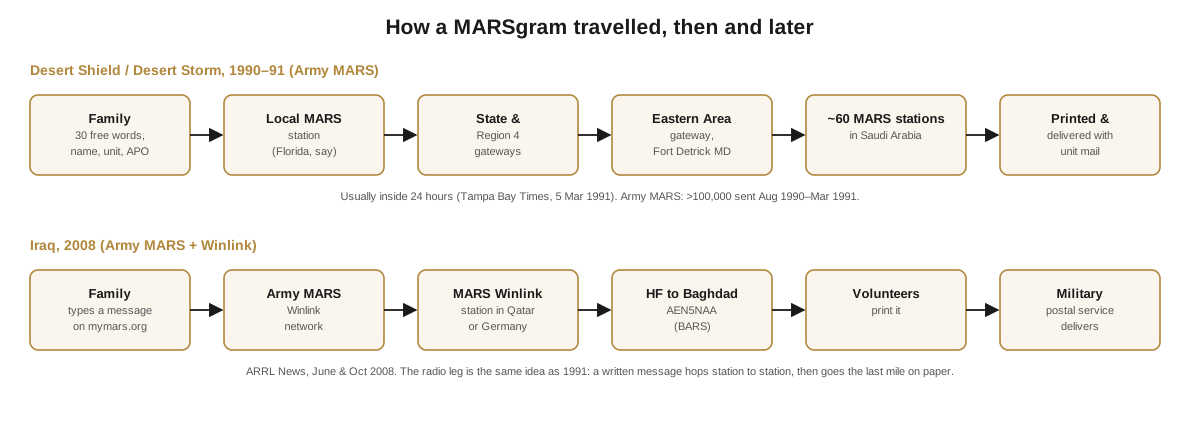
- Since August 1990 it had sent more than 100,000 free 30-word “MARS radiograms” to about 60 MARS stations in Saudi Arabia, usually arriving within 24 hours.
- In Florida alone the traffic ran about 2,700 MARSgrams in December 1990 and 3,200 in January 1991. One Clearwater operator went from six messages a day to as many as 150.
A soldier’s mother told the paper why families used it: “We knew that these would eventually get through… and that the mail could take months.”
The Marines set up their own station. The official history of Marine communications in the Gulf records that the communication platoon of Regimental Combat Team 3 set up a MARS station in early October 1990, handling short radio and message calls home to Hawaii, and that it was “highly popular” (U.S. Marines in the Persian Gulf, 1990–1991).
4.3 The 1990s: consolidation
During the 1990s the Army pulled its scattered post stations together. As Army MARS’s operations chief later put it, every installation once had a MARS station, and in the 1990s they were consolidated at Fort Huachuca, Arizona (army.mil, 2009). The gateway station there, AAA9USA, became the hub of Army MARS.
At the same time the internet was arriving, and with it the beginning of the end for the morale MARSgram. As one Army MARS spokesman said in 2008, MARSgrams “declined with the rise of e-mail and cell phones” (ARRL, June 2008).
4.4 Iraq, Kuwait and Afghanistan
The public record of MARS in the post-2001 wars is thin, much thinner than Vietnam’s. Most of what was done was done quietly, by small teams, at camps whose names were not printed. Here is what the record does show.
2003. A Florida MARS page reported the first MARS licences issued to soldier stations in Iraq and Kuwait, four of them by 1 June. These were to provide MARSgram and phone-patch service “beyond the reach of e-mail” (flmars.org, now offline; a single hobby source).
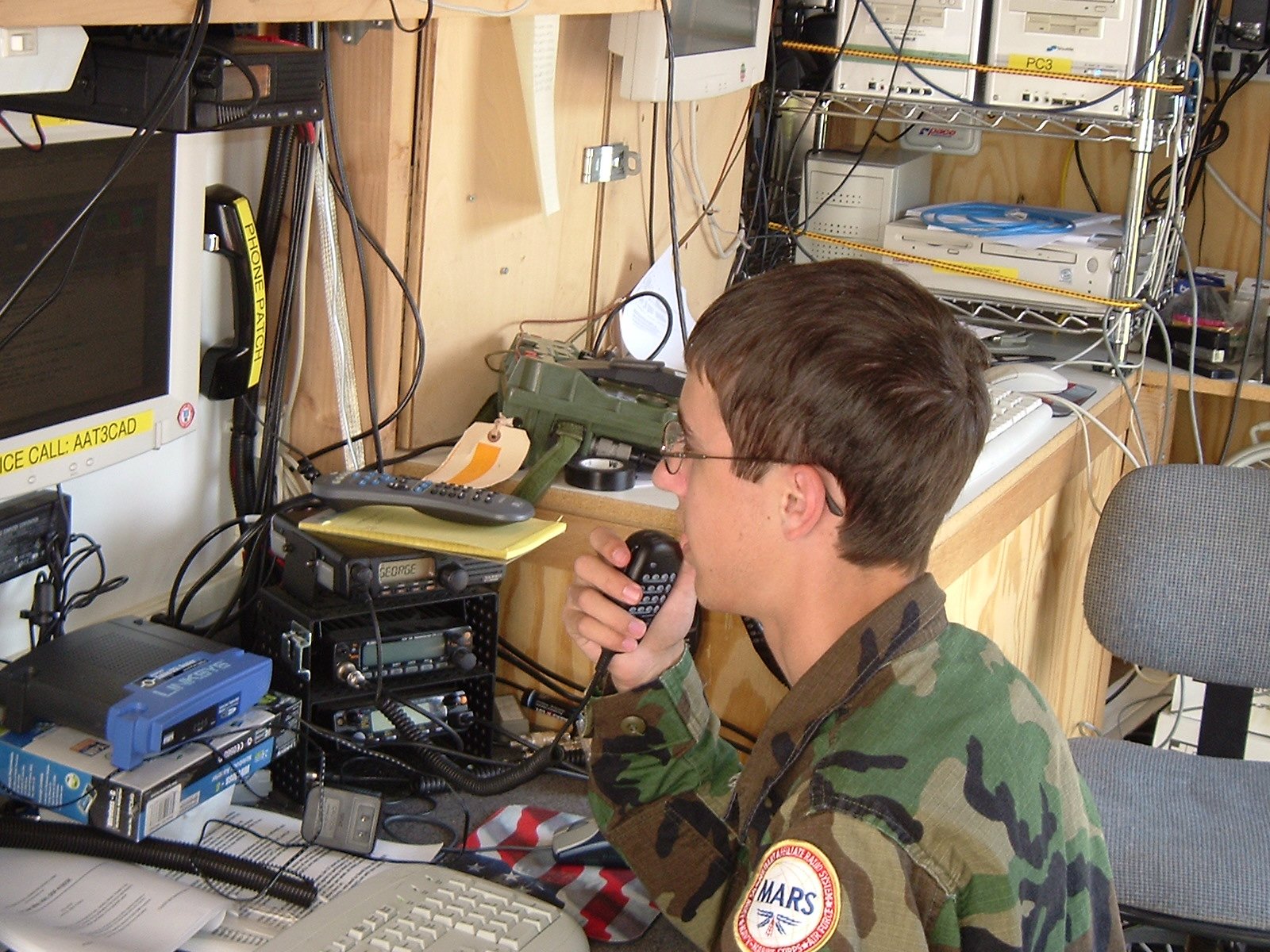
Baghdad, 2008. The Baghdad Amateur Radio Society ran an Army MARS station under the callsign AEN5NAA. Its custodian in 2008 was Capt. Jeff Hammer of the Indiana National Guard, who had served in Afghanistan before. It handled MARSgrams relayed through MARS Winlink stations in Qatar and Germany, on donated gear: an Icom IC-7000, a Kantronics KAM XL, a RIGblaster Pro and a Cushcraft beam (ARRL, 1 Oct 2008). For Father’s Day 2008, Army MARS invited families to type messages on its website. Winlink carried them to Baghdad, where volunteers printed them and handed them to the military postal service. Hammer made the hop to the Qatar station, AEN3QT, on 40 metres with a 5-watt Yaesu FT-817. “God must have been smiling down on us,” he said (ARRL, June 2008).
Hurricane season, 2008. When hurricanes hit the Gulf states that September, MARS carried health-and-welfare traffic to soldiers from those states serving in Iraq (ARRL, Sep 2008).
Afghanistan and Kuwait. This research found no public, sourced account of specific MARS stations at camps in Kuwait or Afghanistan in 2008–2012, and no first-person account from one. The stations existed; I worked several of them. The record is the gap Volume 5 starts to fill.
A MARS official at the Pentagon put the change in one sentence when the station there moved into a new office in 2009: “In the years before the Internet, deployed servicemembers kept in touch… using MARS” (DVIDS, 2009). Even then, a voice on the radio was still worth something to the person in the chair. I saw that again and again.
4.5 2009: “Affiliate” becomes “Auxiliary”
On 23 December 2009 DoD issued Instruction 4650.02, replacing the old directive. It renamed the program the Military Auxiliary Radio System. Some sources date this to 2010; that is wrong. DoD defines a military auxiliary as “an organized body of volunteers prepared to supplement the uniformed services,” like the Civil Air Patrol and the Coast Guard Auxiliary, and the new name put MARS in that company. The 2009 instruction also required MARS stations to operate “radio-only,” without landlines or internet, on emergency power, with some transportable stations (ARRL).
Hurricane Katrina in 2005 drove much of this. Army MARS leaders said plainly that the coordination that worked for Hurricane Gustav in 2008, with about 850 volunteers on standby, Winlink e-mail linking emergency operations centres, and the Fort Huachuca gateway, was “what was missing when Hurricane Katrina happened” (Texas Military Department, 2008). After Superstorm Sandy in 2012, Region 2 operators relayed traffic from an AT&T building in Middletown, New Jersey (army.mil).
4.6 2015: the end of Navy-Marine Corps MARS
My own branch of MARS is gone. A shutdown was announced in May 2009 and then reprieved. In May 2015 a message from the program’s headquarters station announced that Navy-Marine Corps MARS would end on 30 September 2015. Fleet Cyber Command and the Navy’s communications commands had evaluated it and found “no U.S. Navy service-unique requirements.” Members and clubs were invited to join Army or Air Force MARS, and Army MARS said volunteers in good standing would transfer as full members (ARRL, May 2015). An unnamed source told the ARRL that Army MARS had been made the lead for contingency communications, and that Iraq and Afghanistan had shown how much HF still mattered on land.
4.7 MARS today
The current rulebook is DoD Instruction 4650.02, reissued 20 December 2021 under the DoD Chief Information Officer (DoDI 4650.02). Its list of functions shows how far the emphasis has moved:
- HF radio that does not depend on infrastructure;
- support to civil authorities through U.S. Northern Command and Indo-Pacific Command;
- humanitarian assistance and disaster relief for the combatant commands;
- phone patch as a backup to the military’s HF Global Communications System, for “emergency situations, conducting official business, and morale calls”;
- serving as “the Services’ primary interface with amateur radio operators”;
- support to mission-critical infrastructure, contingency communications and continuity of operations.
The phone patch survives in the rules, and in practice: in 2025 Air Force MARS said it still runs about 1,000–1,500 aircraft phone patches a year from six ground stations on the air daily (DVIDS, July 2025).
Modes. CW and the old teletype are gone from daily use. The instruction requires stations to operate “radio only” using the military HF data-modem standard MIL-STD-188-110. In 2017 Army MARS made the serial-tone modem (M110A) its principal digital mode, added online encryption for digital traffic, and expanded automatic link establishment (ALE) as an option (ARRL, Feb 2017).
Working with hams. On the 60-metre amateur channels, MARS and amateurs hold monthly interoperability nets. Large communications exercises imagine the worst. In November 2016 the scenario was a “very bad day” nationwide outage (ARRL). The November 2017 exercise simulated a coronal mass ejection; nearly 2,000 amateur stations took part and sent in 3,025 county situation reports (ARRL). In 2018 the Iowa National Guard’s Exercise Stable Mercury put military, MARS and ham stations on a common digital mode for the first time, using sound-card software written by MARS volunteers (ARRL). Civilian agencies cannot affiliate with MARS; the instruction points them to the Department of Homeland Security’s SHARES HF program instead.
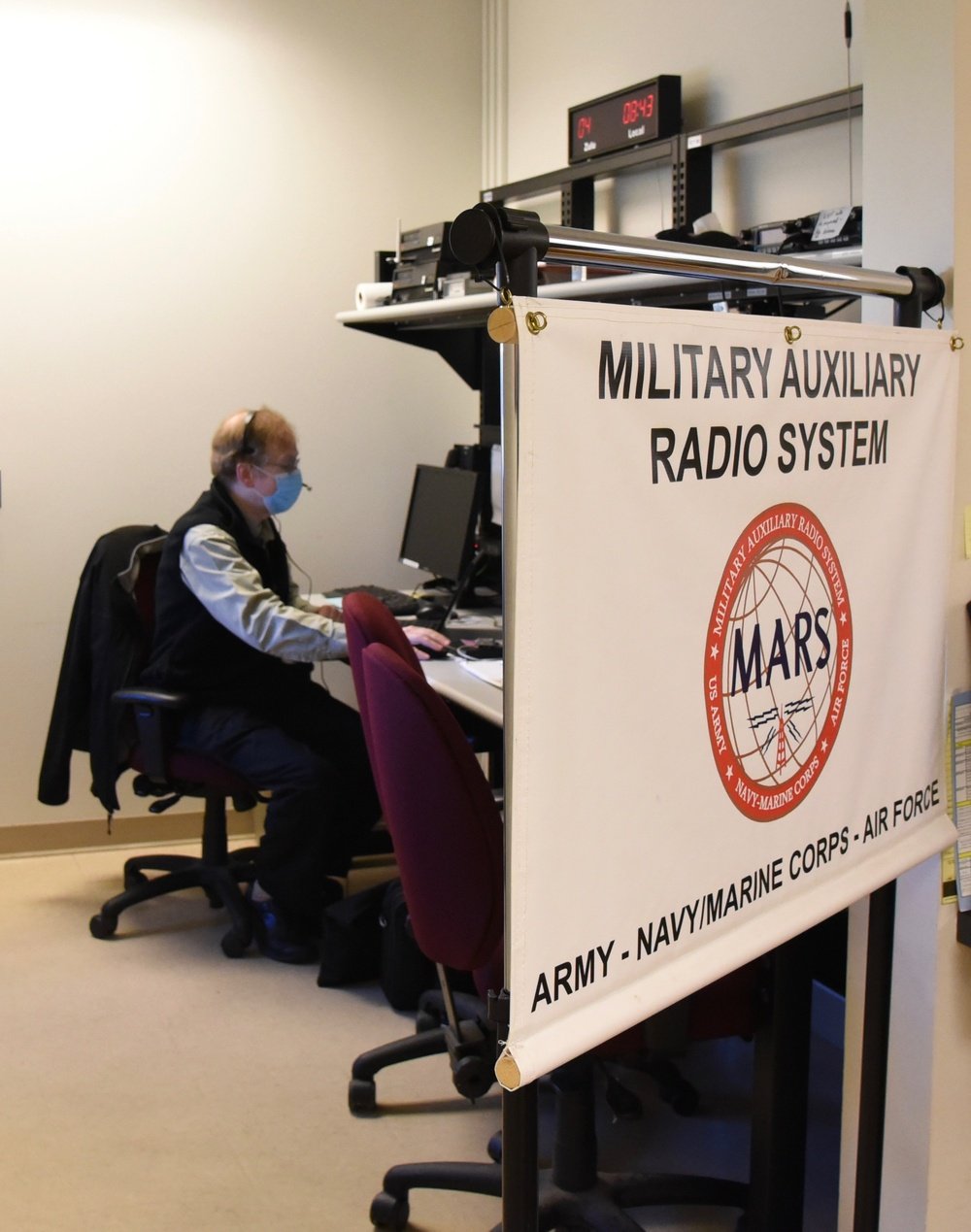
Who can join. Under the 2021 instruction a member must be at least 18, a U.S. citizen or lawful permanent resident, and hold a valid FCC amateur licence, and must keep up the service’s training and on-air hours. Army MARS today accepts any licence class, requires a background check and a non-disclosure agreement, and expects a 100-watt HF station covering 2–30 MHz with a computer for the data modes. It provides no equipment (Army MARS). Air Force MARS, under Air Combat Command at Scott AFB, had about 500 volunteers in 2025.
4.8 Myths this volume corrects
Table 1 — Myths this volume corrects
| You may read | The record says |
|---|---|
| MARS was founded in 1925 / is 100 years old | The Army Amateur Radio System began in 1925. MARS dates from 1948. |
| MARS was founded as the “Affiliate” Radio System | It was the Military Amateur Radio System until 2 Sep 1952 (QST, Nov 1952). |
| Renamed “Auxiliary” in 2010 | 23 Dec 2009, DoDI 4650.02. |
| Navy-Marine Corps MARS ended in 2009 | Announced 2009, reprieved; ended 30 Sep 2015. |
| Phone patches are history | Still in the 2021 DoDI; Air Force MARS runs ~1,000–1,500 aircraft patches a year. |
| MARS carried the Red Cross’s death notices | The 1987 rules forbade initial death/serious-illness notices and sent them to the Red Cross (Vol 3). |
| Curtis LeMay founded Air Force MARS | He was a ham and an SSB enthusiast; no source shows he founded or ran MARS. |