The Military Auxiliary Radio System · Volume 2
MARS — Vol 2: How It Worked — Phone Patches, MARSgrams and Nets
A radio link that only goes one way at a time, a telephone line that goes both, and an operator in the middle saying \"over\" for two people who have never used a radio.
2.1 The source for this volume
Most descriptions of MARS operating come from memory, mine included. This volume leans on something firmer: MCI 25.62, The MARS Operator, published by the Marine Corps Institute in Arlington, Virginia, on 2 April 1987. It was written “to provide instruction to all operators of the Navy-Marine Corps Military Affiliate Radio System,” rated at ten study hours, and reviewed by the Chief of Navy-Marine Corps MARS at the Naval Communication Unit, Washington (scan at navy-radio.com; Library copy). It is the course I took at Iwakuni, and it is the same edition: the worked examples in it are dated October and November 1986.
The course was not strictly a gate to membership. It says a trial member’s 90 days of required training “may consist of completing this course and participation in on-the-air training nets.” But it was the Marine Corps’ own way in, and it ends with a certificate.
Its rules are Navy-Marine Corps rules as of 1987. Army and Air Force MARS ran on the same principles with their own manuals, and the details changed over the decades.
2.2 The mission, as the course put it
The 1987 text states the mission in one sentence: “to provide Department of the Navy sponsored emergency communications on a local, national, and international basis as an adjunct to normal naval communications” (§1201). The functions that follow include “morale and quasi-official record and voice traffic for armed forces and authorized U.S. Government civilian personnel assigned throughout the world,” training members in naval procedure, and keeping “a potential reserve of trained radio communications personnel for military duty” (§1202).
Then comes the line that explains the whole program: “The primary concept of day-to-day traffic passing and phone patching operations is to train for emergency communications” (§1203). The phone patches that meant so much to families were also the drill. The three requirements, in order, were Reliability, Security, and Speed, and “Reliability is always paramount. It must never be sacrificed to achieve security or speed.”
2.3 The phone patch
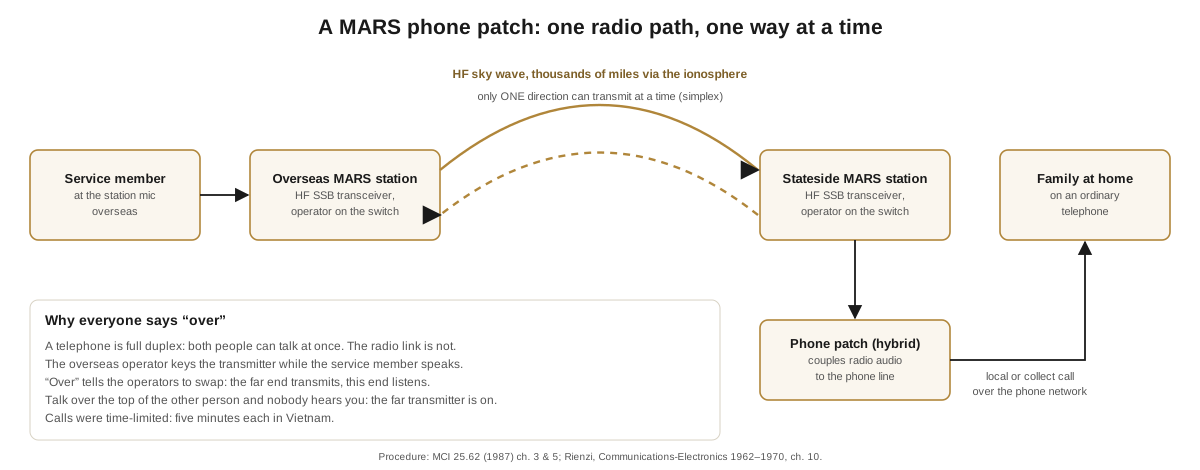
A phone patch joins two different kinds of circuit. A telephone line is full duplex: both people can talk at once, and each hears the other interrupt. A high-frequency single-sideband radio link between two MARS stations is simplex: one frequency, one transmitter on at a time. While the far end is transmitting, you cannot be heard, and while you are transmitting, you cannot hear.
So the call needs operators. At the overseas station the operator puts the service member on the microphone and keys the transmitter while they talk. At the stateside station a second operator connects the receiver audio to a telephone line through a hybrid, the patch, which couples the radio’s audio into the phone line and the phone’s audio back to the transmitter without feeding one into the other. The stateside operator usually places the call as a collect call, or a local call where the station was near the family. Each time a speaker finishes, they say “over,” and the operators swap: the far station transmits and this one listens. In Vietnam the Army limited calls to five minutes, and the quality rose and fell with the ionosphere (Rienzi, Communications-Electronics 1962–1970, ch. 10).
Nobody who has used a phone all their life says “over” naturally. People talk over each other, then hear nothing, then both stop, then both start again. Part of the operator’s job was to coach the caller before the call and to keep the rhythm going during it.
2.3.1 Phone patches were monitored, and callers were told so
The 1987 course spells out a rule that surprises people. Every MARS phone patch was subject to periodic COMSEC (communications security) monitoring, and “use of MARS constitutes consent to such monitoring.” Each station kept a signed consent form from every user for a year. Before connecting a patch, the operator had to tell the caller aloud that “MARS communications are subject to periodic COMSEC monitoring and that the use of MARS constitutes consent to that monitoring,” wait for an acknowledgement, and log it. A sign saying so hung in full view at the station (§3510).
Along with that went a list of things a caller could not say, which applied to messages and patches alike (§3502): nothing about military operations; nothing on unit designation, strength or logistics; nothing on the location and movement of units, ships, aircraft or people; no casualty information from enemy action; and no business. And nothing to ships at sea, because ships moved.
2.3.2 Was it legal?
Through the 1950s and much of the 1960s, the telephone company’s tariffs forbade connecting “foreign attachments” to its lines, and a phone patch was exactly that. A former Navy-Marine Corps MARS operator, Hugh Tinley (K0GHK), recalled that subscribers risked having their phones pulled. He also recalled an unwritten understanding that the phone company would look the other way so long as QST played down phone-patch articles (Tinley memoir). That “unwritten deal” rests on his memory alone. The legal change itself is solid: the FCC’s Carterfone decision of 26 June 1968 opened the network to customer-owned devices that did no harm.
2.4 The MARSgram
A MARSgram was a short written message carried free of charge over MARS circuits and delivered by telephone or by mail. The 1987 form carries the line “THIS MESSAGE HANDLED FREE OF CHARGE BY A STATION OF THE MILITARY AFFILIATE RADIO SYSTEM.” The course’s rules (§4210):
Table 1 — A MARSgram was a short written message carried free of charge over MARS circuits and delivered by telephone or by mail. The 1987 form carries the line "THIS MESSAGE HANDLED FREE OF CHARGE BY A STATION OF THE MILITARY AFFILIATE RADIO SYSTEM." The course's rules (§4210)
| Rule (Navy-Marine Corps MARS, 1987) | |
|---|---|
| MARSgrams per user per day | 5 maximum |
| Length of a personal health-and-welfare text | 25 words maximum |
| Canned texts | Up to 3 Navy-Marine Corps abbreviated texts (NMAT) or ARRL numbered radiograms per message; “NMAT ONE” counts as two words |
| A full mailing address in the text | Counts as one word |
| Delivery | By phone if at all possible; otherwise copied onto a MARSgram form and mailed (§4211) |
| The original | Kept in the station file 6 months (§4212) |
Here is the course’s own example of a MARSgram prepared for transmission, dated November 1986, with its personal details shortened. It comes from a Marine on Okinawa, in the same Western Pacific area where I was operating:
R 161200Z NOV 86
FM CAPT BOB WALTON OKINAWA JA/NNN0... OA
TO MRS SANDY WALTON
   ... OCEANSIDE CA ...
BT
UNCLAS
I WILL BE HOME ON 7 DEC 1986. MORE INFORMATION TO FOLLOW BY LETTER.   BOB
BT
The header is standard military message format. R is the precedence (Routine), followed by the date-time group in Zulu time, then FM and TO. BT brackets the text, and UNCLAS marks it unclassified.
Other services ran slightly different limits: Army MARS in 1990–91 advertised free 30-word MARSgrams (Tampa Bay Times, 5 March 1991). Volume 4 follows a MARSgram from Florida to Saudi Arabia and another from a web form to Baghdad.
2.5 Three modes, one procedure
The 1987 course teaches radiotelegraph (CW), radiotelephone (voice) and radioteletype (RTTY) with the same message structure in all three, which is the Dots & Dashes thread running straight through MARS.
CW used the military prosigns. You answer a call with the caller’s sign, DE, your sign, and K: NNN0AAA DE NNN0AAB K. To break into a transmission you send a string of dashes. Errors are a run of Es, and IMI asks for a repeat. To net a group of stations, net control sends its callsign for 20 seconds followed by a 10-second dash so everyone can tune to it (§5103–5106).
Voice followed the same structure with prowords and the phonetic alphabet. MARS radiotelephone had its own signal reports: LOUD, GOOD, WEAK, VERY WEAK, FADING for strength, and CLEAR, READABLE, UNREADABLE, DISTORTED, WITH INTERFERENCE for readability. The course is firm: “Reports such as ‘Q-5’, ‘Five by Five’, etc., will not be used.” A good signal needed no report at all; “ROGER” alone meant loud and clear (§5201).
RTTY will be familiar to anyone who has read the teletype dives on this site. Every transmission opened with two LTRS, five spaces, two carriage returns and a line feed, and closed with two CRs, four LFs, NNNN and twelve LTRS. Lines were 69 characters at most. The bell was ten characters, JJJJJSSSSS. The test tape was the familiar QUICK BROWN FOX line, sent twice without a line feed between, so the second line overprinted the first and any garble stood out at a glance while saving paper. The course allowed “automated message processor, ‘home’ computer, or mechanical teletypewriter” in 1987, so the old machines and the new ones shared the nets (§5301–5303).
2.6 Nets, regions and the teletype backbone
Daily MARS life was nets: scheduled meetings on an assigned frequency under a net control station (NECOS), whose “decisions are final” on the air (§3104). Each net had a four-character designator built from region, area, sequence and type: B for traffic, C for training, V for voice, W for RTTY. So 5X1B was the first traffic net in the Fifth Navy-Marine Corps MARS Region (§3105).
Long-haul written traffic rode the MARS Radio Teletypewriter Relay System (MARSTELSYS), a chain of primary and major relay stations linking the regions. In 1987 the overseas end listed Japan, Okinawa, Korea, the Philippines, Guam, Midway, Diego Garcia, Cuba, Puerto Rico, Iceland and Antarctica (fig. 3-2/3-3). In the course’s region map, Japan and Okinawa are separate overseas areas, each with its own coordinator’s callsign.
MARS frequencies sit outside the amateur bands and are assigned “on a strict ‘Not to Interfere’ basis” with operational military users (§3402). Frequency monitors watched for off-frequency operation and sent offenders a MARS Monitoring Report, and repeated violations were grounds for termination.
2.7 Emergency teams
Though most MARS work was routine, the course ends on emergencies. It defines four communication conditions, from Condition III (an emergency expected within 48 hours: test the emergency power, find the flashlights) to an emergency actually under way (§6102). It also describes two kinds of team (§6103–6104):
- Auxiliary Radio Teams (ARTs): at least six members under a team captain, with portable VHF FM and HF CW/SSB gear and their own emergency power. They could be dispatched to a disaster or to support Navy disaster control. Each was numbered by region: ART 4-1, ART 4-2.
- Station Augmentation Teams (SATs): volunteers who came in to staff a military or relay station around the clock when traffic surged. Many affiliates ran one-person home stations, and an emergency station needed shifts.
Even the training messages in the back of the book are written like real ones. One asks “ART TEAM 5-1 TO REPORT FOR OVERFLOW PHONE PATCH COMMUNICATIONS.”