The Military Auxiliary Radio System · Volume 1
MARS — Vol 1: From the Army Amateur Radio System to MARS
In 1925 the Signal Corps asked the hams for help. A century later the arrangement is still running, under its third name.
1.1 What MARS is, in one paragraph
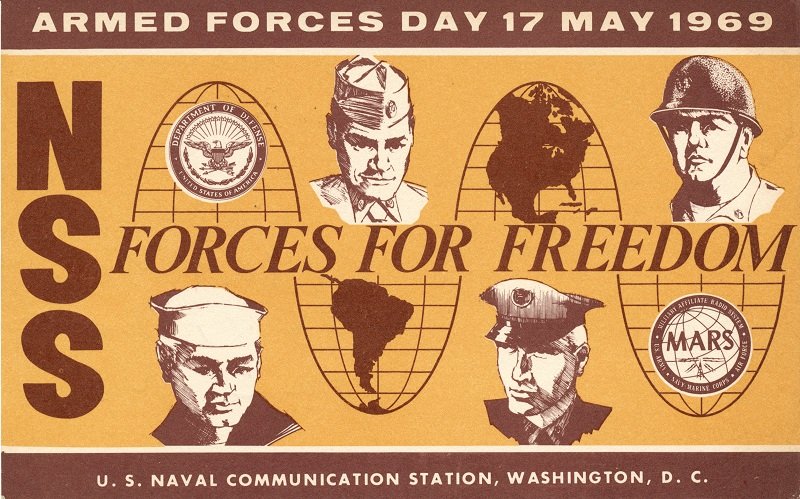
The Military Auxiliary Radio System is a Department of Defense program in which licensed amateur radio operators volunteer to run stations on military frequencies, under military procedure, alongside stations on bases and ships. For most of its life the public knew it for two things: the phone patch, which let a soldier, sailor, airman or Marine overseas talk to home over shortwave radio, and the MARSgram, a short free message carried the same way. Behind both sat the real purpose, written into every version of the rules: a trained reserve of operators and a radio network that would still work when the wires and satellites did not.
I was one of those operators. As an enlisted Marine at Iwakuni, Japan, in 1986 and 1987, I took the Marine Corps Institute course The MARS Operator and volunteered at the station off duty. Twenty years later, as a civilian contractor, I worked MARS stations again in Kuwait, Iraq and Afghanistan. Volume 5 tells that story. This volume covers how the system began.
1.2 1925: the Army asks the hams
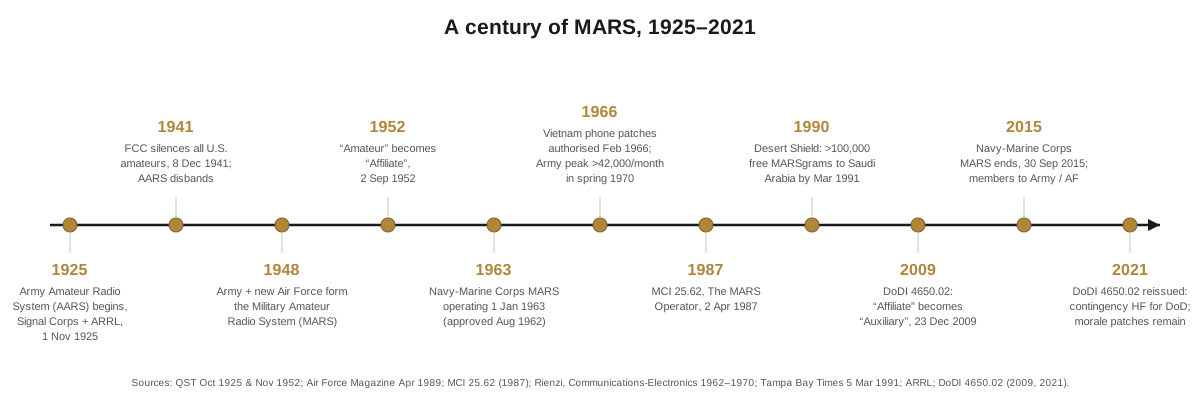
The idea is older than the name. In March 1925 a board of Army officers met staff of the American Radio Relay League (ARRL) in Hartford, Connecticut, and that autumn the War Department approved a plan for an Army Amateur Radio System (AARS), effective 1 November 1925. Capt. Tom C. Rives at Fort Monmouth was the Signal Corps liaison, and the Signal School’s station, 2CXL, was the central station. QST announced it in October 1925 under the headline “The Army Links Up With the Amateur” (QST history summary, W2PA; ARRL).
The structure followed the Army’s map. The National Defense Act of 1920 had divided the country into nine corps areas, and the AARS had a net in each, run by that corps area’s signal officer, with state nets beneath. A ham who joined filed a station card with both the ARRL and the corps-area signal officer and got a certificate of appointment in return. The Chief Signal Officer, Maj. Gen. Charles McK. Saltzman, named the ARRL as the representative of “transmitting amateurs… in their affiliation with the Signal Corps.” That word affiliation comes back in 1952.
What did the Army get? Practice, mostly: drills, traffic nets, and a list of trained operators it could call on. It also got real work. When the Civilian Conservation Corps put young men in remote camps in the 1930s, AARS-linked radio carried their traffic. The Fourth Corps Area had 13 radios on the job in January 1936, later 37 stations, and the Seventh Corps Area cut its monthly communication bill from $3,842.83 to $1,984.25 (ARRL, citing the Signal Corps Bulletin).
A note on the floods. The AARS is often credited with carrying traffic in the great Ohio and Mississippi floods of 1936 and 1937. Amateurs certainly did, and the Signal Corps wrote it up (“Signal Activities During the 1937 Flood in Southern Illinois,” Signal Corps Bulletin, July–September 1937). But this research found no primary account that separates AARS traffic from general ham traffic. So this volume says no more than that.
1.2.1 How big it got
The two most-quoted numbers measure different things, so they shouldn’t be set against each other. An Air Force communications historian wrote in 1989 that “about 8,000 amateur operators had been trained” by the AARS before the war (Morrison, Air Force Magazine, April 1989). A hobby history gives about 5,600 members out of roughly 60,000 licensed hams in December 1941 (AAV5th history). The first counts everyone trained over sixteen years, the second the members at one date.
1.2.2 The Navy’s version
The Navy came to the same idea by a different road. In 1925 the Director of Naval Communications, Capt. Ridley McLean, wrote to ARRL founder Hiram Percy Maxim asking for help building a Naval Radio Reserve of 6,000 operators. It was voluntary, with no drill and optional summer cruises. The ARRL’s Fred Schnell sailed with the fleet that year (ETHW, History of Naval Radio). The Navy had good reason to ask. Its own 1987 MARS course reminded students that within ten days of the U.S. entering World War I, 500 of the country’s 6,000 radio amateurs had enlisted in the Navy, and another 3,500 followed by the end of the war (MCI 25.62, §1101).
1.3 1941: silence, then a new name
On 8 December 1941 the FCC ordered every U.S. amateur station off the air, and the AARS was disbanded (Morrison 1989). Its operators did not disappear. Per the Navy’s later count, more than 25,000 amateurs served with the armed forces in World War II, and the prewar nets had trained a good share of them.
The AARS was reactivated in 1946. Then, in 1948, the Army and the brand-new Air Force (independent since September 1947) jointly launched the Military Amateur Radio System: MARS. Wikipedia gives the month as November, which fits the Air Force MARS 75th anniversary held in November 2023. The exact founding day could not be confirmed. The acronym was already in use by late 1948: QST’s December 1948 issue reports a “Major Ralls, K4AF,” speaking on “the MARS organization” at a Midwest convention (QST, Dec 1948). In 1950 membership was opened to amateurs with no military connection (Morrison 1989).
1.4 1952: “Amateur” becomes “Affiliate”
The first rename is the one most often misdated. QST for November 1952 carried it plainly: effective 2 September 1952, the Department of Defense changed “Military Amateur Radio System” to “Military Affiliate Radio System” (QST, Nov 1952). It gave two reasons:
- The word “amateur” caused “operational difficulties with foreign governments when it came to extending MARS operations on military block channels” overseas. A host nation that would never let a foreign amateur operate inside its borders might accept a military station.
- “Military affiliate” “more clearly defines the relationship.” That is close to Saltzman’s own word from 1925.
The October 1952 QST shows how the system was run that year: jointly by the Army’s Chief Signal Officer and the Air Force Director of Communications, with a civil-military advisory committee that included the FCC, the Federal Civil Defense Administration, the ARRL and the American National Red Cross (QST, Oct 1952). The Red Cross was there from early on. Volume 3 covers what that did and did not mean.
The Air Force kept building. In 1959 MARS was formally tasked to back up Air Force circuits, and from 1961 the Air Force Communications Service ran Air Force MARS as single manager (Morrison 1989).
1.4.1 What about Curtis LeMay?
Almost every popular account of Air Force MARS mentions Gen. Curtis LeMay, the Strategic Air Command chief. He was a real and keen ham. Time in 1959 called him “known as ‘Curt’ to hams all over the world,” and Popular Electronics recorded that he had operated as D4AFE while commanding U.S. Air Forces in Europe (Time, 16 Feb 1959; Popular Electronics, Mar 1958). His SAC deputy, Lt. Gen. Francis Griswold, put Collins single-sideband ham gear aboard SAC aircraft in 1956 and kept in touch through hams and phone patches, which helped persuade the military that SSB worked.
What this research could not find is any primary source saying LeMay founded, ran or specially championed MARS. He was a documented ham and a single-sideband enthusiast in the same years MARS grew. Until a document shows more, that is all the record supports.
1.5 1962–63: the Navy and Marine Corps join
The sea services came last. On 17 August 1962 the Secretary of the Navy approved the Chief of Naval Operations’ recommendation to organise a Navy-Marine Corps MARS, and it began operating on 1 January 1963. Both dates are right; they mark different steps. The source is the Navy’s own course text, the one I studied (MCI 25.62, §1102). A DoD directive formalised the composition and mission of the whole system on 30 November 1968, and DoD Directive 4650.2 reaffirmed it on 17 January 1986 (§1103).
By the time I sat down with that course, Navy-Marine Corps MARS described itself as about 3,000 participating stations: 160 military-sponsored stations, 400 Navy and Coast Guard ships, and 2,450 volunteer affiliate stations (§1104).
1.6 Callsigns: you can tell the service by the first letter
MARS stations do not use amateur callsigns on MARS frequencies. The 1987 course is blunt: “The use of Amateur Radio call signs on MARS networks is not authorized” (§3401a). They use military-style calls from the blocks the ITU gives the United States:
Table 1 — MARS stations do not use amateur callsigns on MARS frequencies. The 1987 course is blunt: "The use of Amateur Radio call signs on MARS networks is not authorized" (§3401a). They use military-style calls from the blocks the ITU gives the United States
| Service | Prefix block (47 CFR 2.302) | Examples on record |
|---|---|---|
| Army | AAA–AEZ, ALA–ALZ | AB6ACB (Army chief of MARS, 1952); AB8USA (Long Binh, 1969); AAA9USA (Fort Huachuca gateway); AEN5NAA (Baghdad, 2008) |
| Air Force | AFA–AKZ | AGA6MA (March AFB); AFA6PF (2010) |
| Navy-Marine Corps | NAA–NZZ, in practice NNN0 | NSS (Washington, 1969); NNN0MPI (Parris Island, 1981); NNN0CQQ (ex-USS Midway, 2013) |
Sources: 47 CFR 2.302 note; QST Nov 1952; NARA photo captions; ARRL 2008; Armed Forces Day crossband schedule 2013.
Navy-Marine Corps MARS carved its NNN0 block up by job. In 1987 Marine Corps stations were assigned from the NNN0M__ range and Navy stations from NNN0N__. Area coordinators, master and chief operators, the Chief of MARS staff, and net coordinators each had their own sub-block (MCI 25.62, §3401). A region director’s assistants used his callsign with a spoken number after it: “TWO” for emergency planning, “FOUR” for training, “TEN” for RTTY, and so on.
1.7 Where the story goes next
- Volume 2 shows how the system worked on the air: the phone patch and why everyone said “over,” the MARSgram, the nets, and the three modes (voice, CW and radioteletype) the 1987 course taught.
- Volume 3 covers Korea, Vietnam, the Antarctic and the Red Cross: the years when MARS meant a voice from home.
- Volume 4 runs from the Gulf War through Iraq and Afghanistan to today’s mission.
- Volume 5 is my own.