The History of Morse Code · Volume 2
The History of Morse Code — Vol 2: Two Codes — American Morse and the International Reform
There is not one Morse code, there are two. The one you can recite is a German revision of 1848; the one that ran America's landlines for a century is a stranger, faster, spikier thing — and understanding why radio chose one over the other explains the code's whole shape.
2.1 The thing nobody tells you
Ask any ham to send “C” and you will get dah-di-dah-dit. That is correct — in International Morse. But if you handed that same C to a Western Union operator in 1890, they would have sent something quite different, because for the first century of American telegraphy the wires did not carry the code in our heads. They carried American Morse, also called “landline” or “railroad” Morse, and it is a genuinely different code. This is the single most common technical error in the whole field: people say “Morse code” as if it were one thing. It is two. This volume is about how the code got built, why it split, and why the version I send on the air tonight is really Friedrich Clemens Gerke’s German reform of 1848 — not Samuel Morse’s original at all.
2.2 How the code is built: dits, dahs, and silence
Before we compare the two codes, we need the unit system they share, because the genius of Morse is not the dots and dashes — it is the timing, and specifically the silence. Everything is measured in one base unit, the length of a single dit:
- a dit (dot) is 1 unit of tone;
- a dah (dash) is 3 units of tone;
- the gap between elements within one letter is 1 unit of silence;
- the gap between letters is 3 units of silence;
- the gap between words is 7 units of silence.
That is the entire specification. Get the silences wrong and the message turns to mush even if every dot and dash is perfect — which is exactly why a good “fist” (the personal rhythm of a hand-sent signal) is a real, audible skill. Figure 1 keys out the word PARIS against a unit grid, and PARIS is not a random example: it is defined to be exactly 50 units long including the trailing word space, which is why it is the reference word for measuring speed. One “PARIS” per minute is 1 word per minute; the plain-language definition of words-per-minute rides on it.
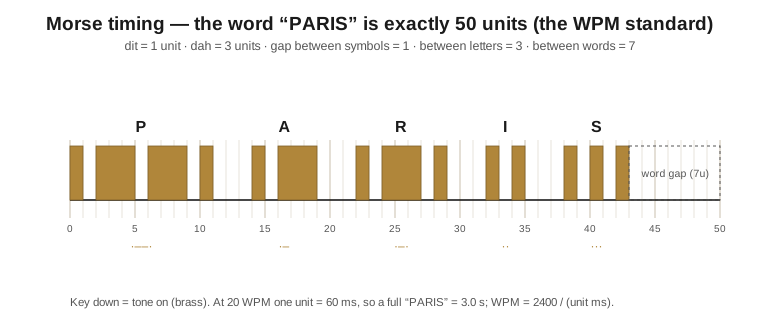
From that 50-unit word you get the speed math directly. At 20 WPM one unit is 60 ms, so a full PARIS takes 3.0 seconds; the general rule is WPM = 2400 / (unit length in ms). This is the same timing whether a fist, a bug, an electronic keyer, or a Raspberry Pi is generating it — the machines in the later sub-projects change who makes the timing, never what the timing is.
2.3 International Morse: two lengths, no surprises
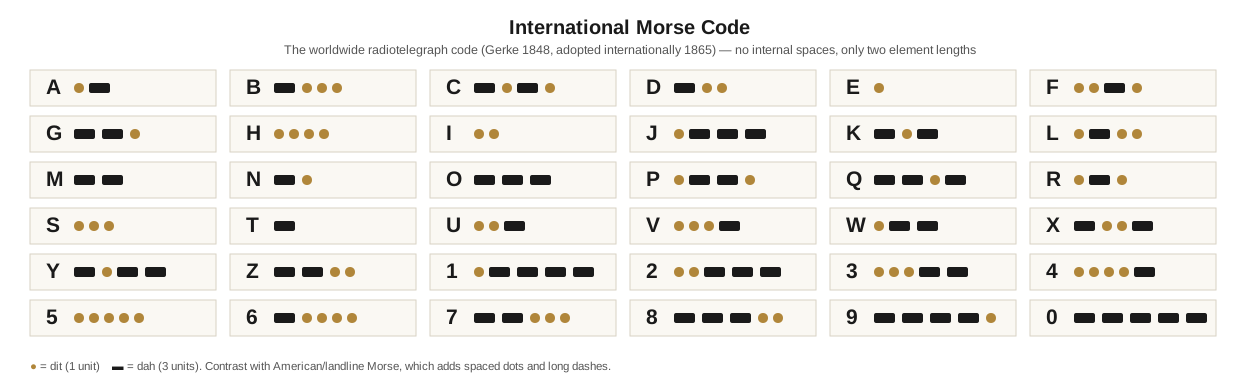
The code you learn today (Figure 2) has exactly two element lengths — dit and dah — and no internal spaces inside a character. Every letter is an unbroken run of dits and dahs with the standard 1-unit gaps between them, and every character is separated from the next by a 3-unit gap. That regularity is not an aesthetic choice; it is what makes the code survivable through noise, and it is the whole reason it beat American Morse onto the radio.
2.4 American Morse: spaced dots and long dashes
American Morse — Morse and Vail’s original — is a wilder animal. It uses more than two element lengths, and it puts gaps inside some letters:
- Several characters are made of spaced dots — dots with a deliberate gap within the letter. The classic is O, which in American Morse is dot‑gap‑dot (· ·), not the three dahs of international O. C, R, Y, Z, and the ampersand also carry these internal spaces.
- It uses long dashes of nonstandard length. L is a single dash longer than a normal dah, and zero is an even longer dash still.
So where International Morse asks a receiver to distinguish just two things (short tone vs. long tone), American Morse asks it to distinguish four: a dit, a normal dah, a long dash, and an internal gap that is longer than an element gap but shorter than a letter gap. Figure 3 lays the difference out with three letters.
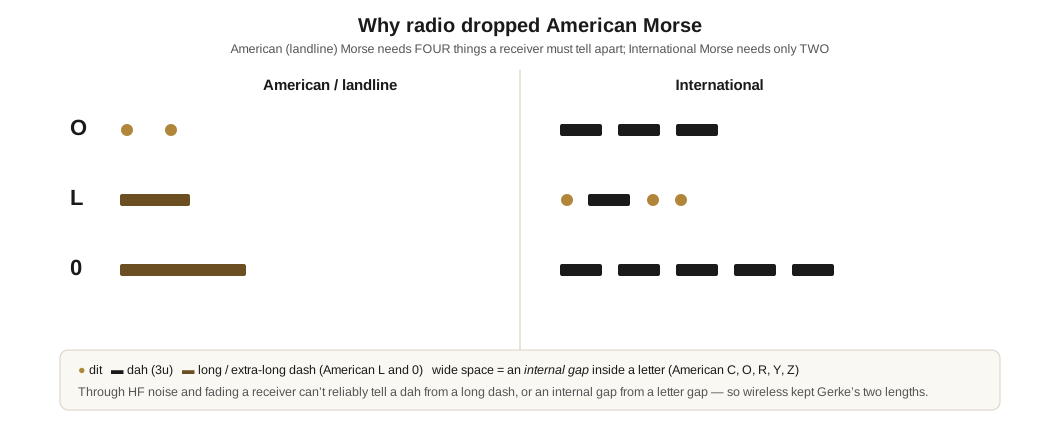
A short comparison table makes the point concrete (dit = ·, dah = −, and a gap shown inside a character = an internal space):
Table 1 — A short comparison table makes the point concrete (dit = ·, dah = −, and a gap shown inside a character = an internal space)
| Character | American / landline | International |
|---|---|---|
| C | · · · (spaced) | − · − · |
| L | − (a single long dash) | · − · · |
| O | · · (spaced dots) | − − − |
| R | · · · (spaced) | · − · |
| Y | · · ·· (spaced) | − · − − |
| Z | ·· ·· (spaced) | − − · · |
| 0 | − (an extra-long dash) | − − − − − |
Letters like E, T, A, I, H, S and many others are identical in both codes — which is exactly what made the two codes so easy to confuse. But the spaced-dot and long-dash characters above are the ones that diverge, and they are the ones that decided the code’s future.
2.5 Why American Morse was faster on a wire — and hopeless on the air
Here is the paradox worth sitting with: American Morse is, for a skilled landline operator, measurably faster than International. Those internal spaces let common letters be shorter (American O is just two quick dots), and a brass-pounder reading a clacking sounder by ear could run at blistering speed. On a clean, closed wire with a crisp mechanical sounder, the extra “alphabet” of element lengths is an advantage.
Put that same code onto a radio wave, though, and it falls apart. On HF the signal fades (its amplitude swims up and down) and it sits in noise (static crashes, other signals, atmospheric hiss). Under those conditions a receiver — human ear or machine — cannot reliably tell a dah from a long dash, or an internal gap from a letter gap, because the very timing distinctions American Morse depends on are the first casualties of QSB and QRN. International Morse, with only two lengths and no internal spaces, degrades gracefully: even badly mangled, a run of shorts and longs is usually still decodable. That robustness is why wireless standardized on it, and why American Morse never left the wire.
2.6 Gerke’s reform and the 1865 standard
The two-length code was not Morse’s second thoughts — it was someone else’s redesign. In 1848, the German telegraph engineer Friedrich Clemens Gerke revised American Morse for the Hamburg–Cuxhaven line, stripping out the spaced dots and the variable-length dashes to leave a clean two-element code. The German-Austrian Telegraph Union adopted Gerke’s version in 1851, and after a few small letter tweaks and a full revision of the numerals it was ratified as International Morse Code by the International Telegraph Convention in Paris on 17 May 1865 — the same treaty that founded the International Telegraph Union, the body that survives today as the ITU.
Myth check — “International Morse is Morse’s code.” It is not. The international code every ham knows is Gerke’s 1848 German revision, standardized in 1865. Morse and Vail’s own code — American/landline Morse, with its spaced dots and long dashes — is the one that has almost vanished, surviving now mainly among landline-telegraph preservationists in clubs like the Morse Telegraph Club. When you send CW, you are sending Gerke, not Morse. (Wikipedia, “Friedrich Clemens Gerke,” “American Morse code.”)
2.7 Where this leaves us
So the code we use is a robustness-optimized, radio-hardened, two-length reform of a faster but fragile original — a design decision forced by the physics of the air itself. That decision was made just in time, because the next thing that happened to Morse code is that it left the wire entirely and went to sea. Volume 3 follows it onto the ships: the general call CQ, the distress calls CQD and SOS, the night the Titanic sent both, and the long, quiet ending of commercial Morse.
2.7.1 Sources (Vol 2)
- Wikipedia, “American Morse code” — spaced dots, long dashes, sounder reading, and why radio adopted International Morse. https://en.wikipedia.org/wiki/American_Morse_code
- Wikipedia, “Friedrich Clemens Gerke” — the 1848 reform, 1851 German-Austrian adoption, 1865 international standard. https://en.wikipedia.org/wiki/Friedrich_Clemens_Gerke
- ITU-R Recommendation M.1677, “International Morse code” — the authoritative modern definition of characters and timing.
- Timing/PARIS-standard and WPM derivation cross-checked against the ARRL operating references; reconciled with the DIY-trainer timing note discussed in Learning & Operating CW.