The Shift-Keying Family · Volume 1
The Shift-Keying Family — Vol 1: Morse Was the First One
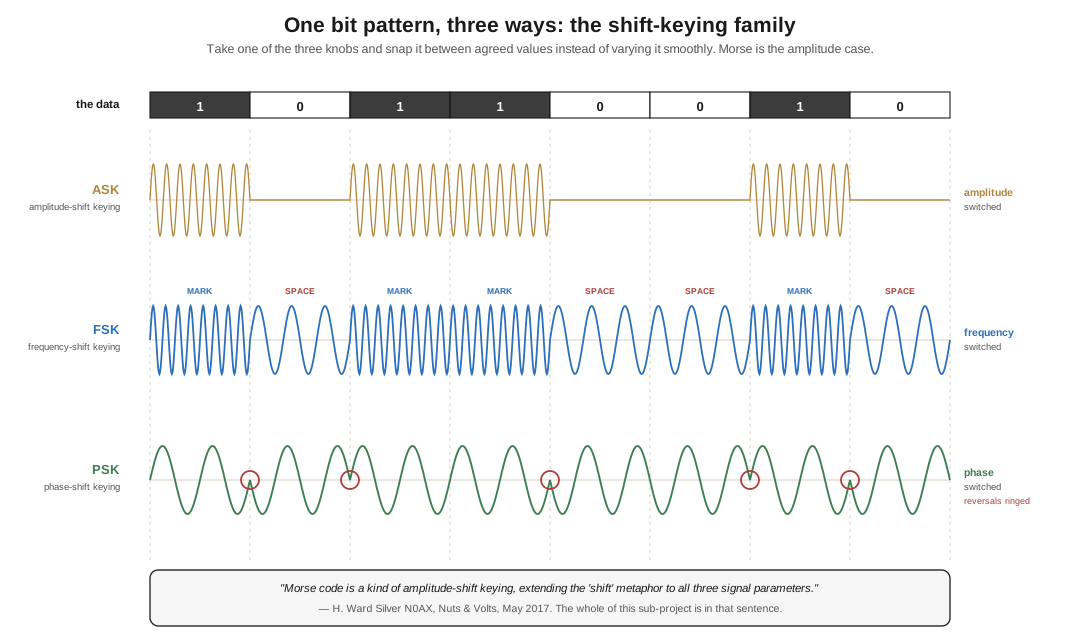
Three knobs, and a machine that grabs one of them abruptly instead of smoothly. Morse code is amplitude-shift keying. RTTY is frequency-shift keying. Everything since is the same idea with more values and better arithmetic.
1.1 The realisation that organises everything
There is a sentence buried in the second of Ward Silver’s Nuts & Volts columns that I think is the most useful thing in either of them, and he tosses it off as an aside in parentheses:
“The clever reader may have also realized that Morse code is a kind of amplitude-shift keying, extending the ‘shift’ metaphor to all three of the signal parameters: frequency, phase, and amplitude.”
Read that twice. Morse code is a digital mode. Not a precursor to one, not an analogue relative of one — it is the first member of the same family that contains RTTY, PSK31, and FT8, and it differs from them in sophistication rather than in kind. Everything in this entire project has been walking toward that sentence: the boy at the key in 1844, the brass pounder reading a sounder by ear, the Model 15 clattering in my father’s shack, and the software on my bench decoding a signal I cannot hear are all doing shift keying. Take one of the three knobs from How a Signal Carries Information and, instead of varying it smoothly with a voice, snap it between a small number of agreed values, each held for a fixed interval.
That is the whole family. The rest is bookkeeping.
1.2 Two words you must not confuse
Before we go further, two definitions that cause more confusion in this subject than anything else.
A symbol is one signalling interval — one period during which the transmitter holds a particular agreed state. The baud rate is the number of symbols per second. It is named for Émile Baudot, whose five-unit code we met in Teletype Machines, and it is a measure of symbol rate, not data rate.
Those are the same number only when each symbol carries exactly one bit. The instant a mode uses more than two states, they diverge:
Table 1 — Those are the same number only when each symbol carries exactly one bit. The instant a mode uses more than two states, they diverge
| Mode | States | Bits per symbol | Symbol rate | Bit rate |
|---|---|---|---|---|
| Binary FSK (RTTY) | 2 | 1 | 45.45 baud | 45.45 bit/s |
| 4-FSK | 4 | 2 | 45.45 baud | 90.9 bit/s |
| 8-FSK | 8 | 3 | 125 baud | 375 bit/s |
| 16-QAM | 16 | 4 | 2400 baud | 9600 bit/s |
Because n states carry log₂(n) bits, doubling the number of states adds only one bit per symbol — the returns diminish fast, and the price is paid in required signal-to-noise ratio. This is the central trade of the entire family.
Two corollaries worth holding onto. “Baud rate” is redundant — baud already means a rate, so the phrase says “symbols per second rate.” And the FCC’s old 300-baud limit was a limit on symbols, not bits, which is precisely why it aged so badly: a clever designer could pack many bits into each of those 300 symbols and occupy far more bandwidth than the rule’s authors imagined, while an honest binary mode was held to 300 bit/s. That mismatch is why the rule was replaced by a bandwidth limit in January 2024 (see How a Signal Carries Information, Vol 2).
1.3 ASK: where we came from
Amplitude-shift keying switches the amplitude between discrete levels. With exactly two levels — full and zero — it is on-off keying, and it is Morse, and this project has already spent fifteen dives there.
It is worth being clear about why nobody builds new ASK modes for HF. Amplitude is precisely the property that a noisy, fading radio channel damages most. A lightning crash is an amplitude event. A fade is an amplitude event. Ignition noise is an amplitude event. Encoding your information in the one parameter the channel is most eager to corrupt is not a good plan, and every mode invented since has moved to frequency or phase for exactly that reason.
That Morse works anyway, and works spectacularly well down into the noise, is down to the decoder rather than the modulation — and for a century and a half the decoder was a trained human brain, which remains extraordinarily good at pulling a rhythmic pattern out of interference. That is the argument of Learning & Operating CW, and it is why CW survives.
1.4 FSK: shift the frequency instead
Frequency-shift keying switches between two or more frequencies. The shift itself is the signalling event; the interval during which one tone is held is the symbol. And FSK is robust in exactly the ways ASK is fragile: a fade attenuates both tones equally, so the decision — which tone is stronger? — survives; a limiter can throw amplitude information away entirely without harming the signal, exactly as in FM.
The amateur world’s canonical FSK is RTTY, which we covered in detail in RTTY on the Air: mark at 2125 Hz, space at 2295 Hz, a 170 Hz shift, 45.45 baud. That dive is the place for the operating detail; here I want the general structure, and specifically the three ways to make an FSK signal — because it confuses everyone once and then never again:
- Shift the RF oscillator directly. The data line pulls the transmitter’s frequency between two values. This is direct FSK, designator
F1B. - Feed two audio tones into an SSB transmitter in place of speech. The SSB rig translates them faithfully to RF. This is AFSK, designator
J2B. - Feed two audio tones into an FM transmitter. Also AFSK, but the underlying RF signal is a full FM signal with all of Volume 1’s Bessel sidebands.
The thing to internalise: methods 1 and 2 produce identical signals on the air. Not similar — identical. An unmodulated carrier shifted between two frequencies, and a single audio tone passed through an SSB transmitter and then switched between two frequencies, are the same electromagnetic wave. There is no measurement that distinguishes them. Method 3 is genuinely different on the air (it is an FM signal, much wider), but the audio out of the receiver sounds the same as the other two, so the decoder does not care.
That is why a $30 sound card and free software can work RTTY with anybody, and why the FSK-vs-AFSK argument is about convenience and filtering, not about the signal.
1.5 MFSK: buy robustness with tones
If two tones work, why not more? Multi-frequency-shift keying uses anywhere from four to several hundred tones, and the extra tones buy two different things at once.
Bits per symbol. With n tones each symbol carries log₂(n) bits, so eight tones carry three bits per symbol. You can send the same data at a third the symbol rate — and a slower symbol rate means each symbol lasts longer, which means the decoder integrates over more time, which means it can dig deeper into the noise.
Room to be clever. With many tones you can spread a character’s energy across several of them, add error correction, and interleave in time, so that a burst of interference wiping out one tone or one instant costs you nothing at all.
The MFSK modes an HF operator actually meets:
- MFSK16 — Murray Greenman ZL1BPU and Nino Porcino IZ8BLY, around 2000. Sixteen tones, convolutional FEC, roughly 316 Hz wide. The mode that showed HF amateurs what MFSK could do.
- Olivia — Paweł Jałocha SP9VRC, 2005. Explicitly designed for atrocious conditions, using Walsh-function coding across a matrix of tones. It comes in a grid of variants written tones/bandwidth — Olivia 8/250, 16/500, 32/1000 and so on — and the 32/1000 variant will pass traffic when the band sounds, to a human ear, completely dead. It is slow: a few words a minute. That is the deal, and it is a deal worth taking sometimes.
- ALE — Automatic Link Establishment, from the military standard MIL-STD-188-141. 8-FSK at 125 baud, and not a conversational mode at all: it is a protocol by which stations continuously scan, sound, and work out which HF frequency will actually reach a given correspondent right now. You hear it as a distinctive chirping sweep. It is the clearest example in the band of a mode that is mostly protocol — layer three of the mode stack doing the heavy lifting.
- MFSK441 does not exist. ⟨correction⟩ Ward’s Part 2 lists “MFSK441” as the meteor-scatter mode. The mode is FSK441 — Joe Taylor K1JT, described in QST for December 2001 — and it is now obsolete, retired in favour of MSK144. See Weak-Signal Modes & FT8, Vol 2, where that whole family lives.
There is a pattern across all of these, and it is the thread of the sub-project: each mode picks a channel and a purpose, and pays for its strengths somewhere. Olivia buys robustness with speed. ALE buys link reliability with a chirping overhead. RTTY buys simplicity and universality with a mediocre error rate — and has survived a century on that bargain.
Volume 2 takes the third knob. Phase is the subtlest of the three, it is where the modern world lives, and it ends with a mode that is somehow an FSK and a PSK at the same time.
1.5.1 Sources (Vol 1)
- H. Ward Silver, N0AX, “Wireless Modes — Part 2,” Nuts & Volts, May 2017 — the “Morse code is a kind of amplitude-shift keying” observation that organises this dive; the three methods of generating FSK and the fact that methods 1 and 2 are indistinguishable on the air; shift, symbol, and the note that “baud rate” is redundant; and the MFSK list. 🔴 That list gives the meteor-scatter mode as “MFSK441”; the mode is FSK441. https://www.nutsvolts.com/magazine/article/wireless-modes-part-2
- RTTY standards (2125/2295 Hz, 170 Hz shift, 45.45 baud) — see Teletype, Tape & RTTY → RTTY on the Air, which cites AA5AU’s guide and the HAL tone references.
- MFSK16: Murray Greenman ZL1BPU and Nino Porcino IZ8BLY, c. 2000. Olivia: Paweł Jałocha SP9VRC, 2005 — Walsh-function FEC, tone/bandwidth variants. Wikipedia “Olivia MFSK” (→ its citations) and the Signal Identification Wiki. https://en.wikipedia.org/wiki/Olivia_MFSK · https://www.sigidwiki.com/wiki/Olivia
- FSK441: J. Taylor K1JT, “WSJT: New Software for VHF Meteor-Scatter Communication,” QST, December 2001 — 4-tone FSK, 147 characters/second.
- ALE: MIL-STD-188-141, 8-FSK at 125 baud. ⟨verify against the current revision of the standard before quoting specifics⟩
- The 300-baud symbol-rate limit and its January 2024 replacement: FCC 23-93 — see How a Signal Carries Information, Vol 2.
- Cross-links: Morse & CW (ASK, and why a human decoder beats the modulation); RTTY on the Air (binary FSK in operating practice); Weak-Signal Modes & FT8 (where MFSK goes when you throw real mathematics at it).