The Hi-Mound UFO and the Autokeyer Era · Volume 2
The Hi-Mound UFO & the Autokeyer Era — Vol 2: From the Bug to the Message Keyer
How electronics took over the timing of Morse — the iambic keyer, the Curtis chip, dot/dash memory and the Mode A/B argument — and the Katsumi MK-1024 that sits next to my UFO and can remember a whole message.
2.1 The problem the electronic keyer solved
A straight key asks your hand to time everything. A bug (the semi-automatic key in its own dive) mechanizes the hardest part — the string of dits — with a vibrating pendulum, but the dahs are still yours and the whole thing imparts a distinctive mechanical swing. The electronic keyer finishes the job: it generates both perfectly-timed dits and dahs from a paddle, at a speed you set with a knob, and it does something no mechanical key can — it remembers.
Two ideas define the electronic keyer, and both matter for understanding the UFO and the Katsumi:
- Self-completing elements and dot/dash memory. Tap the dit paddle and the keyer finishes a full, correctly-timed dit even if you let go early; better yet, if you tap the other paddle while an element is still going out, the keyer remembers it and inserts it next. This is what lets a keyer forgive imperfect timing — the machine cleans up your hand.
- Iambic (squeeze) keying. With a dual-lever paddle, squeezing both paddles at once makes the keyer send alternating dot-dash-dot-dash automatically. It’s efficient and, once it’s in your fingers, fast — the letter C (dah-di-dah-dit) becomes a single rocking squeeze. (This is exactly the trick the single-lever UFO-001 cannot do — see Volume 1. The Katsumi below can.)
2.2 The chip that made it cheap: Curtis
For most of the 1960s an electronic keyer was a box of discrete logic — real estate and soldering. That changed in 1973, when Curtis Electro Devices (John “Jack” Curtis, K6KU) shipped the 8043, the first keyer-on-a-chip: a single IC that did the dit/dah timing with dit memory. Two years later, in 1975, the pin-compatible 8044 added dah memory, which made true iambic keying practical on one chip. These little Curtis ICs are the reason electronic keyers were everywhere by the late 1970s — they’re the brains inside a whole generation of keyers and, functionally, the same job the UFO’s handful of ICs is doing.
The homebrew world had its own landmark at the same moment: the WB4VVF Accu-Keyer (James Garrett), published in QST in the mid-1970s, a build-it-yourself iambic keyer with dot and dash memory and automatic character spacing that became the reference design a generation of hams soldered up on a kitchen table.
2.3 The Mode A vs. Mode B argument
If you hang around CW operators long enough you’ll hear a mild religious war about iambic Mode A vs. Mode B, and it’s worth knowing what it actually is, because it’s a real behavioral difference, not just jargon:
- Mode A (the original Curtis behavior): when you release both paddles, the keyer finishes the element it’s sending and stops.
- Mode B (the Accu-Keyer behavior): when you release both paddles, the keyer sends one additional, opposite element beyond what you were squeezing. It started life as another maker’s design quirk and was later adopted as a selectable feature.
Neither is “correct”; operators simply learn one and their muscle memory locks to it. Curtis eventually made it moot: the 8044ABM (1986) let you select A or B and threw in a speed meter. The reason to care is practical — if you learn on a Mode B keyer and sit down at a Mode A one, your machine-sent letters suddenly grow or lose a dit, and it feels like the floor moved.
2.4 The message keyer — remembering a whole transmission
Everything so far still forms the code in real time from your paddle. The last step in this dive’s evolution adds a memory big enough to hold not one element but a whole message: you key “CQ CQ CQ DE N0SWN N0SWN K” once, the keyer records it (WRITE), and thereafter a button press plays it back (READ) at your set speed, perfectly, as many times as you like. For anything repetitive — calling CQ, sending your callsign, a contest exchange, an RST report — a message (memory) keyer turns a paragraph of tedious, error-prone sending into a button. That is the machine sitting on my desk next to the UFO.
2.5 The Katsumi MK-1024 Message Keyer
The Katsumi MK-1024 is the UFO’s perfect foil: where the UFO is a beautiful single-lever wobbler that automates the dit string, the Katsumi is a no-nonsense grey box that is a true iambic keyer and a four-message memory. Everything I can tell you about it below comes from its own instruction manual (a genuine primary source), not from lore.
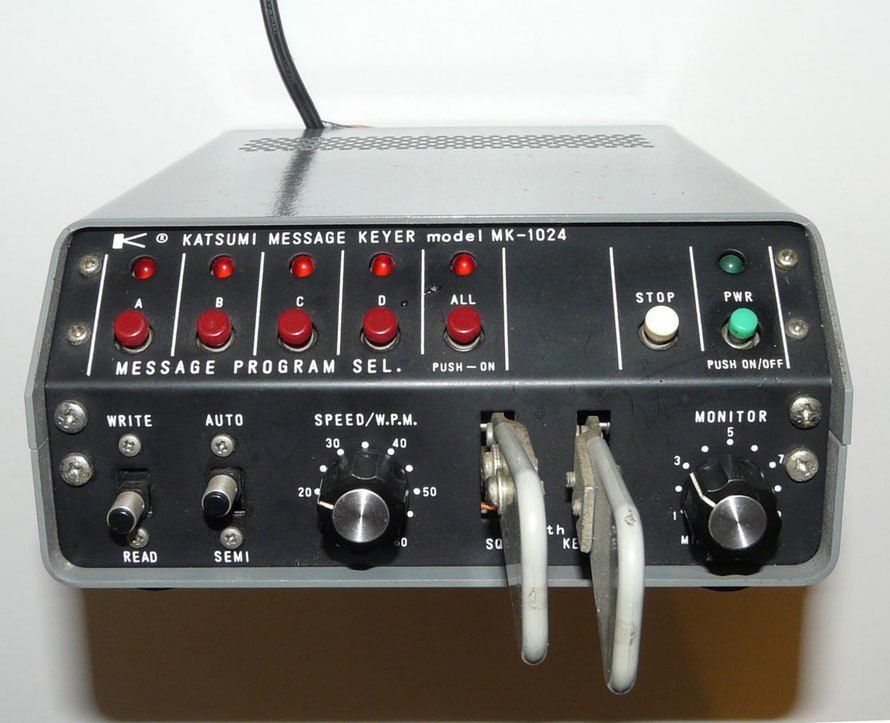
Reading the panel and the manual together:
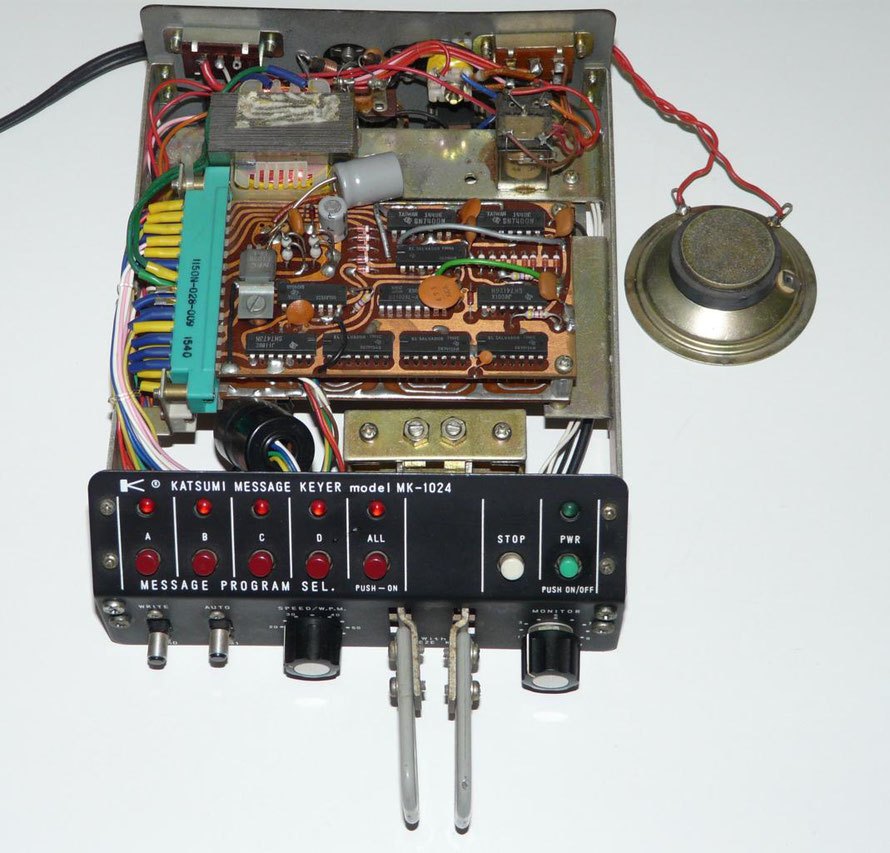
- The name is the memory. “1024” is the size of its RAM in bits — a single NEC μPD2102 1024-bit static RAM. That memory is organized as four independent 256-bit message slots, A / B / C / D (each holds roughly 30 characters), or combined into one 1024-bit message (~120 characters) via the ALL button. So it stores four messages, not five — “ALL” isn’t a fifth slot, it’s the four chained into one long one.
- WRITE / READ. Flip to WRITE, key your message into a slot; flip to READ, and the buttons play it back.
- AUTO / SEMI. AUTO is the normal mode — automatic dits and automatic dahs. SEMI gives you automatic dits but manual dahs (and doubles as a tune-up mode). Notice the family resemblance to the UFO’s “dahs auto or manual” switch — same idea, different execution.
- A true iambic squeeze keyer. The panel says “With SQUEEZE KEYER” and provides dual key levers; it does full dot and dash memory iambic sending — the thing the single-lever UFO can’t do.
- Speed: 6–60 WPM. The dial is marked 6, 20, 30, 40, 50, 60 — so it’s 6 to 60 WPM, not “20–60” (the 20 is just the lowest numbered mark above the 6). This is genuine words-per-minute, unlike the UFO’s characters-per-minute BpM.
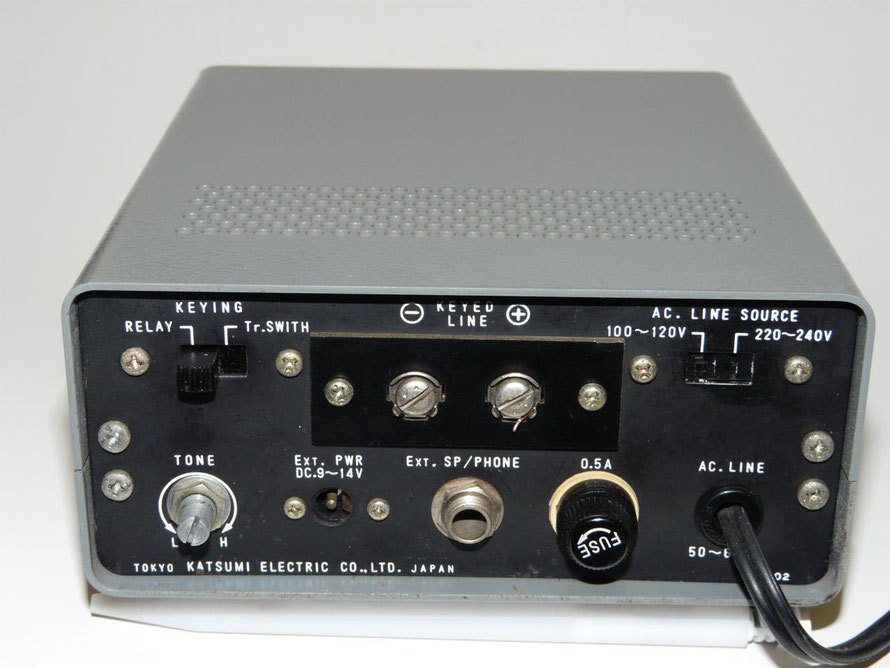
- Output and power. A 2SB546 transistor switch (150 V / 2 A) plus a built-in high-speed relay rated 700 V / 500 mA for keying a high-voltage cathode line — again the era’s telltale, a physical relay for tube gear. It runs from AC mains (100–240 V) or an external 9–14 V DC supply for mobile use, with a monitor/sidetone speaker and an end-of-message LED.
2.6 Where the era went
The message keyer was not the end of the line, just the last purely-dedicated box. The four canned slots of a Katsumi became the dozens of memories in an MFJ or Idiom-Press keyer, then the messages stored in the radio itself, and finally the F-keys of a contest-logging program that sends flawless CW straight out of the computer — the last rung on the ladder from Volume 1. The job never changed from what Morse and Vail set out in 1844; only the question of who holds the timing moved, hand by hand, into the machine.
And that is exactly why I keep the UFO on the desk. It is the moment in that whole march when a Japanese company decided the machine that holds your timing should also be beautiful — a chrome saucer with a glass paddle — and I think they were right.
2.6.1 Sources (Vol 2)
- Katsumi MK-1024 Message Keyer instruction manual (primary) — four 256-bit memories A–D (or one 1024-bit via ALL), NEC μPD2102 RAM, WRITE/READ, AUTO/SEMI, 6–60 WPM, squeeze/iambic with full dot & dash memory, 2SB546 (150 V/2 A) + 700 V/500 mA relay output, AC or 9–14 V DC. (Reprint hosted at dl0bn.de/dc7xj.)
- History of the Curtis keyer chips (8043, 1973 — dit memory; 8044, 1975 — dah memory / iambic; 8044ABM, 1986 — selectable Mode A/B + speed meter): testparts.blogspot.com “History of Curtis Keyers”; Curtis 8044 application note (users.ox.ac.uk/~malcolm/radio/8044print.pdf).
- WB4VVF Accu-Keyer (James Garrett), QST, mid-1970s — the reference homebrew iambic keyer and origin of the “Type B” behavior. ⟨exact QST issue not pinned; commonly cited 1973–75⟩
- Iambic / squeeze keying and dot-dash memory concepts: ARRL operating references; hamradioqrp squeeze-keying notes. Cross-references: Keys & Keyers → Paddles & Electronic Keyers (the iambic Mode A/B timing diagram) and → Semi-Automatic Bugs (the mechanical ancestor).