The Hi-Mound UFO and the Autokeyer Era · Volume 1
The Hi-Mound UFO & the Autokeyer Era — Vol 1: The Most Beautiful Keyer Ever Made
A chrome, ribbed, art-deco flying saucer with a clear lucite paddle sticking out the front — my favorite object in the whole hobby. Here is what it actually is, honestly, and why I love it anyway.
1.1 My favorite key
I own a lot of keys. I love brass hand keys, I love the swing of a good bug, I love a crisp iambic paddle. But if you made me keep exactly one thing from the whole collection, it would be this: the Hi-Mound Autokeyer UFO-001. It is a chrome, ribbed, art-deco flying saucer, about eight inches long, with a clear lucite squeeze paddle protruding from the nose like a little glass rudder, and the words HI-MOUND AUTOKEYER embossed down the side of the hull. It looks like a prop from a 1950s science-fiction serial that somehow ended up on a ham’s operating desk in 1979. It is gorgeous, it is strange, and I have never seen another object quite like it.
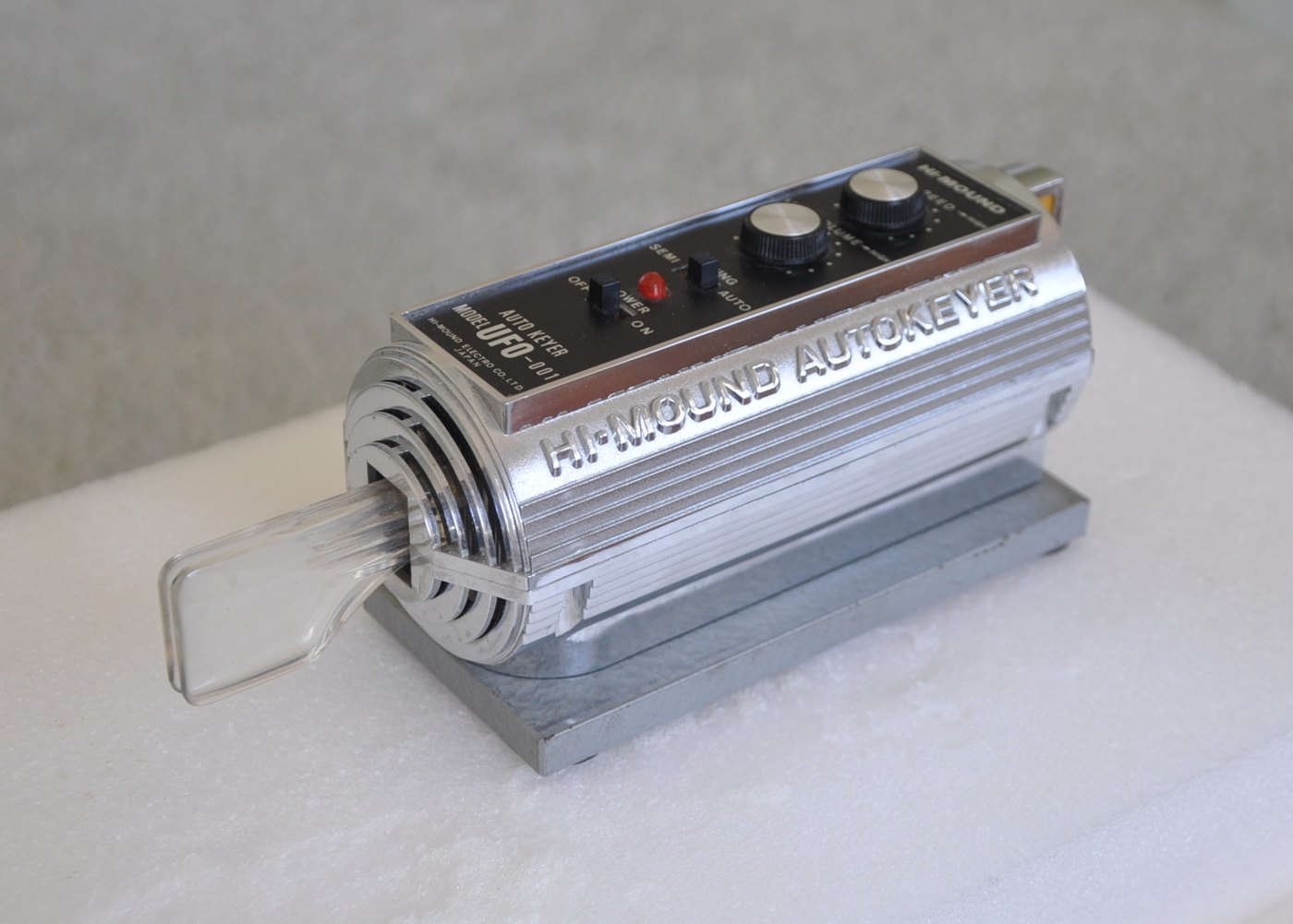
This dive is where the Keys & Keyers sub-project reaches the moment the machine takes over the timing of Morse — the autokeyer era — and the UFO sits right at that hinge. So I am going to do two things at once here: tell you honestly what this specific object is (including correcting the thing everyone, including me at first, gets wrong about it), and use it as the doorway into how electronic and memory keyers work. Volume 2 walks the wider evolution and the Katsumi message keyer next to it. This volume is about the UFO itself.
1.2 Where it sits in the family tree
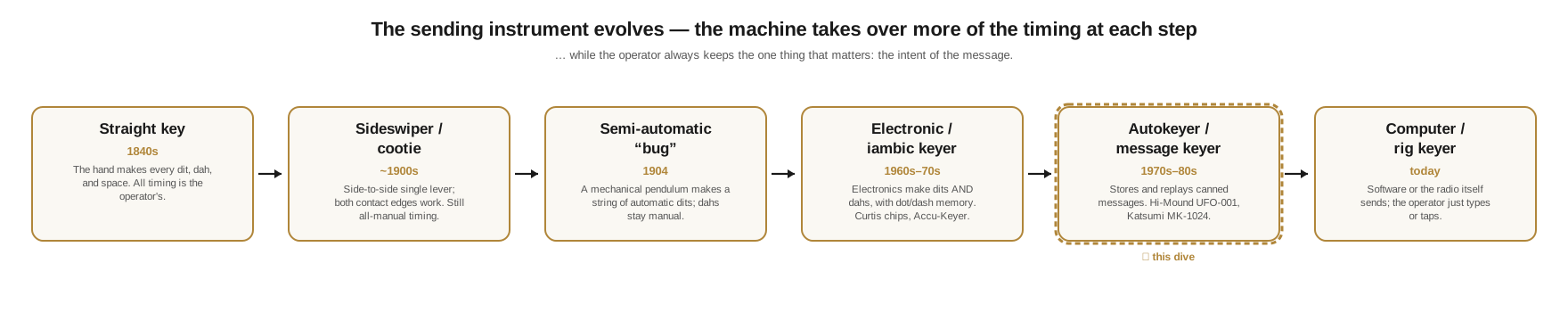
Every earlier dive in this sub-project is a rung on one ladder: at each step, a little more of the timing of the code moves from the operator’s hand into the instrument, while the operator keeps the one thing no machine can supply — the intent of the message. The straight key leaves everything to the hand. The bug mechanizes the dits. The electronic keyer mechanizes both dits and dahs. The autokeyer / message keyer — where the UFO lives — goes one step further and can store and replay whole canned messages. Figure 2 is that ladder.
1.3 The honest technical identity — what the UFO actually is
Here is the correction I promised, and it matters because it is easy to get wrong from a glance. That clear lucite paddle looks like the dual-lever iambic paddle you’d bolt to a modern keyer, and plenty of listings call the UFO an “iambic keyer.” It is not a true iambic squeeze keyer. The radiomuseum.org data sheet is explicit, in German: “keine ‘Squeeze’-Technik, sondern … ähnlich mechanischem Wabbler” — no squeeze technique, but something more like a mechanical wobbler. In plain terms:
- Iambic (squeeze) keying requires a dual-lever paddle — two independent paddles — where closing both at once makes the keyer send alternating dot-dash-dot-dash automatically. The Katsumi in Volume 2 does this. The UFO does not.
- The UFO’s lucite paddle is a single lever: push it one way and it makes a self-timed string of automatic dits with a dot memory; push it the other way and it makes dahs — automatically, or switched to manual. That is a wobbler (bug-style) motion driving electronic logic, not a squeeze.
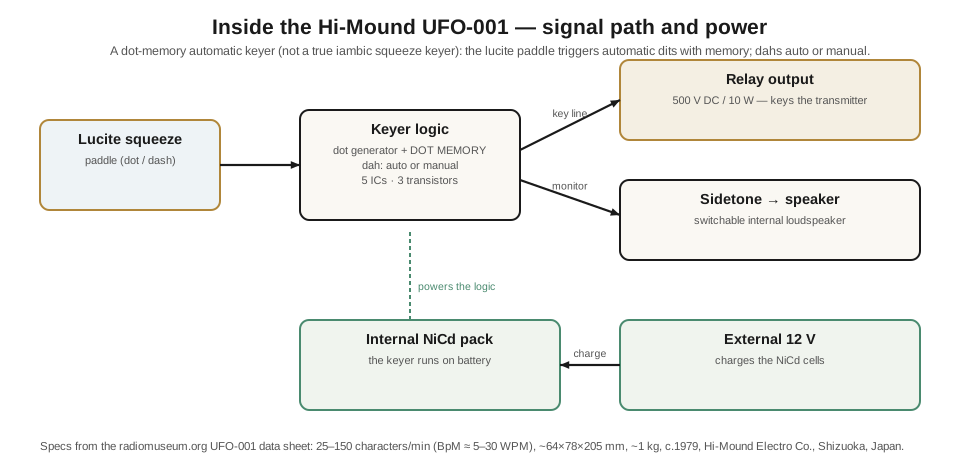
So the UFO is best described as a single-lever electronic autokeyer with dot memory — a machine that automates the dit string (the tedious, easy-to-botch part) the way a bug does mechanically, but does it with 1970s electronics, and adds a dah-memory-lite “auto or manual” dah. It is an evolutionary sidestep, not the mainline iambic keyer — which, honestly, is part of its charm. Figure 3 traces the signal path.
1.4 Reading the spec sheet
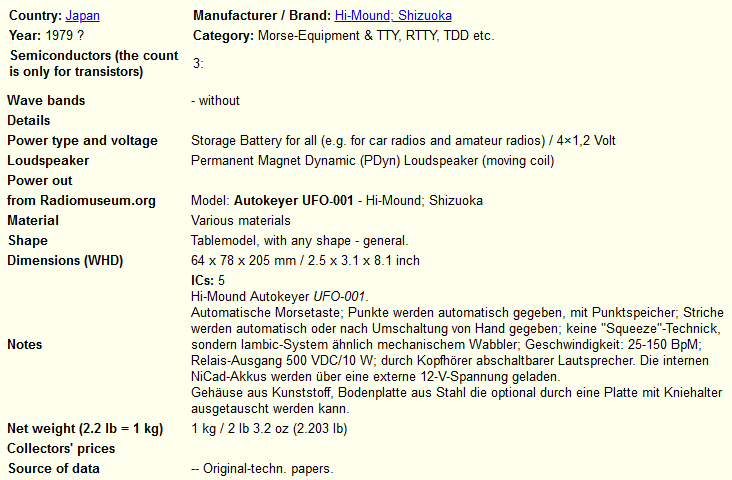
The radiomuseum data sheet (Figure 4) is the closest thing to primary documentation this little machine has, and it’s worth reading carefully because a couple of its numbers get mangled when they’re repeated around the web.
- Speed: 25–150 BpM. This is the one people get wrong. BpM is not words per minute and not baud — it is the German Buchstaben pro Minute, characters (letters) per minute, the speed unit European telegraphers use. By the PARIS standard (5 characters per word), 25–150 BpM works out to roughly 5–30 WPM — a sensible beginner-to-fast-amateur range. If you see the UFO described as “25–150 WPM,” that’s a units error; nobody sends 150 words per minute.
- Output: a relay rated 500 V DC / 10 W. A physical relay, not a solid-state switch — which is exactly what you wanted in 1979 to key the high-voltage cathode line of a tube transmitter without frying your logic.
- Power: an internal NiCd battery pack, charged from an external 12 V supply. The keyer runs on its own battery and tops up from the shack’s 12 V. (A word of warning to any fellow UFO owner: those internal NiCd cells are now 45-plus years old — check them before you trust them, because aged NiCds leak and the electrolyte will happily eat a beautiful chrome saucer from the inside.)
- Build: 5 ICs and 3 transistors, in a plastic case (the chrome is a finish, not solid metal) with a steel base plate that can be swapped for a knee-clamp plate so you can key it on your leg in the field.
- Size and date: ~64 × 78 × 205 mm, about 1 kg, c.1979. (Radiomuseum prints the year as “1979 ?” — their own question mark, so treat it as a close estimate, not gospel.)
1.5 The teardown
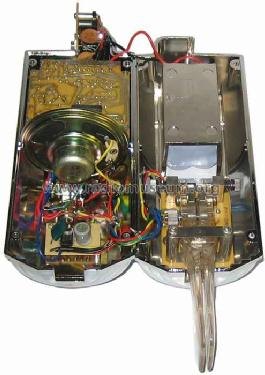
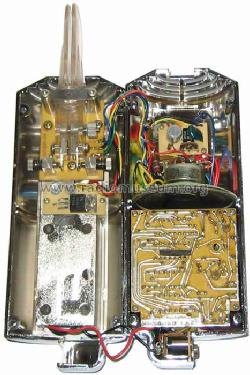
Pop the hull and the UFO stops being a mystery object and becomes a very readable piece of late-1970s Japanese consumer electronics. Figures 5 and 6 show it opened up: the two clamshell halves, the small circuit boards carrying the handful of ICs and transistors, the relay, the NiCd pack, and the speaker — all the blocks from the diagram in Figure 3, in the metal. There is nothing exotic in here; the magic is entirely in the industrial design, the decision to wrap a modest dot-memory keyer in a chromed art-deco saucer with a glass paddle. Whoever styled this at Hi-Mound in the late ’70s was having fun, and it shows.
1.6 Who made it — Hi-Mound
The UFO did not come from nowhere: Hi-Mound is one of the great Japanese key makers, and the company name is itself a nice bit of trivia. It traces to a founder named Takatsuka — and “Hi-Mound” is simply the English rendering of that surname, which means “high mound.” The firm was making telegraph keys as early as the late 1930s; after the war it reorganized (as Takatsuka Musen Denki), passed through Dentsu-Seiki, and by the late 1960s the key-making operation had settled under the name Hi-Mound Electro Co., in Shizuoka. Its catalog is the one a lot of hams grew up on: the HK-series brass straight keys, the MK-series iambic paddles, the BK-100 semi-automatic bug — and, briefly and wonderfully, this chrome saucer. Hi-Mound keys are still made today; since 2020 Vibroplex has been the exclusive US/Canada distributor, which is a lovely closing of the loop — the American company Horace Martin founded to sell the bug now carries the Japanese keys descended from the same idea.
1.7 Why I love a thing that isn’t even “the best” keyer
Let me be honest: on pure merit, a modern iambic keyer with a good dual-lever paddle is a better sending instrument than the UFO. The UFO is a single-lever wobbler with a dot memory and aging batteries. And I do not care even slightly. It is the object that most makes me feel the way I felt as a boy in my dad’s shack — that this hobby is full of strange, beautiful, over-designed machines built by people who clearly loved what they were doing. It sends fine Morse, it looks like it should be beaming a message to Mars, and it is mine. Volume 2 puts it in company: the electronic-keyer chips that defined the era, and the Katsumi MK-1024 message keyer sitting right next to it — a true iambic keyer that can remember and replay whole messages, and the perfect foil for the UFO’s beautiful simplicity.
1.7.1 Sources (Vol 1)
- radiomuseum.org, “Hi-Mound Autokeyer UFO-001” data sheet — maker/Shizuoka, c.1979, “no squeeze technique … like a mechanical wobbler,” dots-auto-with-dot-memory, dahs auto/manual, 25–150 BpM, 500 V/10 W relay, internal NiCd + external 12 V charge, 5 ICs / 3 transistors, dimensions, swappable knee-clamp plate. https://www.radiomuseum.org/r/hi_mound_autokeyer_ufo_001.html
- “BpM” = Buchstaben pro Minute (characters/min), ≈ WPM ÷ 5 — German telegraphy speed convention. de.wikipedia.org/wiki/Schnelltelegrafie
- Hi-Mound company history (Takatsuka / “high mound”; key-making from ~1938; Takatsuka Musen Denki → Dentsu-Seiki → Hi-Mound Electro Co., Shizuoka; HK/MK/BK-100 range): radioblvd.com “Telegraph Keys, Bugs, and Keyers” and telegraphkeys.com Japanese-keys pages; current Hi-Mound distribution via vibroplex.com. ⟨exact year the “Hi-Mound” name was adopted varies by source — late 1960s⟩