The Electric Telegraph · Volume 2
The Electric Telegraph — Vol 2: The Victorian Internet
One wire became a continent's nervous system in a single generation. Western Union and the great consolidation, the transcontinental line that killed the Pony Express in two days, the heartbreaking and heroic Atlantic-cable saga, and the war, the markets, and the news wires that the telegraph rewired forever.
2.1 From a demonstration to a web
Volume 1 left us with a working idea in 1844: a single wire, a code of clicks read by ear, and the relay that lets the signal march as far as you can string poles. What happened next was not gradual. The 1840s and ’50s in America were a telegraph land-rush — dozens of little companies throwing wire along every railroad and turnpike, racing, overbuilding, undercutting, and merging. Out of that chaos came a network, and out of the network came a near-monopoly.
2.2 Western Union and the great consolidation
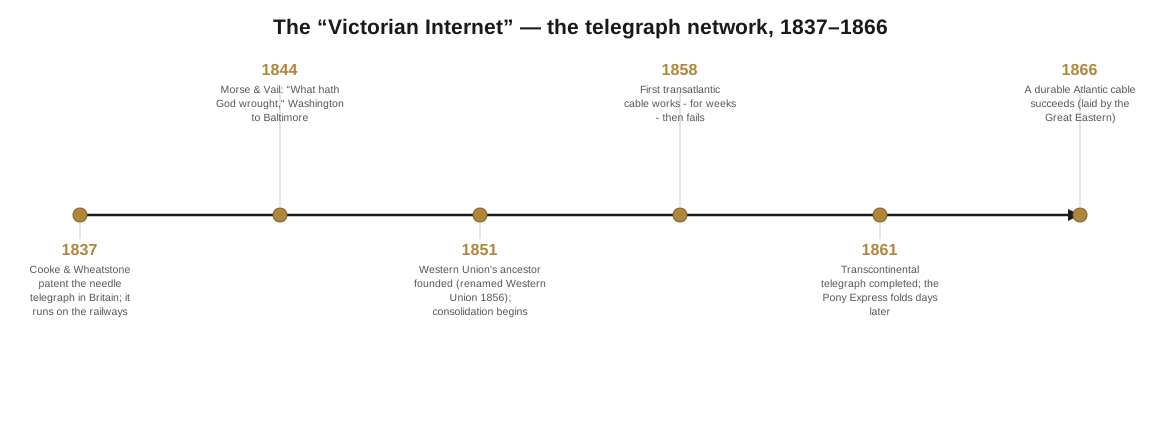
The company that won was founded in 1851 in Rochester, New York, as the tongue-twisting New York and Mississippi Valley Printing Telegraph Company. In 1856, on Ezra Cornell’s urging and after merging with a rival, it took the name that reflected what it was doing — knitting the scattered western lines into one system: The Western Union Telegraph Company. (The name is literally about union of lines, not about the American West as we usually hear it.) Through relentless buyouts of smaller companies through the late 1850s and 1860s, Western Union became one of the first great American corporate monopolies — the near-total owner of the country’s information flow, decades before Standard Oil.
2.3 The transcontinental line — and the two days that ended the Pony Express
The prize was California, cut off from the eastern network by two thousand miles of plains, mountains, and desert. In the summer and fall of 1861, Western Union crews built toward each other from Omaha and from Carson City, and on 24 October 1861 the wire was joined and the first coast-to-coast telegram was sent. The continent, for the first time, could speak to itself in minutes.
There is a beautiful, exact piece of history here that captures the whole disruption in one image. The Pony Express — the relay of hard-riding couriers that had carried the mail across that same gap in a heroic ten days — announced that it was shutting down on 26 October 1861. Two days. The telegraph didn’t slowly erode the Pony Express; it obsoleted it in forty-eight hours. The romantic image of the lone rider outracing the frontier was killed, almost to the day, by a clicking sounder in a Sacramento office. I find that both a little sad and completely thrilling — it is the purest example I know of a communications technology simply ending the thing that came before it.

2.4 Under the ocean: the Atlantic cable
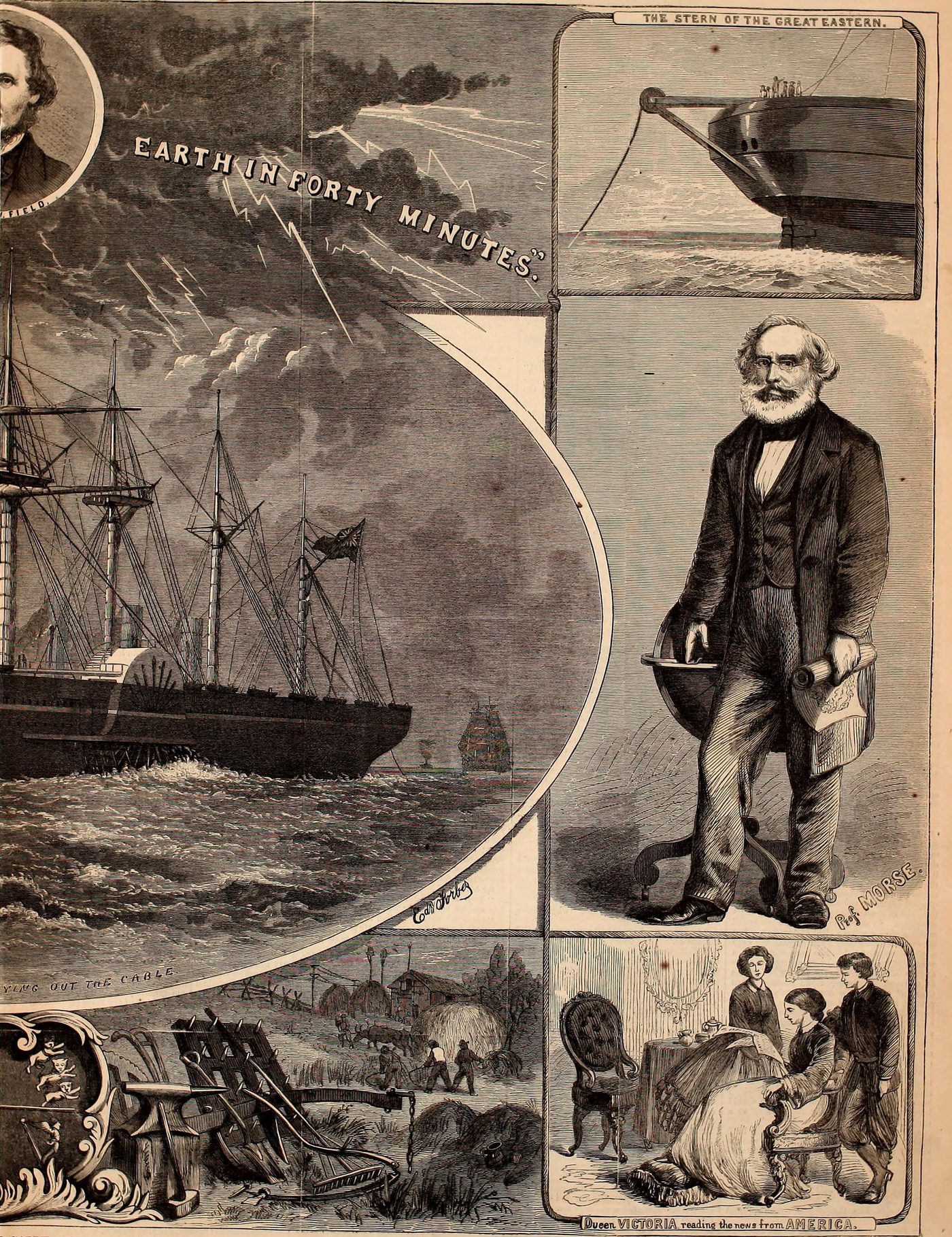
If stringing wire across a continent was hard, laying it across the floor of the Atlantic was very nearly impossible — and the story of it is the great engineering melodrama of the nineteenth century, full of failure, ruin, and stubborn nerve. The driving force behind it was an American paper merchant turned promoter, Cyrus W. Field, who raised the money and the will across a decade of setbacks.
The 1858 cable was completed that August, and for about three glorious weeks it worked. Queen Victoria and President Buchanan exchanged messages across it in mid-August 1858, and both continents celebrated as if the age of miracles had returned. Then it died. The signaling had always been agonizingly slow — a fraction of a word per minute — and an engineer named Wildman Whitehouse, convinced that brute force would push signals through faster, blasted the delicate cable with high voltage and finished it off. After three weeks, the ocean went silent again.
It took eight more years, a lost cable in 1865 (the line snapped mid-ocean and sank), and finally, in 1866, success — a durable, fast cable laid by the SS Great Eastern, at the time by far the largest ship ever built and the only vessel that could carry the whole immense coil. The 1866 expedition even grappled up the lost 1865 cable from two miles down and completed it too, so that two working cables spanned the Atlantic at once. Where the 1858 line had crept at a fraction of a word per minute, 1866 ran at roughly eight — and this time it lasted.
2.4.1 The instrument that made it possible
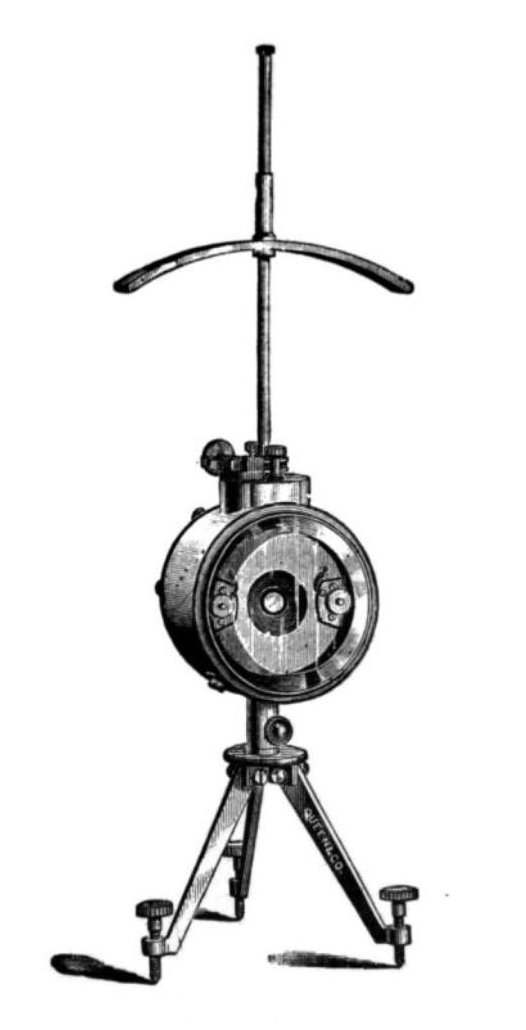
There is a hero of the cable story who wasn’t on the ship: William Thomson, later Lord Kelvin, the Scottish physicist who solved the problem that had defeated everyone else — how do you read a signal so faint that, after two thousand miles of undersea cable, it barely stirs a needle? Thomson’s answer was the mirror galvanometer: he mounted a tiny mirror on the galvanometer’s suspension so that a beam of light reflected off it swung across a distant scale, turning a nearly invisible twitch of the coil into a bright spot sweeping a wide arc. It was sensitive enough to detect the whisper coming out of the deep, and it was in use even on the doomed 1858 cable. (Thomson’s later siphon recorder of 1867, which inked the signal onto a moving tape, served the cables that came after — don’t let anyone tell you it saved the 1858 or 1866 lines; that was the mirror galvanometer.)
2.5 What the wire rewired
The map and the cables are the glamorous part. The deeper story is what instantaneous, long-distance communication did — because it changed nearly everything it touched, and the changes are the direct ancestors of the networked world we live in now.
-
War. The American Civil War (1861–65) was the first conflict directed in near-real-time by telegraph. The U.S. Military Telegraph Corps, formed in 1861, strung some fifteen thousand miles of wire and let commanders coordinate across theaters as never before. Lincoln all but lived in the War Department’s telegraph office, reading the dispatches as they clicked in — the first head of state to follow a war minute by minute from a wire.
-
News. The cost and scarcity of telegraph time reshaped journalism itself. Five New York papers, tired of paying separately to wire in news of the Mexican–American War, pooled their costs in 1846 as the Harbor News Association — the cooperative that became the Associated Press. The terse, front-loaded “who-what-where” style of wire-service writing (and arguably the inverted-pyramid news story) is a child of paying by the word over a scarce circuit.
-
Business and time. The telegraph welded distant markets into single ones — a price in New York was a price in Chicago the same hour — and it became the backbone of railroad dispatching, which in turn drove the standardization of time into zones (the US railroads’ standard time of 1883 grew directly out of the need to coordinate trains by wire).
2.6 Why this is where the dots and dashes begin
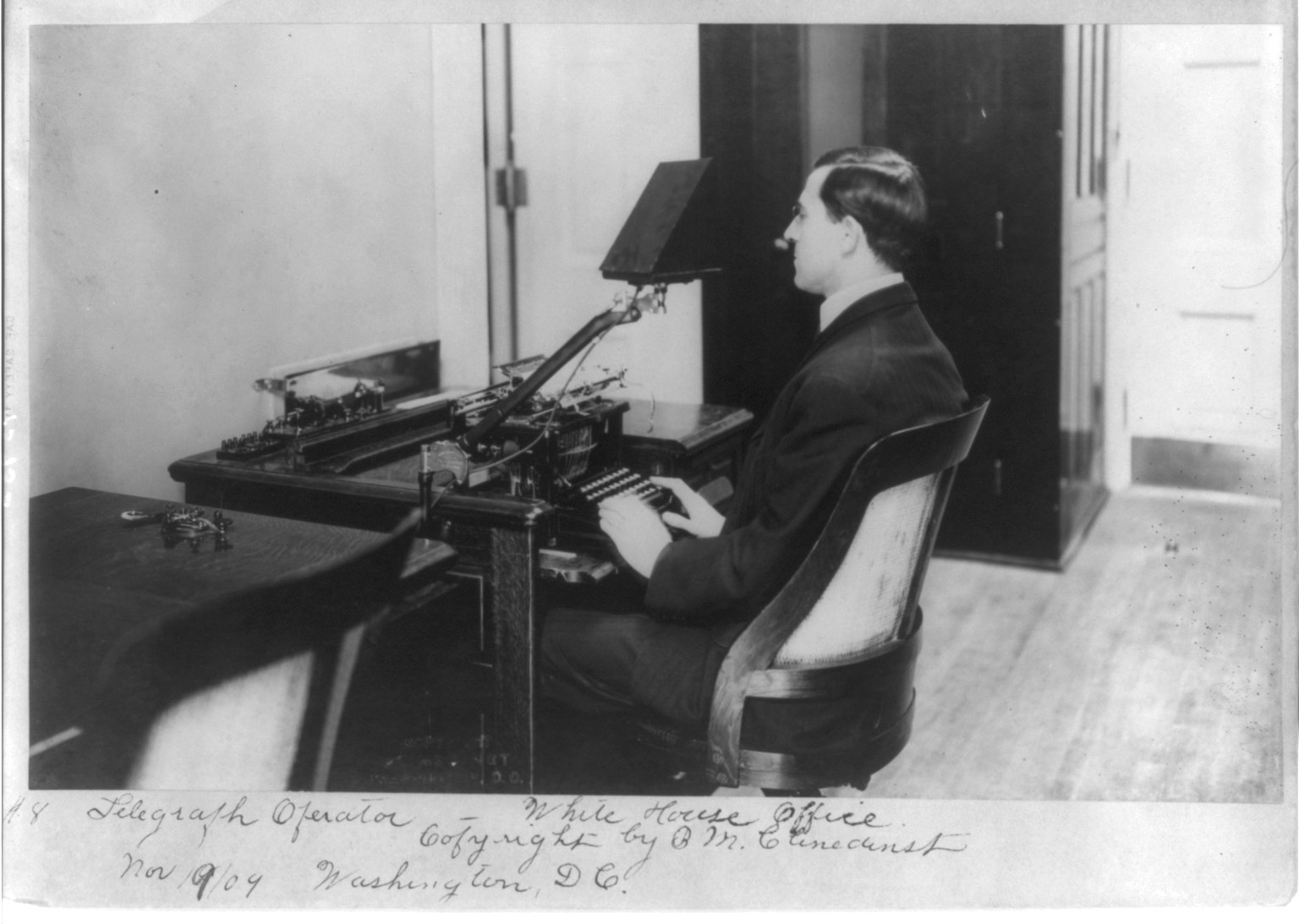
Tom Standage’s phrase — the Victorian Internet — is not a cute exaggeration. Within a single human lifetime the wired world produced everything we think of as distinctly modern about a network: real-time global news, integrated markets, a war run from a command room, a skilled operator class with its own slang and etiquette, online friendships and courtships conducted entirely in Morse between operators who’d never met, and the first anxieties about information overload and privacy on the wire. All of it ran on the humblest possible physical layer: one iron wire, the earth for a return, a battery, a key, and a clicking sounder read by ear.
That last part is why this dive lives at the root of Dots & Dashes. The code you hear on the ham bands tonight is not a quaint survival — it is the native language of the first electrical network humans ever built, and it has never stopped being spoken. When I sit down at a brass key and send, the instrument in my hand is the direct descendant of the landline keys the brass-pounders used in these offices, and the skill in my ear — reading rhythm, not marks — is the exact skill they invented around 1846 when they threw away the paper tape and just listened. Everything after this — the hand keys, the bugs, the keyers, the chrome Hi-Mound UFO I love, even the teletypes and the RTTY and the little Raspberry Pi decoding tones today — is a variation on what these people did first, on one wire, with the whole continent listening.
The next dive, Sounders, Relays & Landline Instruments, opens up the receiving end of that wire — the brass sounder on its resonator box, the relay with its adjusting screws, and the reason American landline Morse is a code you read with your ears. It is, not coincidentally, the dive where Jeff’s love of brass comes fully home.
2.6.1 Sources (Vol 2)
- Western Union: founded 1851 as the New York and Mississippi Valley Printing Telegraph Company (Rochester, NY); renamed Western Union in 1856 on Ezra Cornell’s urging after merging the Erie & Michigan lines; near-monopoly via 1850s–60s consolidation: Wikipedia “Western Union.”
- Transcontinental telegraph: first coast-to-coast line completed 24 October 1861 (Western Union, Omaha↔Carson City); Pony Express announced its closure 26 October 1861: Wikipedia “First transcontinental telegraph,” “Pony Express.”
- Atlantic cable: 1858 cable completed Aug 1858, Victoria–Buchanan exchange ~16 Aug 1858, failed after ~3 weeks (Whitehouse over-volting); 1865 attempt lost mid-ocean; 1866 durable cable laid by SS Great Eastern (largest ship afloat), which also recovered and completed the 1865 cable; ~8 wpm vs 1858’s fraction of a wpm; Cyrus W. Field as promoter: Wikipedia “Transatlantic telegraph cable,” “Cyrus W. Field.”
- Kelvin: William Thomson (Lord Kelvin) mirror galvanometer (used on the 1858 cable) and later siphon recorder (patented 1867): Wikipedia “Mirror galvanometer,” “Siphon recorder.” (Attribution note: the primary galvanometer image used here is a PD book plate; a Science Museum photo of the actual 1858 apparatus exists under CC BY-SA 2.0.)
- Impact: U.S. Military Telegraph Corps (1861, ~15,000 mi of wire; Lincoln in the telegraph office): Wikipedia “U.S. Military Telegraph Corps”; David Homer Bates, Lincoln in the Telegraph Office (1907). Associated Press founded 1846 as the Harbor News Association: Wikipedia “Associated Press.” Railroad time standardization (US standard time, 1883). Overall framing: Tom Standage, The Victorian Internet (1998).
- Image credits: Cooke-Wheatstone five-needle telegraph photo CC BY 2.0 (Flickr “chailey”); transcontinental map, Morse register, Harper’s cable montage, telegraph operator, and Kelvin galvanometer plate all public domain (pre-1928), via Wikimedia Commons / Library of Congress.