The Electric Telegraph · Volume 1
The Electric Telegraph — Vol 1: The Wire and the Men
How a key, a battery, a single iron wire, and a distant electromagnet became the first machine that let a message outrun the horse that carried it. The rival systems of 1837, the collaboration that flattened into one man's name, and the quiet piece of engineering — the relay — that let a signal cross a continent.
1.1 Before it had a name
Every dive in this project comes back, sooner or later, to a boy sitting in his father’s ham shack listening to dots and dashes he couldn’t yet read. But the dots and dashes are older than radio by two full generations. Before Marconi, before the vacuum tube, before there was such a thing as a “signal” traveling through the air, there was a wire — a single strand of iron on glass insulators, marching across the country on poles — and at each end a man with his hand on a key and his ear cocked to a clicking brass instrument. That is where all of it starts: not with wireless, but with the electric telegraph, the machine that first proved you could take a thought, turn it into a pattern of ons and offs, and deliver it a thousand miles away before the day was out.
It is impossible to overstate how strange that was. For the whole of human history up to the 1840s, a message could travel no faster than the fastest thing carrying it — a rider, a ship, a semaphore tower blinking to the next hilltop on a clear day. The telegraph broke that link between message and messenger for the first time. Tom Standage called the resulting network the Victorian Internet, and the comparison is fairer than it sounds: within twenty years the wired world had online romances, hacking, commercial fraud, information overload, and a priesthood of skilled operators who could talk to each other in a shorthand nobody else understood. I recognize those operators. They are my people, a century early.
1.2 Two inventions, one year: 1837
The popular American story starts and ends with Samuel Morse, and it’s wrong in an instructive way. In 1837, two complete, workable electric telegraphs were patented on two continents within months of each other, and they were nothing alike.
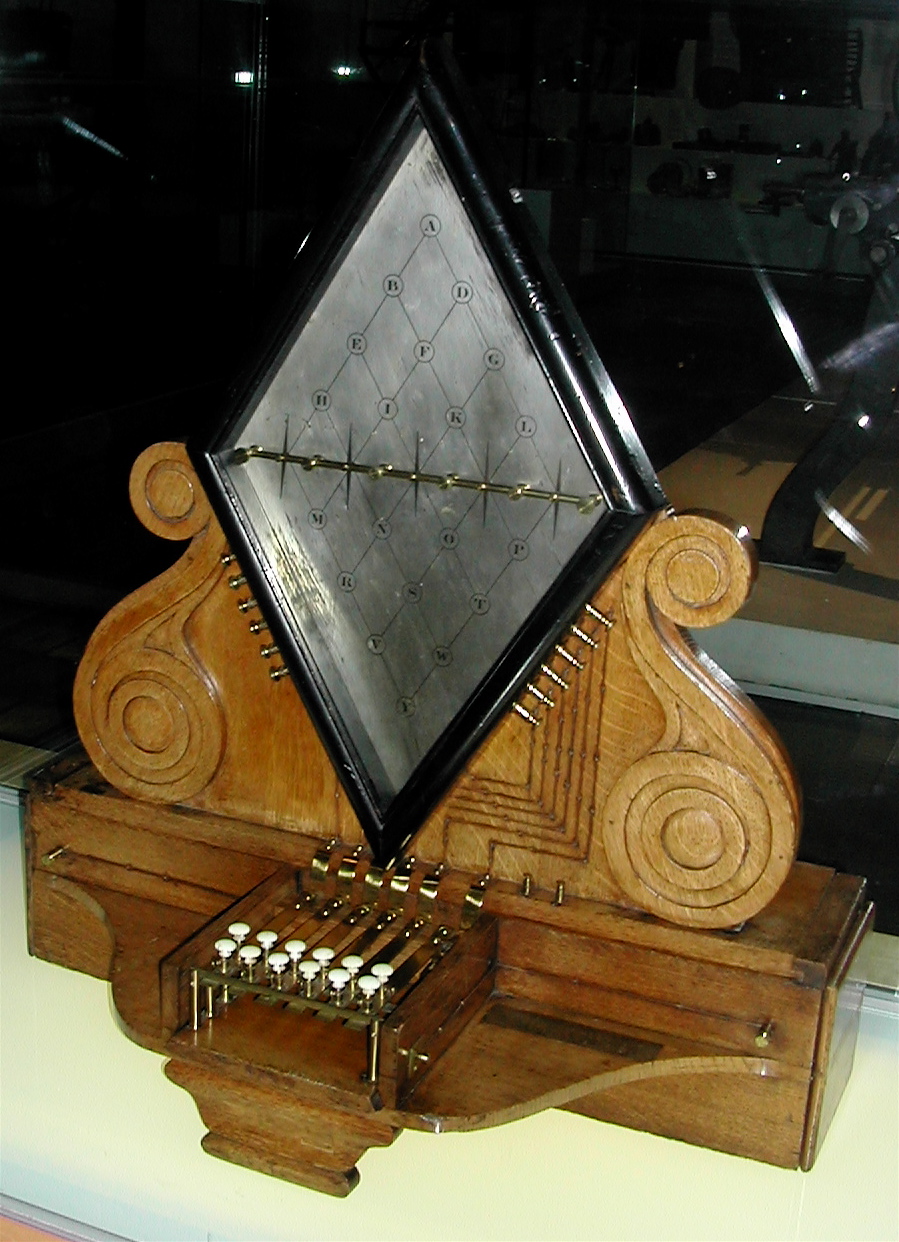
In Britain, William Fothergill Cooke and the physicist Charles Wheatstone patented a needle telegraph. Instead of a code of clicks, theirs used magnetic needles that a current would deflect left or right; the operator swung several needles at once so that they pointed at a letter on a diamond-shaped grid painted on the face of the instrument. The first commercial version had five needles (and needed five or six line wires), and it went into service on the railway between Euston and Camden Town in July 1837 — a genuinely working public telegraph, slightly ahead of Morse’s in actual deployment.
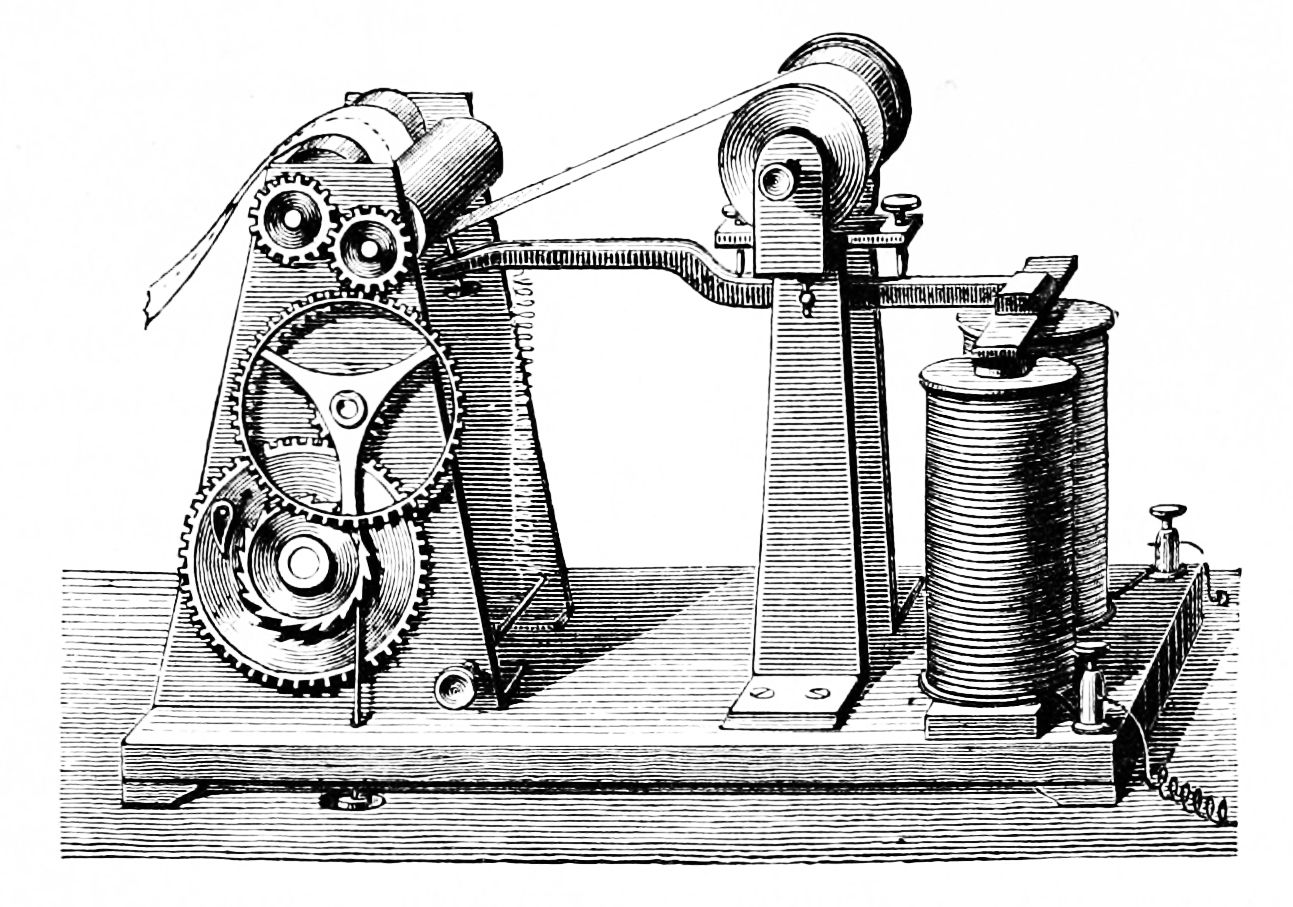
Across the Atlantic, Samuel F. B. Morse — a portrait painter and Yale man, not an engineer — filed for a completely different idea: a single circuit that spelled out letters as a code of long and short current pulses, marked on a moving paper tape by an electromagnet-driven stylus. It is worth being honest about the myth here. Morse was the promoter, the visionary, and the tireless lobbyist, but he was not, on his own, the man who made it work. Two other names belong on the machine:
- Joseph Henry, the American physicist whose work on electromagnets — and specifically on getting a feeble current at the far end of a long wire to do mechanical work — is the physics the whole thing rests on. Henry never patented it; he considered it science, freely given.
- Alfred Vail, the young machinist and partner who built the practical instruments, sank his family’s ironworks money into the project, and did far more of the real mechanical engineering than the name “Morse code” will ever admit. There’s a good case that the efficient dot-dash alphabet we still use owes as much to Vail as to Morse.
I’m not here to knock Morse off his pedestal — the overcorrection (“Morse did nothing”) is as false as the hero-worship. But when you send CW tonight, know that you are using Morse and Vail’s code, resting on Henry’s physics. The flattening of a three-way collaboration into one man’s name is the oldest bug in this whole field’s story.
1.3 “What hath God wrought” — 24 May 1844
After years of lobbying, Congress in 1843 appropriated $30,000 to build a demonstration line from Washington to Baltimore, about forty miles along the Baltimore & Ohio Railroad right-of-way. On 24 May 1844, from the chamber of the Supreme Court in the Capitol, Morse sent to Vail in Baltimore the message that everyone half-remembers: “WHAT HATH GOD WROUGHT.”
The details are worth getting right, because they usually aren’t. The phrase is from Numbers 23:23; it was chosen not by Morse but by Annie Ellsworth, the young daughter of the Commissioner of Patents, a friend who had brought Morse the news that his funding had passed. It is a quotation, deliberately reverent, and — unlike the “SOS = Save Our Souls” backronym we’ll debunk elsewhere — it means exactly what it says. That first message still exists, inked in dots and dashes on a paper tape, in the Library of Congress.
1.4 Why one wire beat six
Here is the technical heart of why Morse’s system conquered the world and Cooke & Wheatstone’s, for all its head start, did not. The needle telegraph was legible at a glance — no code to learn — but it paid for that with wire. Five needles meant five or six wires strung across the country, and wire was the single most expensive thing about a telegraph line. Morse’s system spelled everything out on one circuit. One wire is cheaper than six by any measure, and over the distances America needed to cross, cheap won. Even in Britain, the multi-needle instruments gave way to single-needle sets under exactly this pressure, and worldwide the wire standardized on Morse’s one-circuit, coded approach.
And there is a further, subtler economy. Morse’s original design didn’t even need a full metallic loop out and back. A single overhead wire, with each station’s circuit grounded to a buried metal plate, uses the earth itself as the return conductor — the single-wire earth-return circuit, first demonstrated by Carl August von Steinheil in 1838. That halves the wire again. One strand of iron on the poles, the planet as the other half of the circuit: that is the frugal, elegant physical form of the “Victorian Internet.”
1.5 The register gives way to the ear
Morse imagined the telegraph as a writing machine — the whole point of the “register” was to produce a permanent paper record, dots and dashes embossed or inked on tape, which a clerk would then read back and transcribe. It’s why the code exists as marks at all.
But the operators outran the machine almost immediately. By 1845–46, telegraphers noticed they could recognize the clicks of the register’s armature — the “clack” as it pulled down, the “clack” as it let go — faster than they could read the tape afterward. Within about a decade the paper record was, for most traffic, a needless middleman. A dedicated instrument optimized purely for sound — the sounder — appeared around 1856 and took over, and the register was demoted to the few offices that still legally required a paper copy. (The receiving-side story — the sounder, the resonator, and why American landline Morse is a code you read by ear — is the whole of the next dive, Sounders, Relays & Landline Instruments.)
This matters far beyond the telegraph office, because that acoustic habit — reading a message as a rhythm of sound rather than decoding it as marks — is exactly the skill that carried straight into radio. When a ham copies CW by ear tonight, they are doing the same thing a landline brass-pounder did in 1860: hearing the pattern, not counting the marks. The paper tape was a detour. Sound was always the native tongue.
1.6 The relay: how a signal crosses a continent
There is one more piece of engineering without which none of the network in Volume 2 — the transcontinental line, the ocean cables — is possible. A telegraph signal weakens as it travels. Push a current down a hundred miles of iron wire and what limps out the far end is far too feeble to slam an armature and make an audible click. Left alone, the telegraph would have been a short-range toy.
The fix is the relay, and it is one of those ideas so good it never went away — it’s the direct conceptual ancestor of the vacuum tube, the transistor, and every amplifier since. A relay is a sensitive electromagnet placed on the main line. The weak incoming current isn’t asked to do the loud work of running a sounder; it only has to do the featherweight work of tripping the relay’s delicately balanced armature. And when that armature closes, it switches on a fresh local battery at that station, which drives the local sounder at full strength. The message arrives faint and leaves loud — reborn at every station.
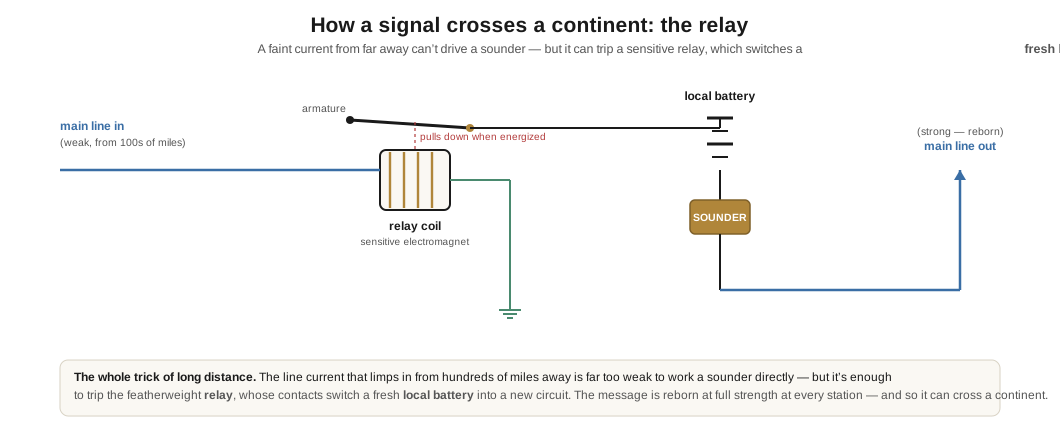
Chain those relays station to station and the line can be as long as you can afford to build it. This is the whole trick of long distance, and it is genuinely beautiful: the signal is not pushed across the continent by one heroic battery in Washington; it is re-created, from scratch, at every relay, out of a fresh local battery’s energy, keyed by the exhausted arriving pulse. The message that reaches San Francisco is not the same electrons that left New York. It’s a copy of a copy of a copy — and it is perfect, because each relay makes a clean new pulse rather than passing along a degraded one.
Hold that picture. In Volume 2, we string these single wires and their relays across a continent and then under an ocean, put the Pony Express out of business in the space of two days, and watch a painter’s stubborn idea turn into the nervous system of the modern world.
1.6.1 Sources (Vol 1)
- Cooke & Wheatstone needle telegraph (patented May 1837; five-needle instrument; Euston–Camden Town railway demonstration 25 July 1837; needle-per-wire cost disadvantage): Wikipedia “Cooke and Wheatstone telegraph”; Science Museum Group collection record (5-needle telegraph, 1837).
- Morse / Vail / Henry: the 1844 Washington–Baltimore line (~40 mi, B&O right-of-way), “What hath God wrought” 24 May 1844, Numbers 23:23, phrase chosen by Annie Ellsworth: Wikipedia “Baltimore–Washington telegraph line”; U.S. Senate “Morse’s Telegraph in the Capitol.” Joseph Henry’s electromagnet physics (unpatented) and Alfred Vail’s mechanical/code contribution: Wikipedia “Alfred Vail,” “Morse code.” The $30,000 Congressional appropriation of 1843.
- Single wire over multi-wire; earth return: single-wire earth-return demonstrated by Carl August von Steinheil, 1838; ground completes the circuit, halving wire: Wikipedia “Earth-return telegraph.”
- Register → sound reading: operators reading the register’s clicks by ear from ~1845–46; the purpose-built sounder c. 1856 displacing the paper register: zerobeat.net “History of Morse telegraphy” (ch. 19); electronics-notes.com “Morse telegraph sounder.” Cross-link: The Telegraph → Sounders, Relays & Landline Instruments.
- The relay as an electromechanical amplifier (weak main-line current switches a fresh local battery; chaining regenerates the signal over distance): Wikipedia “Earth-return telegraph”; Morse Telegraph Club “Ask the Wire Chief.” Framing: Tom Standage, The Victorian Internet (1998).