The Code, Timing & Abbreviations · Volume 2
The Code, Timing & Abbreviations — Vol 2: The Alphabet, the Tree, and the Shorthand
The characters themselves, a way to decode them by branching, and the dense shorthand — prosigns, Q-codes, and abbreviations — that lets two operators hold a whole conversation in a fraction of the letters.
2.1 The alphabet
Here is the whole International Morse alphabet — letters, numerals, and the two element lengths (Figure 1). This is the chart to laminate.
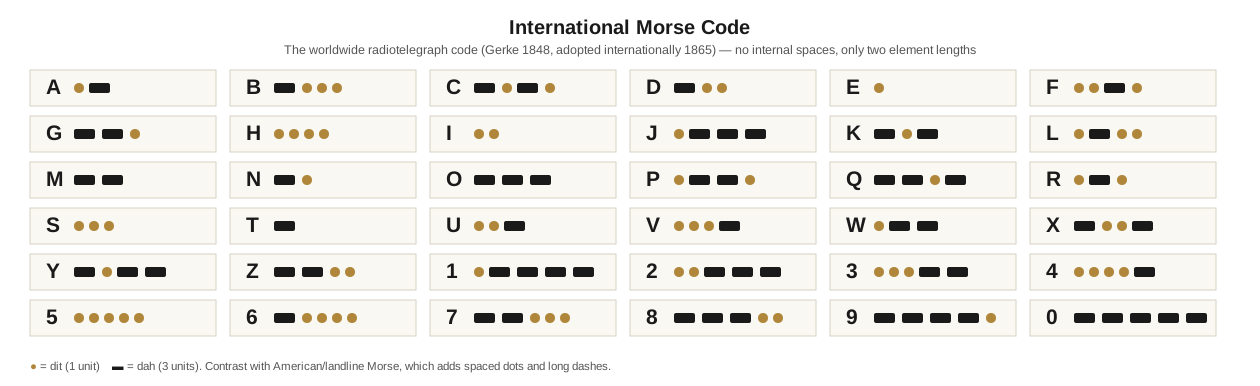
Notice the elegance the code inherited from Murray-era frequency-weighting (the History dive): the commonest letters are the shortest. E is a single dit, T a single dah, I and A and N and M just two elements each. The rarer the letter, the longer its code. That’s not an accident; it’s what makes Morse fast.
2.2 Decoding by branching: the Morse tree
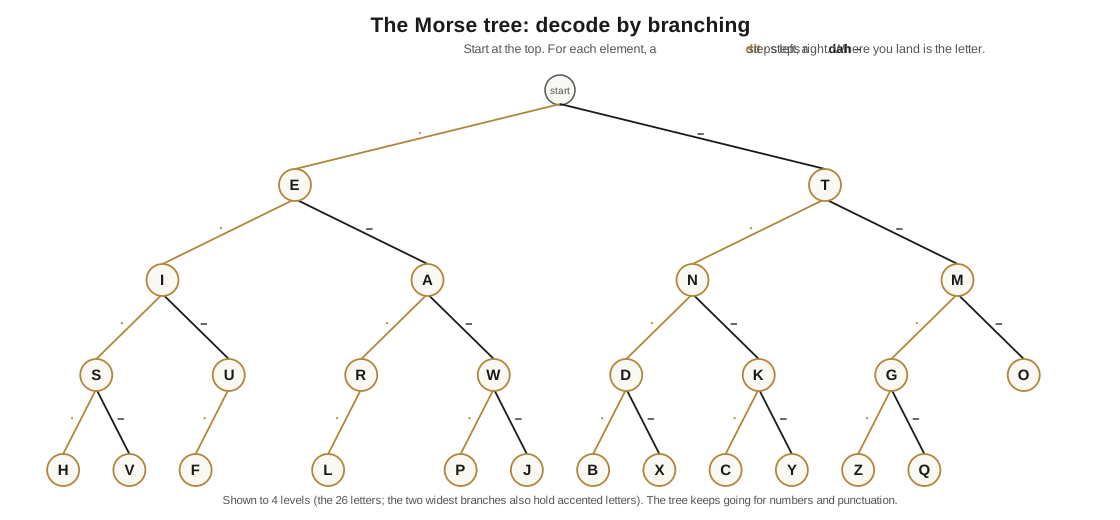
There’s a lovely way to see the whole alphabet’s structure at once — as a binary tree (Figure 2). Start at the top; for each element you hear, a dit steps left and a dah steps right; where you stop is your letter. It’s not really how a fluent operator copies (they hear whole letters, and whole words, as sounds), but it’s a wonderful map of how the code is built, and a genuine decoding aid when you’re learning.
2.3 Punctuation and prosigns
Beyond letters and numbers, a working operator needs punctuation and prosigns — and here’s the key distinction: a prosign is two or more letters run together as a single symbol with no gap between them, used as a procedural signal. The only thing that turns the letters A and R into the prosign AR is the absence of the 3-unit letter gap. The essentials:
Table 1 — Beyond letters and numbers, a working operator needs punctuation and prosigns — and here's the key distinction: a prosign is two or more letters run together as a single symbol with no gap between them, used as a procedural signal. The only thing that turns the letters A and R into the prosign AR is the absence of the 3-unit letter gap. The essentials
| Symbol / prosign | Meaning | Code |
|---|---|---|
Period . | full stop | ·−·−·− |
Comma , | comma | −−··−− |
Question ? | question mark | ··−−·· |
Slash / | fraction bar | −··−· |
AR (= +) | end of message | ·−·−· |
BT (= =) | break / new section | −···− |
| SK (VA) | end of contact | ···−·− |
| KN | go ahead, named station only | −·−−· |
| AS | wait / stand by | ·−··· |
| Error (HH) | error — correct text follows | ········ (8 dits) |
(Yes, AR shares its pattern with +, and BT with = — the prosign is the punctuation, told apart by context and by being sent run-together.)
2.4 Cut numbers
In contests, where you send the same signal report (“599”) thousands of times, operators shorten the digits into cut numbers — a letter that sounds almost like the number but is quicker to send. The two everyone uses are T for 0 and N for 9, so “599” becomes the famous “5NN.” The common set:
Table 2 — In contests, where you send the same signal report ("599") thousands of times, operators shorten the digits into cut numbers — a letter that sounds almost like the number but is quicker to send. The two everyone uses are T for 0 and N for 9, so "599" becomes the famous "5NN." The common set
| 0 = T | 1 = A | 2 = U | 3 = V | 5 = E | 7 = G | 8 = D | 9 = N |
|---|
(T=0, N=9, A=1, and E=5 are near-universal; the middle ones vary by operator, and 4 and 6 are usually sent in full.)
2.5 Q-codes: a question in three letters
The Q-codes are the genius shorthand of radio — three-letter codes that each carry a whole sentence, and that work as either a question or a statement. They came off the wire (the Telegraph dive) and went worldwide. The ones every CW operator knows:
Table 3 — The Q-codes are the genius shorthand of radio — three-letter codes that each carry a whole sentence, and that work as either a question or a statement. They came off the wire (the Telegraph dive) and went worldwide. The ones every CW operator knows
| Q | Means | Q | Means | |
|---|---|---|---|---|
| QRZ | who’s calling me? | QSY | change frequency | |
| QRM | man-made interference | QTH | my location is… | |
| QRN | static / atmospheric noise | QSL | I acknowledge / QSL card | |
| QSB | your signal is fading | QRT | I’m shutting down | |
| QRP | low power (≤5 W) | QRV | I’m ready | |
| QRO | increase power | QRX | stand by, I’ll call again | |
| QSO | a contact / conversation | QTC | I have messages for you |
2.6 The abbreviations — and the fist
Finally, the plain shorthand: abbreviations (unlike prosigns, sent as normal separate letters) that trim the common words of a QSO down to a few characters. A short conversation in CW is dense with them:
Table 4 — Finally, the plain shorthand: abbreviations (unlike prosigns, sent as normal separate letters) that trim the common words of a QSO down to a few characters. A short conversation in CW is dense with them
| 73 | best regards | DE | ”from” (this is…) | |
|---|---|---|---|---|
| 88 | love and kisses | K | over — any station transmit | |
| OM | old man (any op) | R | received / roger | |
| YL / XYL | young lady / wife | CQ | calling any station | |
| FB | fine business (great) | AGN | again | |
| HI | laughter (ha-ha) | ES | and (&) | |
| WX | weather | HR | here / hear | |
| PSE | please | TNX / TU | thanks | |
| RST | signal report | GM/GA/GE | good morning/afternoon/evening |
Put it together and “CQ CQ CQ DE N0SWN N0SWN K” — calling any station, this is N0SWN, over — is a complete, efficient hail in a handful of characters. And when I send it by hand, it carries the one thing no abbreviation can encode: my fist. Every operator’s hand-sent Morse has a subtly individual rhythm — a hair long on the dahs, a certain lilt in the spacing — and a good fist is even, clean, and easy to copy, while a bad one runs its letters together. Experienced operators recognize each other on the air by fist alone, the way you’d know a friend’s handwriting. It is the human fingerprint left on a code made of nothing but time — and it’s exactly what the next dive, Learning & Operating CW, is about building in your own hand.
2.6.1 Sources (Vol 2)
- International Morse alphabet, numerals, punctuation, and prosigns (AR/BT/SK/KN/AS, 8-dit error; AR=+, BT==): ITU-R M.1677-1; Wikipedia “Prosigns for Morse code”; morsecode.world. https://en.wikipedia.org/wiki/Prosigns_for_Morse_code
- Cut numbers (T=0, N=9, A=1, E=5 universal; U/V/G/D vary): johndcook.com; masteringmorse.com; ac6v.com. Q-codes: Wikipedia “Q code”; ARRL Q-signals. CW abbreviations: hamuniverse.com; maritimeradio.org. The “fist” (individual, recognizable rhythm): Wikipedia “Morse code.” Cross-link: Morse & CW → Learning & Operating CW.