The Code, Timing & Abbreviations · Volume 1
The Code, Timing & Abbreviations — Vol 1: Dits, Dahs, and the Clock
Morse isn't dots and dashes — it's dots and dashes and silence, all measured in one unit of time. Get the clock right and the code is legible; get it wrong and it's mush. Here is the timing, exactly.
1.1 The code is really about time
Everyone thinks Morse code is dots and dashes. It isn’t — it’s dots, dashes, and the silences between them, and all of it is measured against a single yardstick: the length of one dit. Get the silences right and even a sloppy fist is readable; get them wrong and perfect dots and dashes turn to porridge. This is the reference dive — the one you keep open on the bench — and it starts where the code actually lives: the clock.
1.2 The five numbers
The entire timing of International Morse is five numbers, all in units of one dit, and they are fixed by international standard (ITU-R M.1677):
Table 1 — The entire timing of International Morse is five numbers, all in units of one dit, and they are fixed by international standard (ITU-R M.1677)
| Element | Duration |
|---|---|
| a dit | 1 unit |
| a dah | 3 units |
| gap between elements inside a character | 1 unit |
| gap between letters | 3 units |
| gap between words | 7 units |
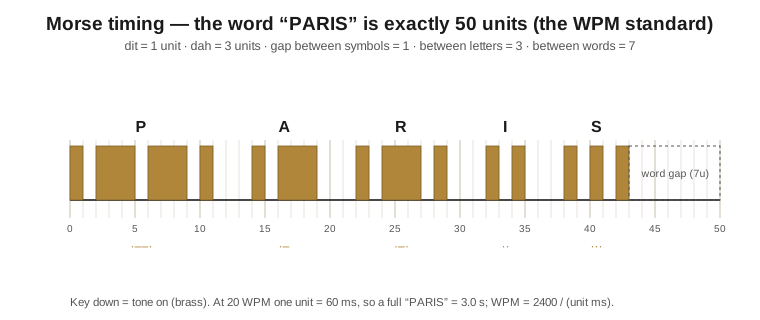
That’s it. Figure 1 keys out the word PARIS against a unit grid so you can see all five at once.
1.3 The “4-unit” trap — and how PARIS proves it wrong
Here’s a correction worth making carefully, because it trips up beginners and even some code-trainer software (including, I’ll admit, the notes for a DIY CW trainer I have on the bench, which say “space between letters = 4 dits”). The gap between letters is 3 units, not 4. The “4” comes from an off-by-one double-count — mentally treating each character as ending with its internal 1-unit gap and then adding a full 3-unit letter gap on top (1 + 3 = 4). But the standard is clear: the 1-unit gap only lives between elements inside a character; between characters, the gap is 3 units, total.
And there’s a beautiful proof that 3 (not 4) is right: the word PARIS. By definition PARIS-plus-a-word-space is exactly 50 units — that’s what makes it the yardstick for speed. Add up PARIS with 3-unit letter gaps and a 7-unit word gap and it comes to exactly 50. Use a 4-unit letter gap and it comes to 54, which breaks the entire words-per-minute standard. The arithmetic settles it: 3 and 7.
1.4 Speed: PARIS, WPM, and one simple formula
Because PARIS is exactly 50 units, sending it once per minute is 1 word per minute, and everything scales from there. The relationship between speed and the length of a dit is one clean formula:
dit length (ms) = 1200 / WPM
So at 20 WPM a dit is 60 ms; at 13 WPM (the old US license-exam speed) it’s about 92 ms. The full picture:
Table 2 — So at 20 WPM a dit is 60 ms; at 13 WPM (the old US license-exam speed) it's about 92 ms. The full picture
| WPM | dit length |
|---|---|
| 5 | 240 ms |
| 13 | 92 ms |
| 20 | 60 ms |
| 25 | 48 ms |
| 35 | 34 ms |
(You’ll also see the word CODEX — 60 units — used as an alternative standard when the “words” are random 5-letter code groups rather than real English. At 20 WPM CODEX gives a 50 ms dit. PARIS is the usual one.)
1.5 Farnsworth: bending the clock to learn
The timing has one famous, deliberate distortion, used for teaching, and it’s worth understanding here because it’s pure clock manipulation (Figure 2). The problem: a beginner who simply slows the whole code down learns to count the dits and dahs, and hits a wall around 10 WPM because counting doesn’t scale. Farnsworth timing (named for Donald “Russ” Farnsworth, W6TTB) fixes this by splitting the two clocks apart: it sends each character at full speed — say 18 WPM — so you learn the letter’s sound-shape as one gestalt, while stretching the gaps between characters so the overall speed drops to something copyable, say 5 WPM.
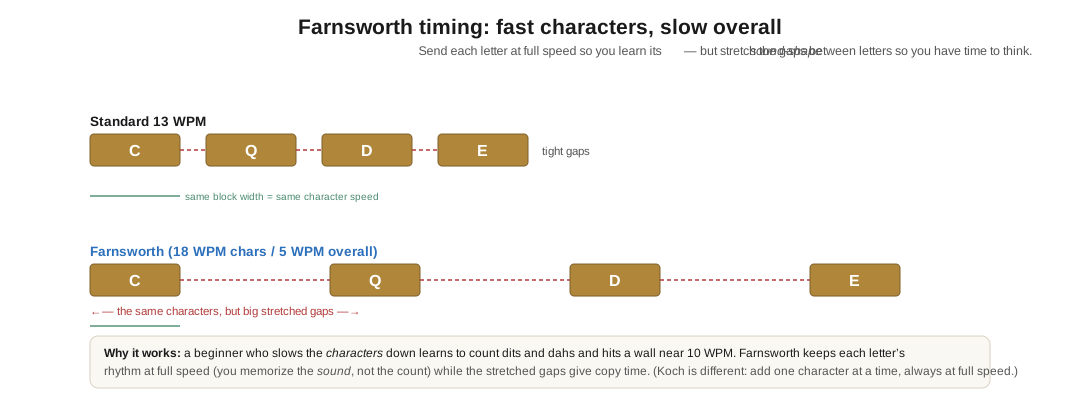
You get the best of both: full-speed rhythm to memorize, slow-enough pace to keep up. (The Koch method is a different learning approach — it keeps full target speed from the very start and adds characters one at a time as you master each — and it belongs to the Learning & Operating CW dive.) Volume 2 leaves the clock behind for the characters themselves — the full alphabet, the decoding tree, the punctuation and prosigns, and the shorthand that lets operators talk fast.
1.5.1 Sources (Vol 1)
- ITU-R M.1677-1, “International Morse code” — the unit timing (dit 1, dah 3, inter-element 1, inter-letter 3, inter-word 7). https://www.itu.int/dms_pubrec/itu-r/rec/m/r-rec-m.1677-1-200910-i!!pdf-e.pdf (quoted in Wikipedia “Morse code”).
- PARIS = 50 units and dit(ms) = 1200/WPM; CODEX = 60 units: morsecode.world/international/timing. The “4-unit letter gap” is an off-by-one double-count, disproved by PARIS summing to 50 only with 3/7.
- Farnsworth timing (characters at full speed, stretched spacing; Donald “Russ” Farnsworth W6TTB) and the Koch distinction: ARRL Farnsworth standard (KE3Z); morsecode.world/international/timing/farnsworth.html. Cross-link: Morse & CW → Learning & Operating CW (Koch, the learning path).