Teletype Machines · Volume 2
Teletype Machines — Vol 2: The Machines
Four machines carried the electromechanical age: the cast-iron Model 15 that ran the news and the war, its tape-handling sibling the 19, the rugged Model 28, and the Model 33 that walked out of the wire room and became the first computer terminal.
2.1 One company, a handful of legends
Almost every teletype an American ever touched came from one firm. Morkrum-Kleinschmidt became the Teletype Corporation in 1928, was bought by AT&T in 1930, and built its machines in Chicago for the rest of the century. A few of its models are genuine legends, and knowing them is knowing the whole electromechanical age of text.
2.2 The Model 15 — the cast-iron workhorse
The Model 15 is the one most people picture: a heavy, cast-iron page printer (it prints on a page/roll, not a tape) that speaks 5-level ITA2 at “60 speed.” It was the mainstay of U.S. military communications in World War II, and in its keyboardless, receive-only form it was the classic “news teletype” clattering in every newspaper office. Its production record is staggering — roughly 33 years of continuous manufacture, until 1963, something like 200,000 machines. If you’ve seen one teletype in a movie, it was probably a Model 15.
2.3 The Model 19 — the Model 15 that handles tape
The Model 19 is a Model 15 that grew a paper-tape habit. It’s the Model 15 page printer combined, on one table set, with a paper-tape perforator (to punch tape) and a Model 14 Transmitter-Distributor — a tape reader that plays a punched tape back onto the line at a steady speed. That combination — punch a message onto tape, then let the machine send it perfectly — is the whole idea of store-and-forward working, and it’s the subject of the next dive (Paper Tape & the Perforator). The 19 was the standard message-handling set for years.
2.4 The Model 28 — the rugged one
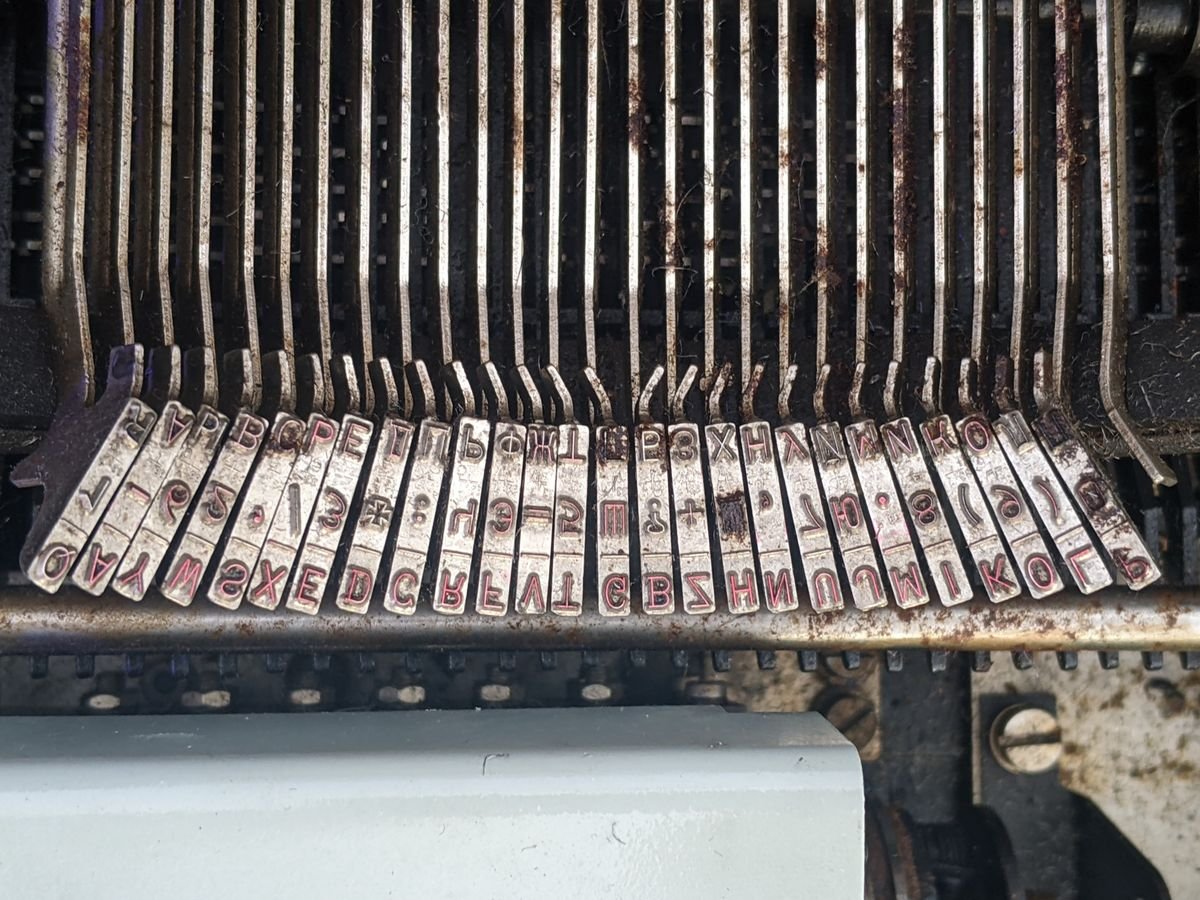
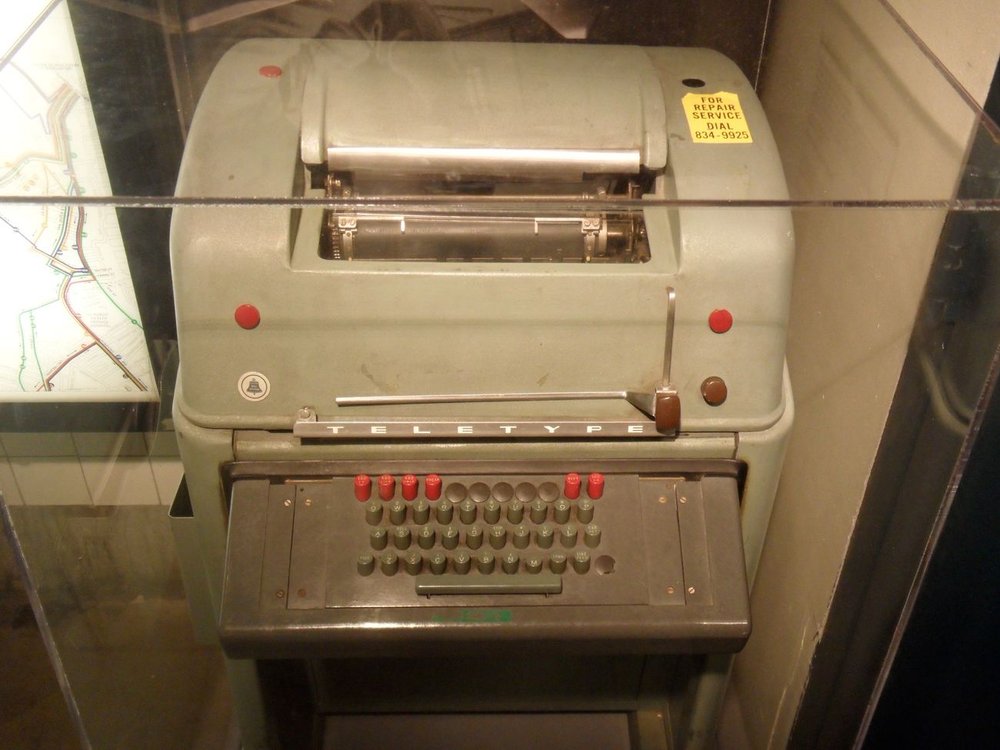
Where the Model 15 was cast iron, the Model 28 was engineered iron — “regarded as the most rugged machines Teletype Corporation built.” It introduced an exchangeable type box (swap the printing element instead of rebuilding the machine), first went to the U.S. military in 1951 and commercial service in 1953, and typically ran at 100 words per minute — faster than the 60-speed Model 15. It came as a KSR (keyboard + printer) or an ASR (with a built-in tape punch and reader). Boxy, grey, and nearly indestructible, the 28 ran the military and financial wires for decades.
2.5 The Model 33 — the machine that met the computer
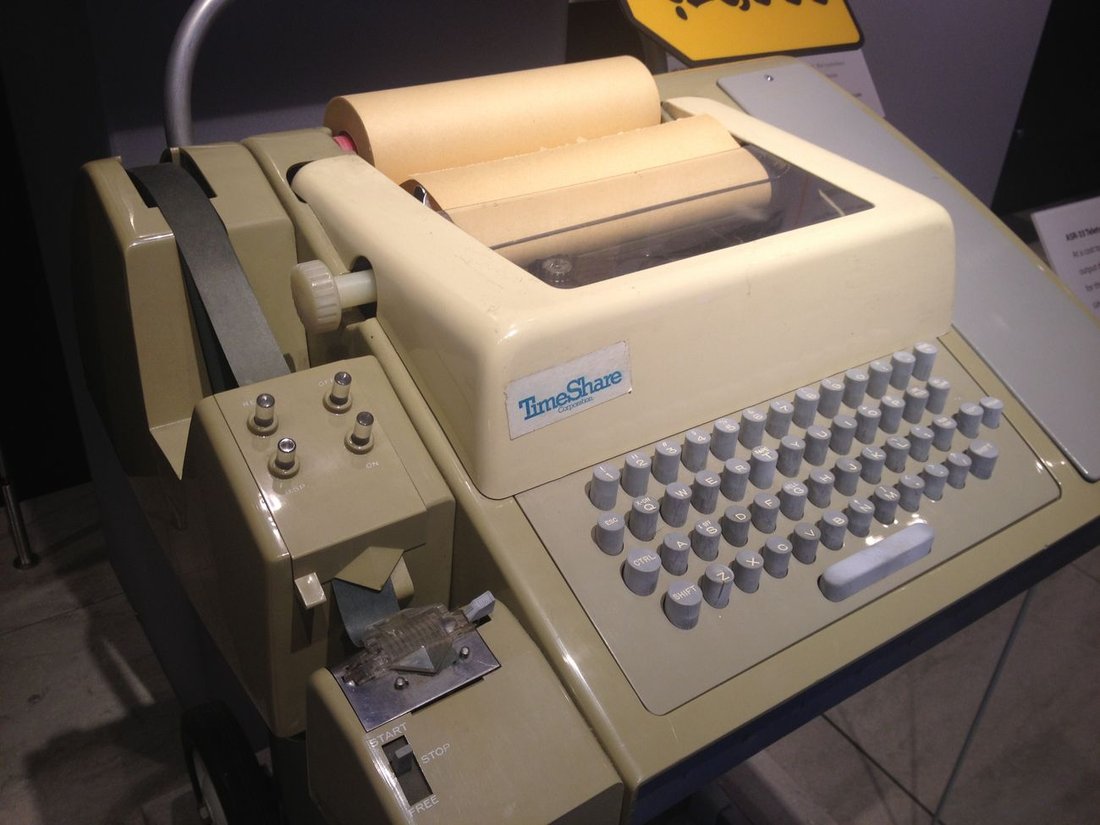
And then there’s the one that changed everything by leaving the wire room. The Model 33 ASR (1963, originally designed for the U.S. Navy) was among the first products to use the brand-new ASCII code — 7 bits, not 5 — running at 110 baud, ten characters per second. And in its ASR form it carried an 8-hole paper-tape punch and reader on its left side (note: 8-level ASCII tape, not the 5-level Baudot tape of the older machines — a real distinction).
Its arrival lined up with a hinge in history: 1963 saw the Model 15’s production end, ASCII published, and the Model 33 introduced. That timing is why the Model 33 ASR became ubiquitous as the console of the early minicomputer era — the beige machine you see beside a DEC PDP-8 or a Data General Nova in every photo of 1960s–70s computing. For a whole generation, the Model 33 was the first thing you ever typed a program into, and its paper tape was how you saved it. The teletype had started as a telegraph instrument and ended as the ancestor of the computer terminal.
2.6 KSR, ASR, RO — and the bells
Three little abbreviations you’ll meet on every teletype:
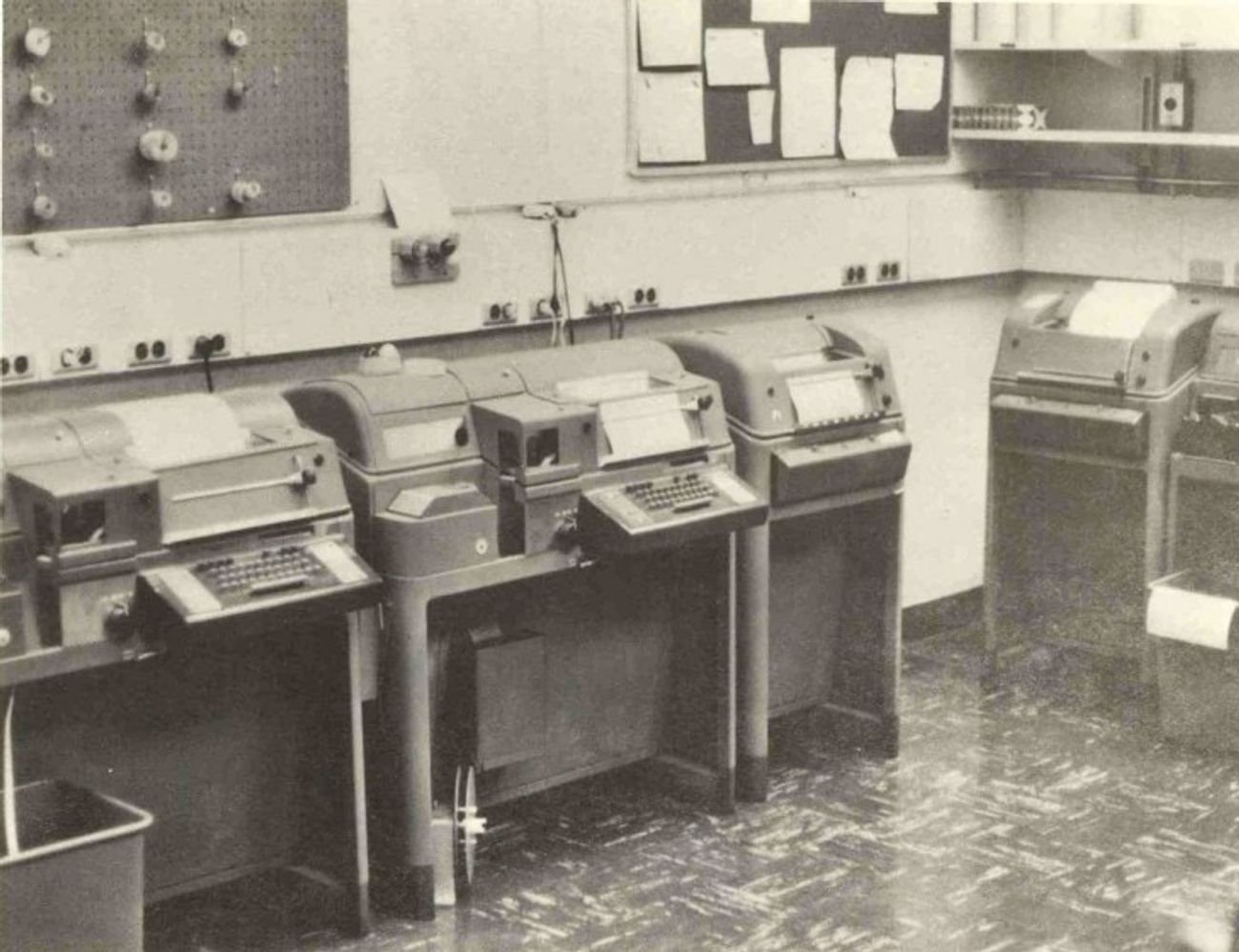
- KSR — Keyboard Send-Receive: a keyboard and a printer. You type, it prints, the far machine prints. No tape.
- ASR — Automatic Send-Receive: a KSR plus a paper-tape punch and reader, so you can prepare and store messages on tape and send them automatically. The full store-and-forward machine.
- RO — Receive Only: no keyboard at all — the classic news teletype that just prints what comes down the wire.
And one perfect detail about that news wire: the machines rang a bell (the ASCII/ITA2 BEL character) to get an operator’s attention, and the wire services turned the number of bells into a code of urgency — on the UPI wire, four bells meant “Urgent,” five bells a “Bulletin,” and ten bells a FLASH. A reporter dozing on the night desk would come awake to a machine frantically ringing ten times because something enormous had just happened. That, and the carriage slamming home with a CR/LF at the end of every line (a pairing the Murray code introduced), is the teletype I remember — a machine that didn’t just print the news, it announced it. The reels of tape those machines punched and read are the next dive.
2.6.1 Sources (Vol 2)
- Wikipedia, “Teletype Corporation” (renamed 1928, AT&T 1930, Chicago; the Model 15 news teletype; the Model 19 = Model 15 + perforator + Model 14 TD), “Teletype Model 15” (WWII mainstay, ~33 years’ production to 1963). https://en.wikipedia.org/wiki/Teletype_Corporation
- Wikipedia, “Teletype Model 28” (most rugged, exchangeable type box, 1951 military/1953 commercial, KSR/ASR, ~100 WPM) and “Teletype Model 33” (ASCII, 110 baud, 10 cps, 8-hole tape, ASR/KSR, 1963, US Navy origin, the early-minicomputer console). https://en.wikipedia.org/wiki/Teletype_Model_33
- Wikipedia, “Teleprinter” — KSR/ASR/RO; the BEL character and the UPI 4/5/10-bell urgency codes; CR/LF from the Murray code. Cross-link: Teletype, Tape & RTTY → Paper Tape & the Perforator (store-and-forward tape working).