Teletype Machines · Volume 1
Teletype Machines — Vol 1: The Clatter in My Father's Shack
A teletype is a typewriter that types by itself, a hundred miles away, and it does it with a five-bit code and a beautiful trick for starting each letter. Here is how it worked — and where I first fell in love with the sound of it.
1.1 The sound I grew up on
The Morse code came out of the speaker in my father’s ham shack, but the teletypes you could feel in your chest. In the late 1960s and early ’70s I would sit in that shack and watch the machines run — the heavy grey printers hammering out line after line, the carriage slamming back with a bang at the end of each row, the little bell dinging, and the reels of pale paper tape (the ones I remember as pink) spooling out of the punch. It was mechanical and loud and alive in a way the radio never was, and I have loved teletype machines ever since. This whole Teletype, Tape & RTTY sub-project comes out of that room. This dive is about the machines themselves — what a teletype actually is, and the clever code and mechanism that let a typewriter type by itself from a hundred miles away.
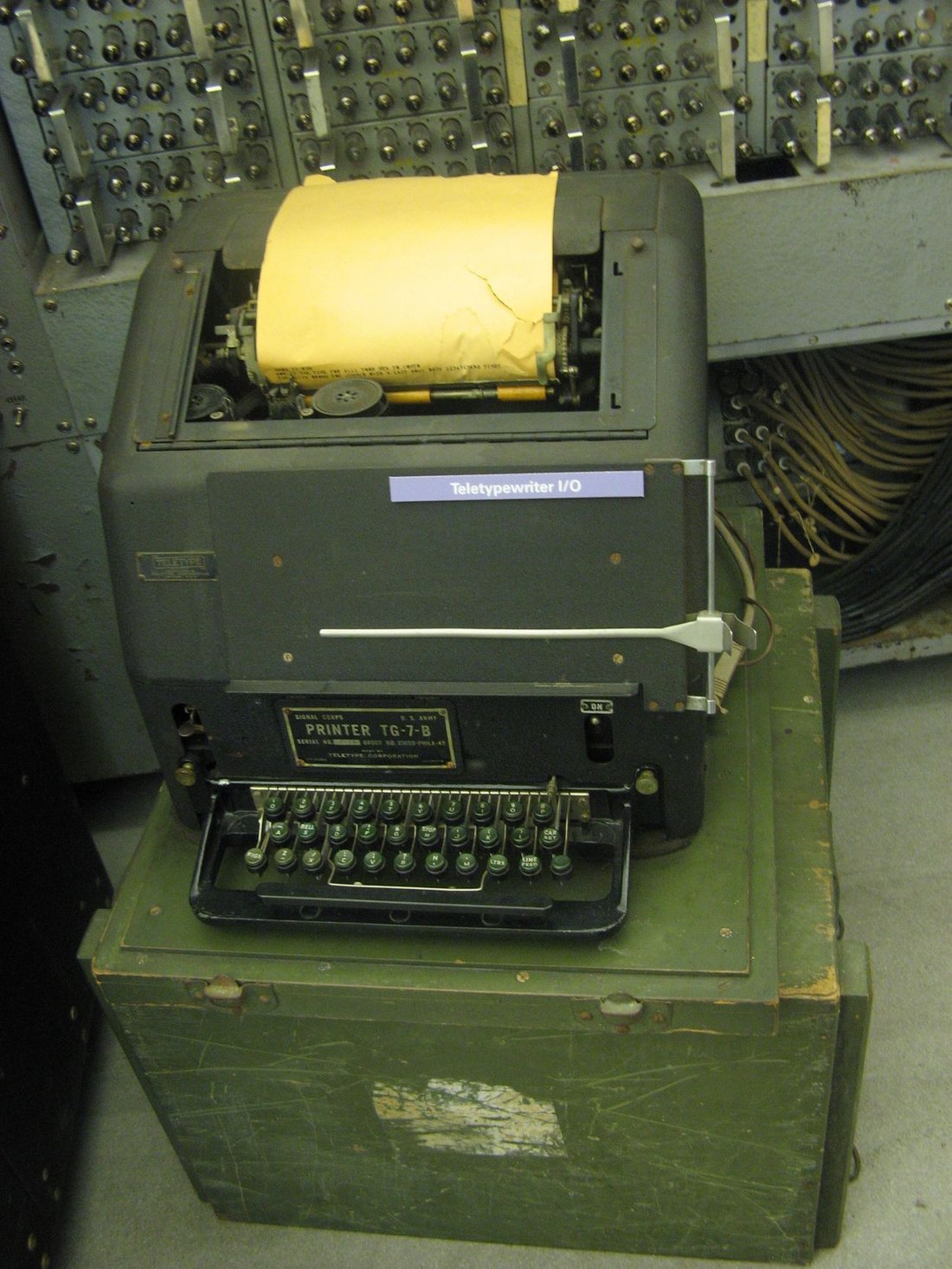
1.2 What a teletype is
A teletype (teleprinter, teletypewriter) is an electromechanical machine that sends and receives typed text over a wire or a radio link. You type on a keyboard; the machine turns each character into a pattern of electrical pulses; a distant machine reads those pulses and prints the character on paper — no operator needed at the far end. It is Morse’s idea (text over a wire) with the human decoded out of the loop: where a brass-pounder had to hear the code and type it, a teletype does the sending and the receiving mechanically. It is, at heart, a typewriter that types by itself.
1.3 The five-bit code — and the myth about its name
Every teletype character is just five bits. That’s the foundation, and it comes with a naming correction worth making up front, because nearly everyone (including, famously, the ARRL Handbook) gets it wrong.
- Émile Baudot built a multiplexed telegraph in the 1870s (patented 1874) and settled on a 5-bit code by 1876. His name is why we say “baud.”
- But the code your teletype actually uses isn’t Baudot’s. In 1901, Donald Murray rebuilt the system around a typewriter-style keyboard and paper tape, and — cleverly — he reassigned the code by letter frequency to minimize wear on the machinery, giving the commonest letters the fewest punched holes (E and T each became a single hole). Murray’s code, standardized internationally as ITA2 in 1932 (and as “US TTY” in America), is what runs on a teletype.
So when a ham says their machine sends “Baudot,” they almost always mean ITA2 / US TTY — a Murray-descended code, not Baudot’s original. I’ll call it ITA2 and note where “Baudot” is used loosely.
1.4 Five bits can’t spell — so the code shifts
Five bits give only 2⁵ = 32 combinations, and that’s not nearly enough for 26 letters plus ten digits plus punctuation. The solution is elegant (Figure 1): the same 5-bit code means two different things, depending on which mode the machine is in. Two of the 32 codes are reserved as shift characters — LTRS (letters, 11111) and FIGS (figures, 11011) — and sending one flips the machine between a letters interpretation and a figures interpretation of every following code. On a US teletype the top keyboard row does double duty exactly this way: the code for Q is also the code for 1, W is 2, E is 3, and so on.
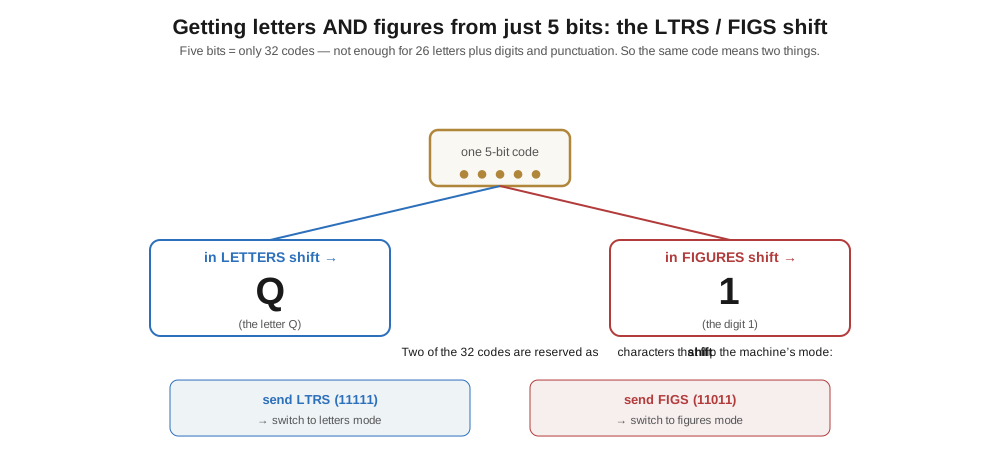
(This is why an old teletype message garbled by a missed shift comes out as gibberish digits where words should be — it never got the LTRS character and stayed stuck in figures mode.)
1.5 The start-stop trick: how the far machine keeps in step
Here’s the problem that makes teletype genuinely clever. The sending and receiving machines are not connected to a shared clock — each has its own motor, free-running. So how does the receiver know where one character ends and the next begins? The answer is the start-stop frame (Figure 2), and it’s the heart of asynchronous serial communication (the same idea your computer’s serial port still uses).
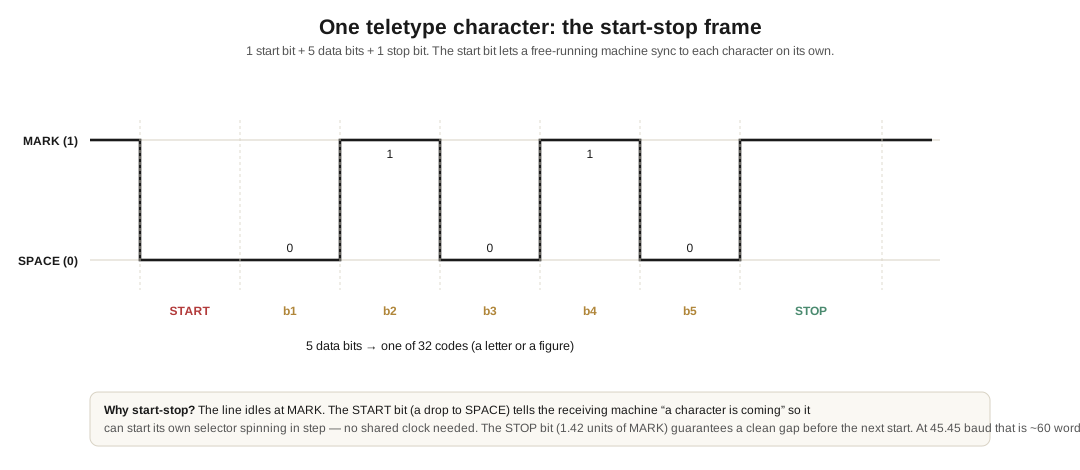
- The line idles at MARK (current flowing).
- Each character begins with a START bit — a drop to SPACE — which tells the receiving machine “here it comes” and trips its selector into motion, spinning up in step for exactly this one character.
- Then the five data bits go by.
- Then a STOP bit — about 1.42 units of MARK (an odd length that’s really a mechanical rest, letting the printer’s iron catch up) — guarantees a clean gap before the next START.
Because the machine re-synchronizes on every single character, the two motors never have to stay in lockstep for long, and small speed differences don’t matter. The standard amateur/US speed is “60 speed” — 45.45 baud, about 60 words per minute; Europe often ran “66 speed,” 50 baud.
1.6 The mass of oiled iron
None of this was electronic — it was machinery, and gloriously so. On receive, the incoming pulses (a current loop — 60 mA on the old machines, 20 mA on the later ones) energize a selector magnet that trips a clutch; a rotating distributor samples the five bits in time and sets a stack of code bars, and those bars mechanically pick the right character out of a type box or type basket and slam it against the paper. It is serial-to-parallel conversion done entirely in cast iron and cams, forty pounds of it, oiled and clattering. That clatter — the thing I felt in my chest as a boy — was the sound of a machine thinking in metal. Volume 2 is about the specific machines that made it: the Model 15, the tape-handling Model 19, the rugged Model 28, and the Model 33 that walked out of the wire room and became the first thing a lot of people ever typed a computer program on.
1.6.1 Sources (Vol 1)
- Wikipedia, “Baudot code” — Baudot’s 5-bit code (1874/1876); Murray’s 1901 keyboard + paper tape + frequency-reordered code (E, T = one hole); ITA2 (1932 CCITT) / US TTY; and the explicit note that hams (and the ARRL Handbook) call ITA2 “Baudot” incorrectly. https://en.wikipedia.org/wiki/Baudot_code
- Wikipedia, “Teleprinter” — the start-stop frame (1 start + 5 data + 1.42 stop), “60 speed” = 45.45 baud ≈ 60 WPM (and 50 baud ≈ 66 WPM); LTRS/FIGS shift; current-loop signaling; the type box and cast frame. https://en.wikipedia.org/wiki/Teleprinter
- Wikipedia, “Baud” — the unit is named after Émile Baudot. Mechanism (rotating distributor/selector, code bars, current loop 60→20 mA): corroborated by the hughpyle ASR33 documentation and the Teletype selector patent (US3406254A).