Straight Keys and Hand Keys · Volume 2
Straight Keys & Hand Keys — Vol 2: The Canon — Military Keys, Great Makers, and Brass
The war-surplus J-38 that was everyone's first key, the enclosed navy keys that couldn't spark, the makers from Bunnell to a little firm in Michigan, and the modern brass keys worth saving up for.
2.1 The key that taught a generation: the J-38
If you learned code in mid-century America, your first key was almost certainly a J-38. It was the U.S. Army Signal Corps’s standard WWII training and practice key — a flat bakelite base, a nickel-plated lever, a shorting switch at the back, and binding posts to wire it in series with headphones and a training oscillator. The military had them made by the hundreds of thousands, by a roll-call of contractors that famously included The Lionel Corporation (yes, the toy-train company, its name cast right into the frame), along with J. H. Bunnell, American Radio Hardware, McElroy, Signal Electric, and others. After the war, surplus J-38s flooded the market for a few dollars each, and a whole generation of hams learned on them. They still turn up at every hamfest, and they still work.
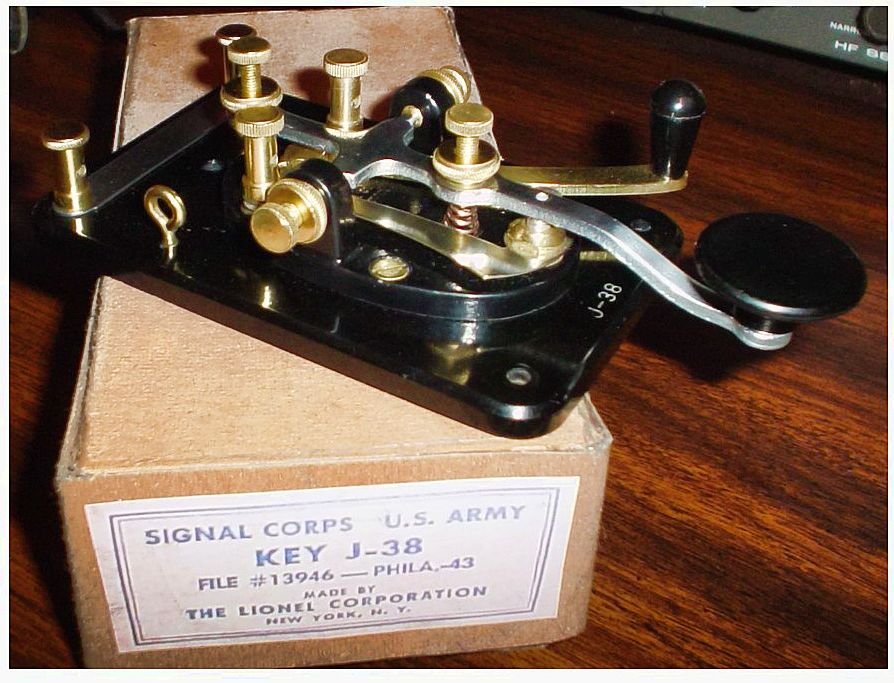
There’s a naming tangle worth getting right, because nearly everyone gets it wrong. The J-37 is the bare key element — the little phenolic-framed key itself. The J-38 is essentially a J-37-type key mounted on a base with the shorting switch and training posts added. And the leg clamp — the strap-to-your-thigh mount for keying in an aircraft or a tank — is the J-45, not the J-37. You’ll constantly read “the J-37 is the leg-clamp key”; it isn’t. The J-37 is the key; the J-45 is the clamp it drops into; the J-38 is the training base it drops into. (There was a flameproof base too, the J-47.) Small thing, but it’s the kind of detail this project exists to get right.
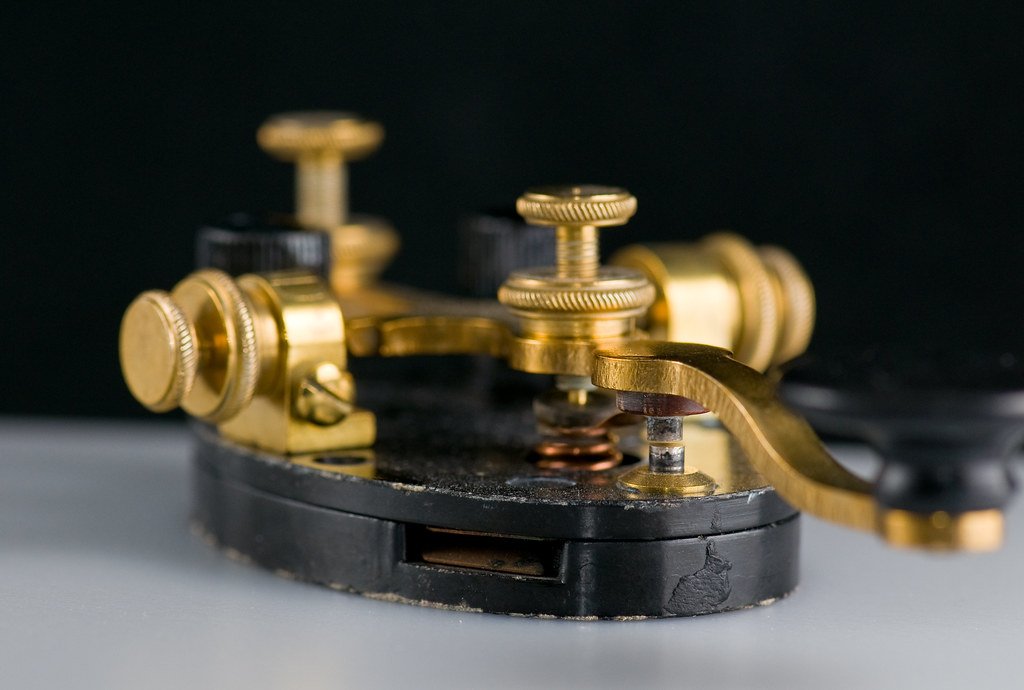
2.2 The keys that couldn’t spark: navy “flameproof”
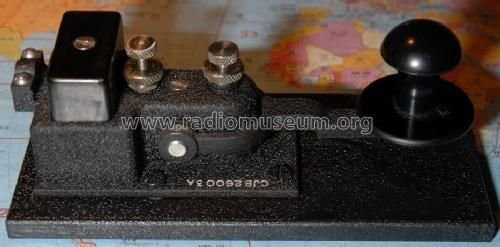
Aboard a ship or a submarine, a tiny spark at the key contacts is not a triviality — it can ignite fuel vapor or the hydrogen off a charging battery bank. So the navy used “flameproof” keys: keys with the contacts totally enclosed under a cover so no spark could reach the air. The classic is the Type 26003A — officially “Key, Signalling, Searchlight, Totally Enclosed,” a dark bakelite key with a shrouded contact housing, used for both radiotelegraphy and signal-lamp work. It was made by about a dozen contractors identified by a maker prefix on the same design — CMI- for the Molded Insulator Co., CJB- for J. H. Bunnell, and so on (those prefixes are makers, not different models). Bunnell was the last one standing, building the 26003A until 1988. Set one next to an open brass key and you can read the whole difference between a shipboard tool and a bench ornament.
2.3 The great makers
- J. H. Bunnell & Co. — the giant of American telegraph instruments, founded in 1878 by Jesse H. Bunnell, a Civil War field telegrapher (McClellan’s personal operator). His steel-lever key, patented in 1881, was produced in the hundreds of thousands and copied everywhere; the firm is still trading, and made both J-38s and the navy flameproof keys above.
- Signal Electric Mfg. Co. — a personal favorite for a Michigan man, because it was based in Menominee, Michigan, up in the Upper Peninsula. Signal Electric is well loved by collectors for its keys and sounders — the M-100, with its brass base, nickel-plated lever, and platinum contacts, is the one to know (and that gleaming brass key leading Volume 1 is a Signal Electric transmitting key) — and it was a J-38 contractor too. (You’ll see an “R-88” model cited around the web; I couldn’t verify that designation in a solid source, so I’ll name the M-100 and leave the rest to a catalog.)
- British “Key W.T. 8 Amp” — the standard WWII British Army field key, a bakelite base with brass fittings, issued with wireless sets across the Commonwealth; the counterpart to the American J-38.
2.4 The brass you save up for
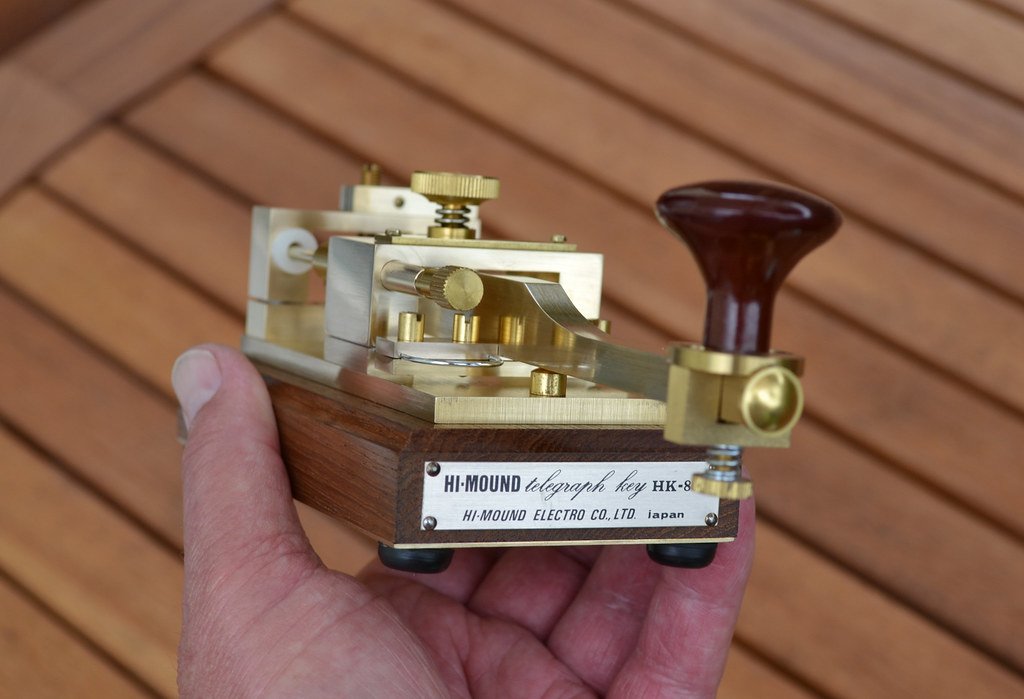
The straight key never stopped being made, and the modern boutique makers have turned it into something close to jewelry — which, as a brass lover, I have no defense against. Kent (England) builds a solid-brass Standard key on a wooden plinth. Begali (Italy) makes precision keys like the “Spark” with a jeweler’s finish. GHD (Japan) turns out beautifully-made keys and bugs. And Hi-Mound — the same Japanese firm behind my beloved UFO autokeyer — makes the classic HK-series brass straight keys (the low-profile HK-708, the taller HK-707 and HK-709) that have sat on ham desks for decades. These are the keys people buy once and keep for life, and they are the reason the straight-key section of the collection gleams.
2.5 Why the straight key never leaves
Every other key in this sub-project was invented to get around the straight key — its speed limit, its fatigue, its unforgiving demand on the hand. And yet not one of them retired it. Operators who own bugs and electronic keyers and chrome autokeyers still keep a straight key on the desk, still take it to the field, still run it in the annual Straight Key Night on New Year’s Eve when tens of thousands of hams put the machines away and send by hand for the joy of it. It is the simplest key, the hardest to master, and the one that most sounds like a human being. In a hobby full of clever machines that took over the timing, the straight key is where you go to take it back.
2.5.1 Sources (Vol 2)
- k6ix, “J-38 Keys” and “J-37 Keys”; W1TP Telegraph Museum “American Military Keys”; telegraphkeys.com “military” — the J-38 training key, its many WWII contractors (incl. Lionel), and the J-37 (bare key) / J-45 (leg clamp) / J-47 (flameproof base) distinctions. https://k6ix.net/J38Keys.html · http://k6ix.net/J37Keys.html
- kd2uj “Military/Naval keys,” morsemad “marine,” jhbunnell.com — the navy flameproof Type 26003A (“totally enclosed”), the CMI/CJB maker prefixes, Bunnell as final producer to 1988.
- J. H. Bunnell history (founded 1878 by Jesse H. Bunnell; steel-lever key patented 1881): jhbunnell.com. Signal Electric of Menominee, MI, and the M-100 (brass base / nickel lever / platinum contacts): K8IR Signal Electric page; radiomuseum.org. ⟨“R-88” model unverified⟩
- Boutique/brass makers (Kent UK; Begali Italy “Spark”; GHD Japan; Hi-Mound HK-708/707/709, founded 1947): dxengineering.com (Hi-Mound HK-708), radioworld.co.uk (Kent), Begali/Morse Express. British “Key W.T. 8 Amp No. 2”: militaria references.