Straight Keys and Hand Keys · Volume 1
Straight Keys & Hand Keys — Vol 1: The Simplest Key, the Hardest to Master
One lever, one pivot, one pair of contacts — and a lifetime in the tuning of it. The anatomy, the adjustment, the fist it builds, and the side-to-side cousin born to save your wrist.
1.1 The key everything else is measured against
Everything in the Keys & Keyers sub-project is, in the end, a way of getting around the limitations of this — the plain straight key, the up-and-down hand key that has been sending Morse since the 1840s. The bug automates its dits; the electronic keyer automates both elements; the chrome UFO wraps that in a flying saucer. But the straight key is the root, and here’s the paradox that makes it my sentimental favorite: it is the simplest key to understand and the hardest to truly master. There is nowhere to hide behind a machine. Every dit, every dah, every space is your hand, and a straight key played well — clean, even, unhurried — is one of the finest sounds in radio. This volume is about how the thing is built, how you tune it to your own hand, and the fist it builds. And I get to lead with brass, which I love.
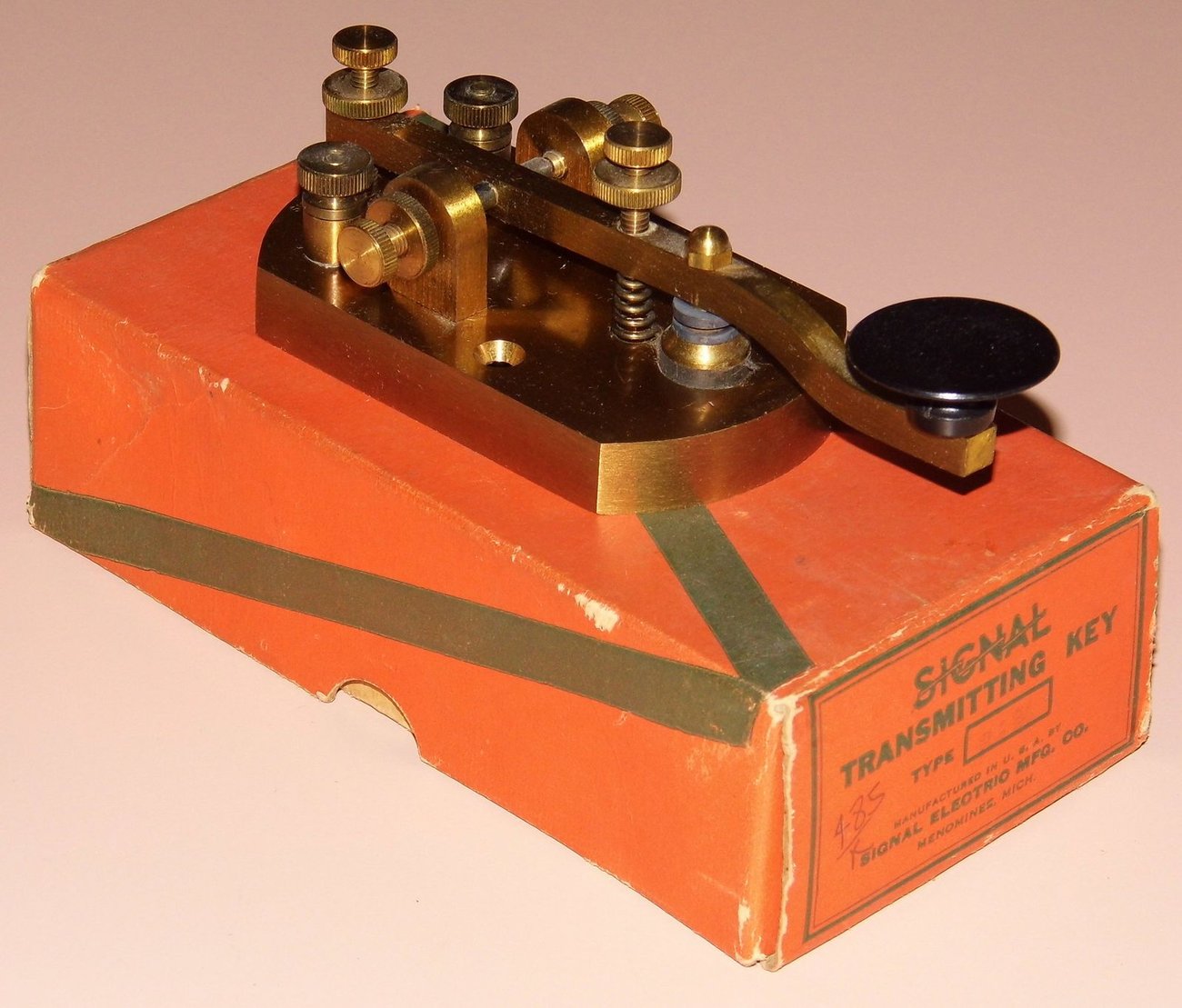
1.2 Anatomy: one lever and a handful of screws
A straight key has almost nothing to it, which is exactly why the little it has matters so much. Figure 1 is the side view.
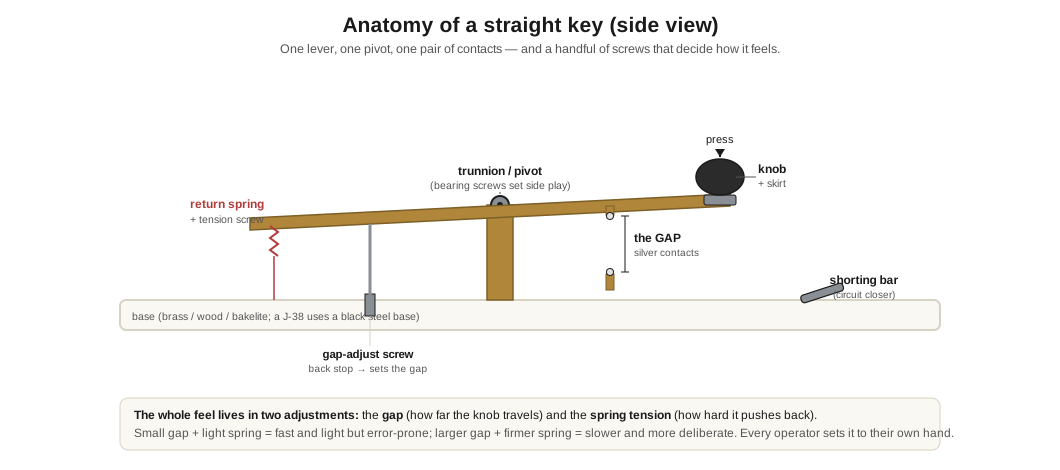
- The lever (often brass) pivots on the trunnion — a pair of bearing screws whose adjustment sets the side-to-side play. Too loose and the key wobbles; too tight and it binds.
- The knob sits at the front, with a skirt — the flared guard that keeps your fingers off the live contact area.
- The contacts are a pair of small discs, classically silver, one on the lever and one fixed below it. The distance between them is the gap.
- A return spring with a tension screw lifts the lever back up after each press.
- And there’s a small shorting bar (circuit closer) — which deserves its own paragraph, because it’s the most misunderstood part of the key.
1.3 The shorting bar is not a lock
Newcomers assume that little swing-over bar is a key lock or a travel catch. It isn’t. It’s a landline holdover, and understanding it tells you something about where all of this came from. On the old telegraph, keys were wired in a series loop — every station’s key in one continuous circuit — and the line had to stay closed for the sounders down the line to work. If you opened your key and walked away, you’d break the loop for everyone. So each operator, when not actively sending, closed the shorting bar to bridge their own key’s contacts and keep the loop alive for the others. Radio doesn’t need it, but the bar rode along onto radio keys out of pure convention, a little brass fossil of the wired era (which the Telegraph sub-project covers in full).
1.4 Adjustment: the whole feel lives in two screws
Here is where a straight key stops being simple. Its entire character — fast or deliberate, light or firm — lives in just two adjustments, and every serious operator sets them to their own hand:
- The gap — how far the knob travels before the contacts close. A common starting point is about 1.5–2 mm (roughly a business card’s thickness), reduced as you get faster. A small gap feels quick and light; too small and you’ll send spurious extra dits every time your hand twitches.
- The spring tension — how hard the spring pushes back. Light tension is fast and effortless but unforgiving; firm tension is slower and more deliberate but rock-steady.
The trade-off is real and personal: small gap + light spring = fast but error-prone; larger gap + firmer spring = slower but sure. There is no single correct setting — only your setting, and finding it is half the pleasure of owning a good key.
1.5 The fist — and why it’s yours
Because a straight key leaves all the timing to your hand, your sending develops a fist: a personal rhythm as individual as handwriting. Experienced operators can recognize a specific person on the air purely by their fist — a fact that was exploited militarily in WWII, when radio operators were fingerprinted by their sending style and tracked across the dial. A good fist is even, well-spaced, and unhurried; a bad one runs its dits and dahs together or rushes the spaces. Building a clean fist on a straight key is the foundation the whole hobby respects, and it’s why many operators who own fancy keyers still keep a straight key on the desk.
1.6 Glass arm — and the escape sideways
There is a dark side to pounding brass, and it drove the next inventions in this sub-project. Sending fast on a straight key all day, hour after hour, the up-and-down motion can produce a genuine repetitive-strain injury the old operators called “glass arm” or telegrapher’s paralysis — a cramping, disabling loss of control in the sending hand. It was real and career-ending, and it created enormous pressure to find a gentler way to send.
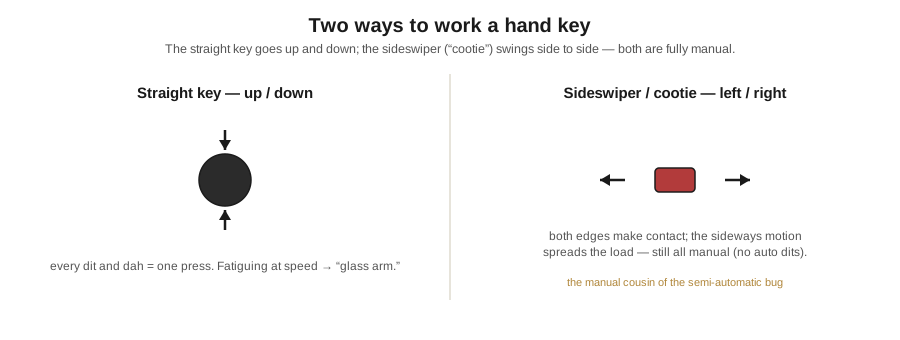
The first answer was to turn the key on its side. The sideswiper — affectionately the “cootie” — is a horizontal, single-lever key that swings side to side instead of up and down, spring-loaded to a center rest, with contacts on both the left and the right (Figure 2). You still make every dit and dah by hand — it’s fully manual, with no automatic anything — but the side-to-side motion uses different muscles and spreads the load, easing the wrist. The first commercial sideswiper was J. H. Bunnell’s, patented in 1888.
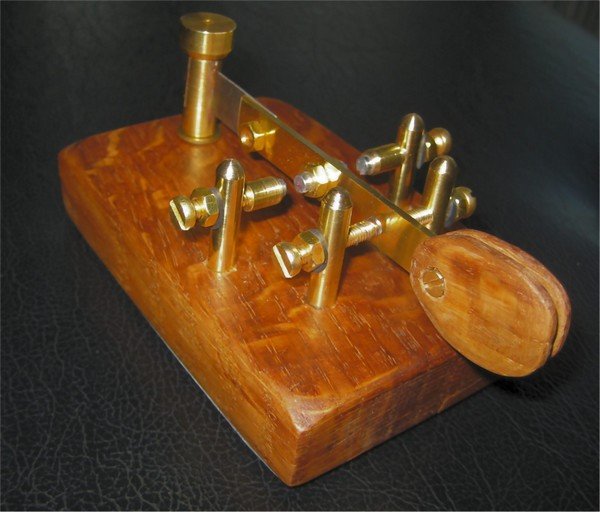
The cootie is the crucial evolutionary hinge: it’s the manual answer to glass arm, and the semi-automatic bug (its own dive) is the mechanical one — Horace Martin’s pendulum finishing the job the sideswiper started. Volume 2 turns from how you work a hand key to the keys themselves: the war-surplus J-38 that was everyone’s first key, the enclosed navy “flameproof” keys, the great makers, and the brass that makes this the prettiest corner of the collection.
1.6.1 Sources (Vol 1)
- Wikipedia, “Telegraph key” — anatomy, the shorting bar / circuit closer as a closed-loop landline holdover, the sideswiper (fully manual, “cootie”), the unique “fist,” and glass arm / telegrapher’s paralysis driving the sideswiper and the bug. https://en.wikipedia.org/wiki/Telegraph_key
- Electronics-Notes, “How to set up and use a straight Morse key” — gap (~1.5–2 mm starting point, reduced for speed), spring tension, and the fast/light-vs-deliberate trade-off (and the warning about spurious dits from too little tension). https://www.electronics-notes.com/articles/ham_radio/morse_code/use-setup-straight-morse-key.php
- Sideswiper history (Bunnell, patented 1888): sideswipernet.org; Morse Code World “keys.” Cross-links: Keys & Keyers → Semi-Automatic Bugs (the mechanical answer to glass arm) and The Telegraph → Sounders/Relays (the closed-loop origin of the shorting bar).