Sounders, Relays and Landline Instruments · Volume 2
Sounders, Relays & Landline Instruments — Vol 2: The Relay, the Local Circuit, and the Brass
The sensitive instrument that let a whisper on the main line ring a loud sounder in the office; the key-on-base sets and the makers who built them (one of them right here in Michigan); and the unbroken line from a brass-pounder's bench in 1880 to the key under my hand tonight.
2.1 Two instruments that look alike and do opposite jobs
Volume 1 left the sounder clacking on its resonator, and left a problem hanging. A sounder is built to be loud — it takes a healthy jolt of current to snap that armature down hard enough to make a crisp, readable click. But the current that limps into a station after a hundred miles of iron wire is anything but healthy; it’s a whisper. Ask a loud sounder to run directly off a long main line and it will click feebly, unreliably, or not at all. This is the exact problem the last dive’s Volume 1 introduced with the relay — and here, at the receiving bench, is where you actually see it solved.
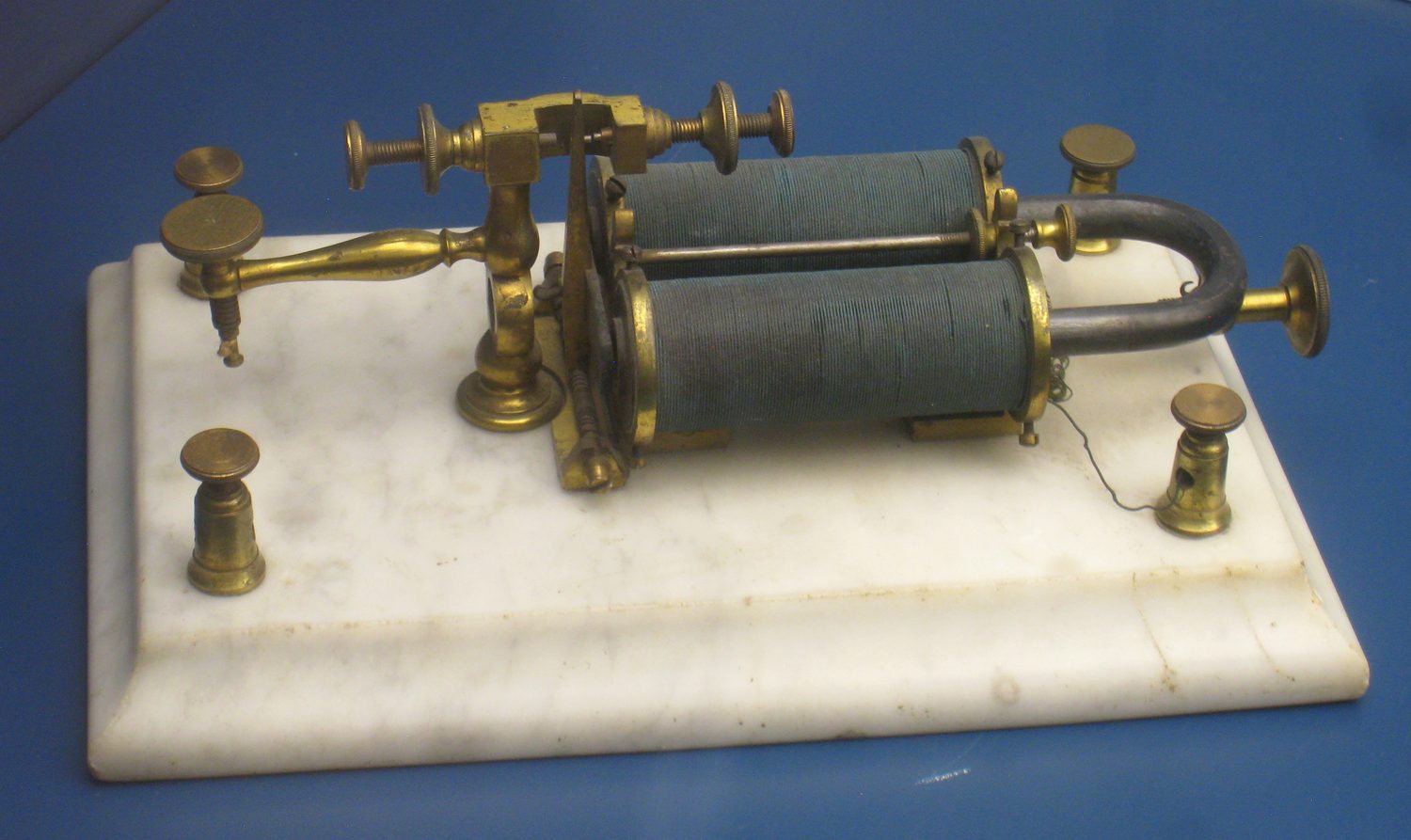
The solution is the relay, and the crucial thing to grasp is that a relay and a sounder are near-twins in appearance — both are an electromagnet with an armature — but they are tuned for opposite jobs. A sounder is deliberately insensitive and loud; a relay is deliberately delicate and sensitive, with a feather-light armature and a hair’s-breadth contact gap, trimmed by its adjusting screws to trip on the tiniest trickle of current — roughly twenty times less current than it takes to work a sounder.
2.2 The main line decides; the local battery does the work
Here is the whole arrangement, and it’s genuinely elegant. The relay sits on the main line and is the only thing asked to respond to that weak incoming current. It does no loud work itself; all it does is decide — armature down when the distant key is pressed, up when it’s released. But the relay’s armature is a switch, and what it switches is a completely separate local circuit: a fresh local battery right there in the office (historically a stack of crowfoot gravity cells), wired to the loud local sounder. When the faint main line trips the relay, the relay closes the local circuit, and the local battery — not the exhausted main line — slams the sounder down at full volume.
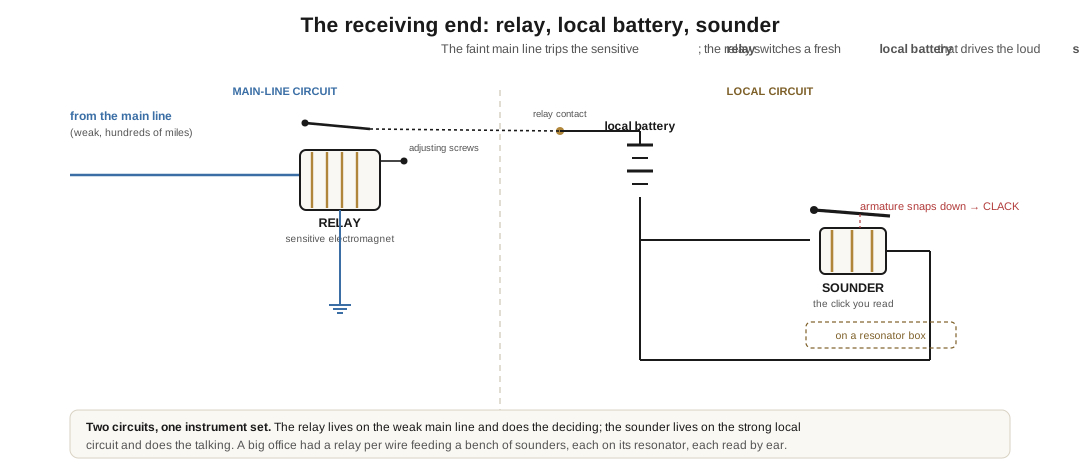
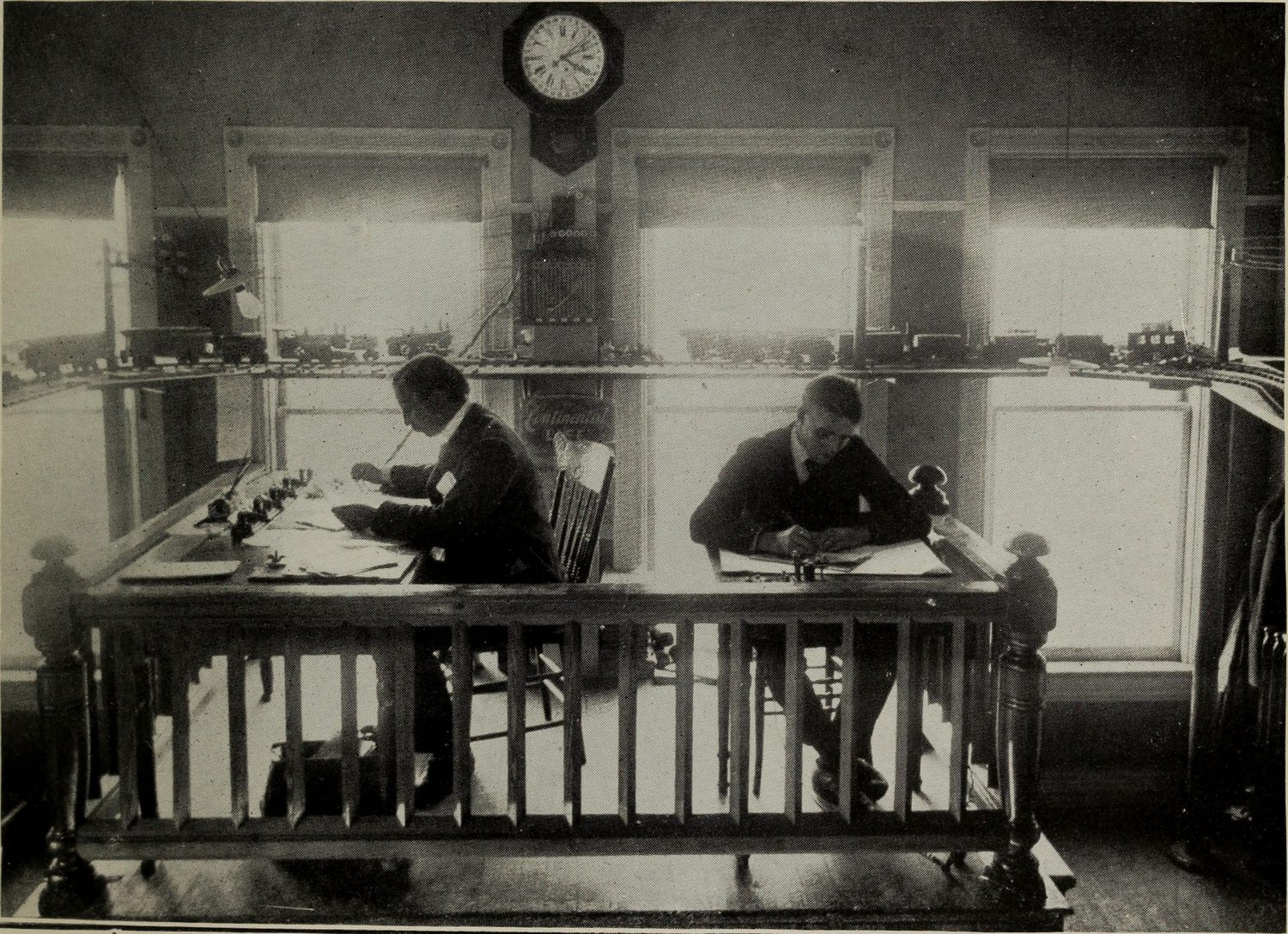
Two circuits, then, working as one instrument set: a sensitive relay on the weak main-line circuit, and a loud sounder on the strong local circuit, married by the relay’s contacts. A busy office was a wall of these — one relay per incoming wire, each feeding its own sounder, each sounder on its own resonator, each read by ear by its own operator. And because the relay regenerates the signal from a fresh local source, you can chain them: the local circuit at one station can be the main line into the next, so the message is reborn at full strength again and again, and the wire can run as far as you can build it. The relay is the reason a single key in New York can be heard in San Francisco — and, not for nothing, it is the direct conceptual grandfather of the vacuum tube, the transistor, and every amplifier and logic gate since. The humble brass relay on a telegrapher’s bench is where “a small signal controls a large one” was first made a daily, industrial fact.
2.3 The brass, and the makers — including one in Michigan
Now the part I love. Once you had a key, a relay, and a sounder, somebody had to build them, beautifully, by the tens of thousands — and the makers’ names are stamped right into the brass, which is half the joy of collecting these things.
The giant was J. H. Bunnell & Co. of New York, founded in 1878 by Jesse H. Bunnell, himself a Civil War Military Telegraph operator who’d pounded brass under fire. His steel-lever key (patented 1881) was made in staggering numbers, copied everywhere, and set the shape of the American telegraph key for the next century — including, eventually, the wartime J-38 that trained a whole generation of hams. Western Electric built much of Western Union’s gear, including the Main-Line KOB sets you’d find bolted to a railroad depot’s operating table.
And here’s the one that makes me grin, because it’s practically local: the Signal Electric Manufacturing Company of Menominee, Michigan. Right here in my state, up on the Upper Peninsula border, a real factory turned out telegraph keys, sounders, and relays — you’ll find surviving instruments stamped “Signal Electric Mfg. Co., Menominee, Mich.” — along with the learner sets a lot of people first learned the code on. (Their exact founding year is oddly hard to pin down — they’re well documented operating through the 1900s–1920s — but the Michigan tie is solid brass.) I take a particular pleasure in the idea that some of the instruments that carried the Victorian Internet were built a few hours’ drive from where I sit.
2.4 The KOB: a key and a sounder, married on one board
One instrument deserves its own moment: the KOB, which stands for Key On Base (sometimes “key on board”). Early telegraph tables had the key, the sounder, and the relay as three separate instruments scattered across the desk; starting in the 1860s, makers began mounting a key and a sounder together on a single base, wired in series, with a pair of binding posts at the back for the line. The KOB was the practical little workhorse of the small office and the practice bench — one tidy instrument that both sends and (via its sounder) receives.
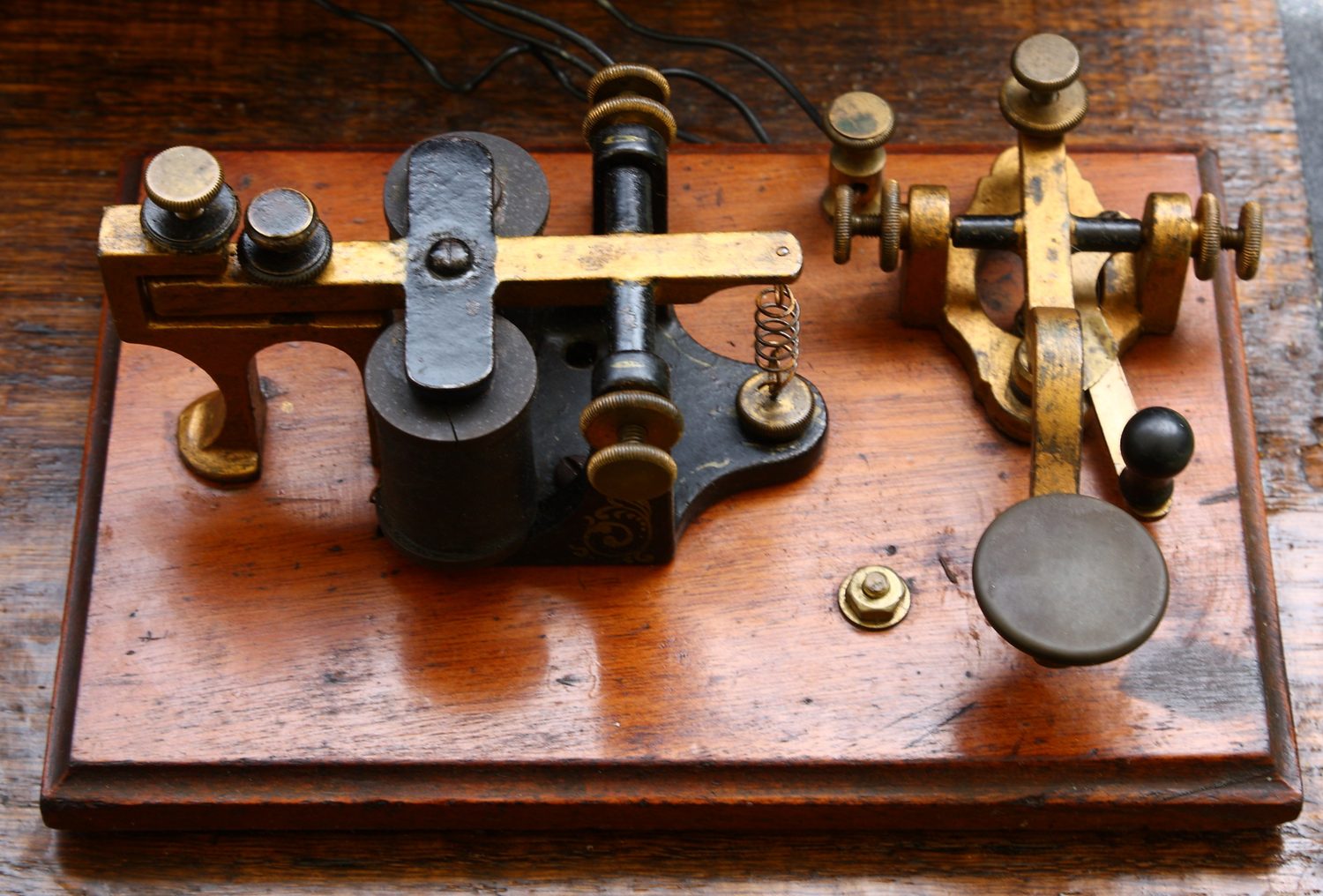
And the KOB is exactly where this whole sub-project reaches out its hand to the rest of Dots & Dashes, because the amateur’s operating position is the KOB’s direct descendant. Surplus landline keys, the Bunnell steel-lever lineage, the J-38 — they flowed straight out of the telegraph office and onto the ham bench when landline Morse faded and radio rose. The straight key I bought at a hamfest, the brass I display on the shelf, the very posture of sitting at a key with a sounder or a rig and reading code by ear — all of it is the landline operator’s bench, lightly evolved.
2.5 Closing the loop
I began this whole project with a boy in his father’s ham shack in the late 1960s, listening to dots and dashes he couldn’t read and aching to understand them. It feels right to end it here, on a brass sounder and a resonator box, because this is the deepest root of that sound. Long before radio, in a telegraph office lit by gaslight, an operator sat with his ear cocked to an instrument that made nothing but two clicks, and out of the silence between them he pulled words, and news, and money, and war, and love letters, at a speed the world had never known. He read with his ears. He never wrote down a dot.
Everything in Dots & Dashes is a variation on what he did. The straight keys and the semi-automatic bugs and the electronic keyers; the chrome Hi-Mound UFO I love above all my keys; the clattering teletypes and the reels of pink paper tape; the RTTY terminal units and the little Raspberry Pi decoding tones on my bench today — all of it descends from a key, a battery, one iron wire, a relay, and a brass sounder read by ear. The technology kept reinventing the machine. The thing itself — turning thought into a pattern of ons and offs, and sending it, hand to ear, to another human being — has never changed at all. That boy finally learned to read the dots and dashes. This project is everything he found on the other side of them.
73 de N0SWN.
2.5.1 Sources (Vol 2)
- Relay vs. sounder (relay = sensitive electromagnet on the main line, ~20× more sensitive than a sounder; adjusting screws set armature tension/gap): insulators.info “The Morse, or American Telegraphic System”; telegraphlore.com “basic circuit”; Smithsonian NMAH relay records. The relay does the amplifying, not the sounder.
- Main-line vs. local circuit: the relay switches a separate local circuit powered by a fresh local battery (crowfoot/gravity cells) that drives the local sounder at full strength; chaining relays regenerates the signal over distance. Cross-link: The Telegraph → The Electric Telegraph (the relay-repeater figure).
- Makers: J. H. Bunnell & Co. founded 1878 by Jesse H. Bunnell (Civil War Military Telegraph operator); steel-lever key patented 1881: jhbunnell.com; Wikipedia “Jesse H. Bunnell.” Western Electric Main-Line KOB sets. Signal Electric Mfg. Co., Menominee, Michigan (keys/sounders/relays; active 1900s–1920s, founding year unconfirmed): k8ir.com “History of Signal Electric.”
- KOB (Key On Base): key + sounder on one base, wired in series, from the 1860s; practice sets and small offices: telegraphkeys.com; Bullock Texas State History Museum (Western Electric Main-Line KOB). Bridge to amateur radio (surplus landline keys, Bunnell lineage, J-38): cross-link Keys & Keyers → Straight Keys and Hand Keys.