Sounders, Relays and Landline Instruments · Volume 1
Sounders, Relays & Landline Instruments — Vol 1: Reading With Your Ears
The whole strange, wonderful truth of landline telegraphy is that the good operators threw away the paper and just listened. This is the sounder — a machine that makes no tone, only two clicks — and how a brass-pounder read a language in the silence between them.
1.1 The instrument that only clicks
Everybody pictures the telegraph as a machine that writes — a stylus scratching dots and dashes onto a ribbon of paper tape. That was Morse’s original idea, and Volume 1 of the last dive told how the operators outran it almost immediately, learning to read the clicks of the register by ear faster than they could read the tape. This dive is about the instruments they used once they’d made that leap — the receiving side of the wire — and it is where my love of brass finally comes all the way home, because these are the most beautiful objects in the whole hobby.
The star of the receiving bench is the sounder, and the first thing to understand about it is deeply counterintuitive: a sounder makes no tone at all. It does not beep, buzz, or sing. It is simply an electromagnet with a pivoted iron bar — an armature — poised above it on a trunnion. When current flows down the line, the magnet pulls the armature sharply down against a stop: clack. When the current stops, a spring snaps the armature back up against a second stop: clack. That’s it. That’s the whole instrument. Two clicks, a down and an up, slightly different in pitch, over and over.
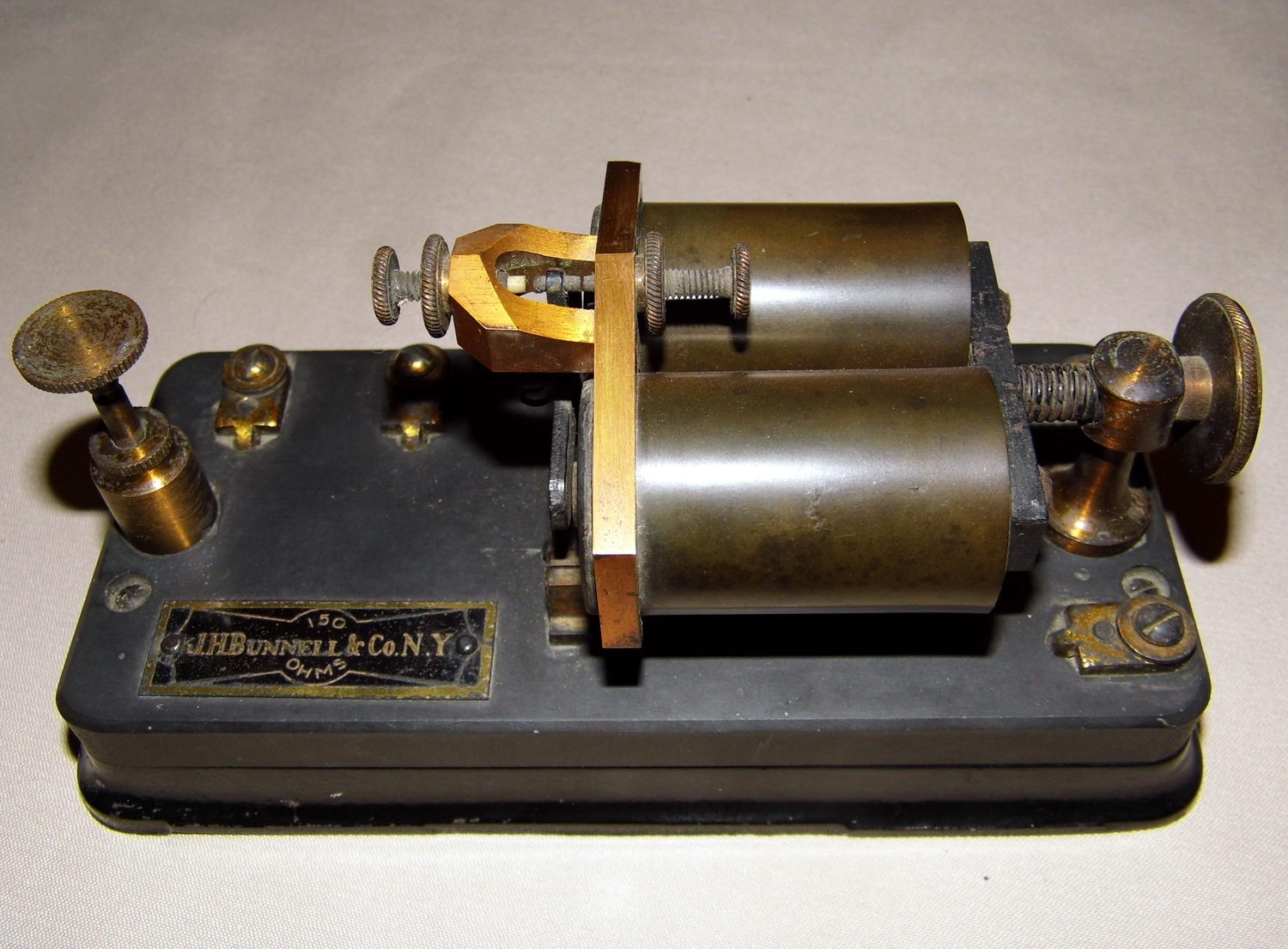
1.2 The message lives in the silence
So if the sounder only says clack… clack, how on earth do you read Morse on it? Here is the elegant, slightly mind-bending answer, and it is the spine of this entire dive: you don’t read the clicks — you read the time between them.
The operator hears the down-click when the current comes on, and then waits for the up-click when it goes off. It is the length of the interval between that down-click and that up-click that tells him whether he just heard a dit or a dah. A short gap between down and up is a dot; a longer gap is a dash. The dots and dashes aren’t sounds you hear — they are durations of silence you measure, bracketed by two clacks.
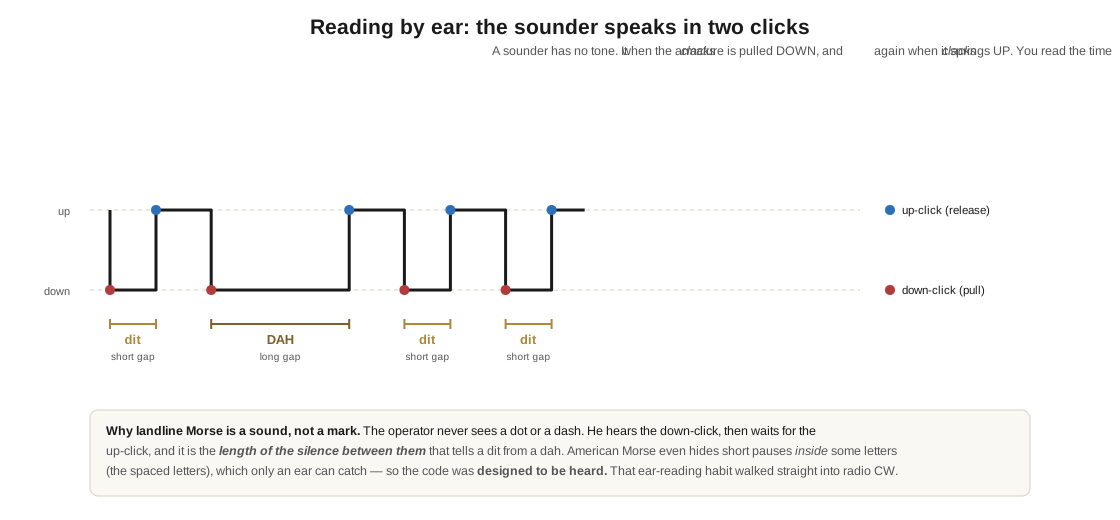
This is why I keep insisting, all through Dots & Dashes, that Morse is fundamentally a sound and not a set of marks. On a landline sounder it could not be more literally true. And it explains a technical fact that trips up almost everyone: American (landline) Morse is not the same code hams use today. The International Morse of the radio bands is clean and regular — every dash the same length, no gaps inside a letter. American Morse, the code these sounders were built to speak, is messier and older: it has spaces inside some letters (the so-called spaced characters, like C and O and R) and dashes of different lengths (a long dash for L, an extra-long one for zero). You cannot represent those interior spaces as marks on a page in any obvious way — but you can absolutely hear them as a hitch in the rhythm. American Morse was, in the deepest sense, a code designed to be heard, not seen. Radio later adopted the tidier International code precisely because a clean, regular code survives noise and fading better than a subtle one full of pregnant pauses. But the habit — reading a message as rhythm, in your head, nothing written down — came straight off these sounders and into the headphones of every CW operator since.
1.3 Why the ear beat the pen
It’s worth pausing on why sound reading won, because it wasn’t nostalgia — it was raw speed. Morse and Vail’s register was a genuinely clever machine, but it had a clockwork motor to run, a paper tape to feed, ink or an embossing point to maintain, and then the marks still had to be read back and transcribed by a clerk afterward. Every one of those steps is slower than a trained human ear. By the late 1840s operators on the busy New York–Boston line had noticed they could copy the register’s clicks directly, faster than the pen laid them down and far faster than reading the tape after the fact — and it freed their hands and eyes to write the message down as it came.
Once that was clear, the paper was just a middleman, and by about 1856 a purpose-built instrument that dispensed with paper entirely — the sounder — had displaced the register for the great bulk of traffic. (Be a little careful with the history here: the sounder is often credited flatly to Alfred Vail, but sound reading really emerged as an operator practice and the dedicated instrument evolved through several hands; the safe, true statement is “by 1856 the sounder had replaced the register,” not “so-and-so invented it on such-a-date.”) The register hung on only where a law or a nervous manager still demanded a paper copy. Everywhere else, the office ran on ears.
1.4 The resonator: cupping a hand to the wire
There’s one more instrument in this volume, and it’s a lovely, purely acoustic one — no electricity in it at all. Picture a big-city telegraph office in 1875: a long room, a dozen operators, a dozen sounders all clattering at once. How does any one operator pick his own instrument out of that din?
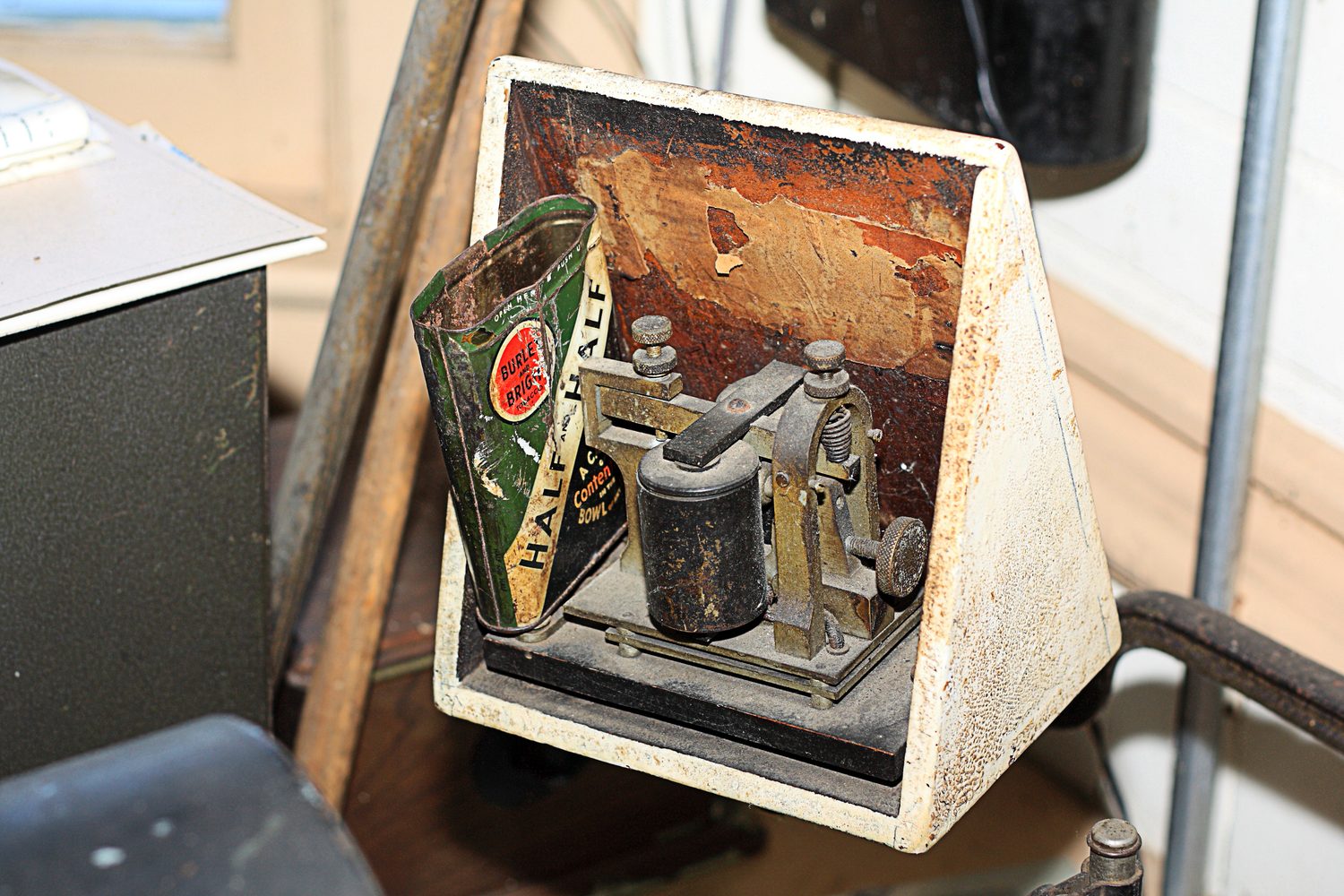
The answer is the resonator — a wooden box or hood, often a swing-arm affair on a jointed bracket, that the sounder is mounted on or inside. It does exactly what a cupped hand behind your ear does, or what the body of a violin does for a string: it amplifies the click and aims it toward the operator’s ear, so that his sounder stands out from the roomful of others and he can swing it in close when the traffic is heavy. It is completely passive — it does no electrical work whatsoever, and it belongs to no circuit. It is just clever woodwork for directing sound, and the pairing of a bright brass sounder on a warm wooden resonator box is, to my eye, one of the most handsome things any technology ever produced. When you see a sounder “on a resonator,” that tall wooden box is what’s meant.
The next volume opens up the two instruments that make the sounder work over real distance — the relay and its local battery — and then gets to the brass I love most: the makers (including one right here in Michigan), the key-on-base sets, and the straight line from a landline operator’s bench in 1880 to the key under my hand tonight.
1.4.1 Sources (Vol 1)
- The sounder mechanism (electromagnet + pivoted armature; down-click on current, up-click on release; dit-vs-dah read by the interval between the two clicks): Wikipedia “Telegraph sounder”; Smithsonian NMAH telegraph sounder object records.
- Sound reading displaced the register by ~1856; faster by ear than the pen: Encyclopædia Britannica, “Telegraph — development of the telegraph industry” (“By 1856 the register in the Morse system was replaced by a sounder…”); early sound-reading on the New York–Boston line ~1848. ⟨Caution: the sounder is often loosely credited to Alfred Vail; treat single-inventor attribution as uncertain — it evolved as an operator practice.⟩
- American (landline) Morse vs. International Morse: American Morse has internal spaces in some characters and variable-length dashes, making it an acoustic timing-read code that doesn’t map onto International Morse. Cross-link: Morse & CW → The History of Morse Code.
- The resonator (passive wooden box/hood that amplifies and directs the sounder’s click toward one operator’s ear; no electrical role): Smithsonian NMAH resonator record; telegraphlore.com.