Semi-Automatic Bugs · Volume 1
Semi-Automatic Bugs — Vol 1: The Pendulum in the Lever
Horace Martin's semi-automatic key mechanized the hardest part of sending Morse — the string of dits — with a vibrating pendulum, and in doing so gave the code a whole new voice: the bug's unmistakable swing.
1.1 The problem with a straight key
Spend an hour on a straight key at any real speed and your wrist will tell you what the problem is. Every single dit is a separate downward press of your hand, and a message is mostly dits — an E is one, an S is three, an H is four, and the word “Mississippi” is a small massacre. The faster you go, the more the fatigue and the timing errors pile up, and the operator who has to send all day — the railroad man, the commercial brass-pounder — needs a way out. The semi-automatic key, universally called the bug, is that way out: a machine that makes the dits for you, evenly and tirelessly, while you keep the dahs. It is the single cleverest piece of mechanical design in this whole hobby, and this dive is about how it works, who invented it, and why the keys it produced are still on the air and still worth collecting a century later.
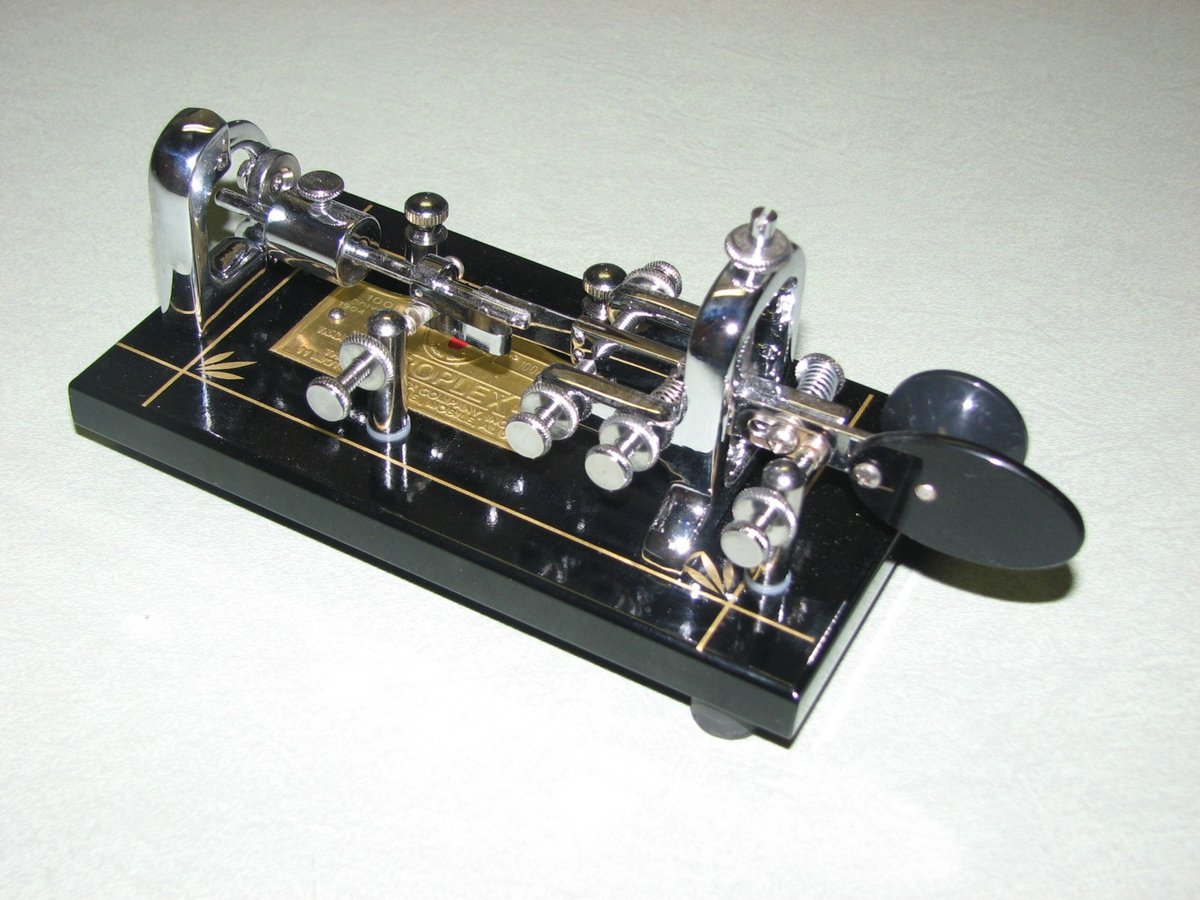
1.2 Horace Martin and two different inventions
The bug is the work of one man, Horace Greeley Martin, a New York telegrapher, and it’s worth separating his two inventions because they get conflated constantly.
His first was the Autoplex (developed around 1902–03, patents No. 732,648 and 767,303): an electrically-operated auto key. It used a battery and an electromagnet to pull a spring-loaded clapper that made and broke the circuit rapidly, producing a stream of automatic dots — dahs still made by hand. It worked, but it needed its own battery, and at roughly $20–25 (about two weeks’ wages in 1903) it was too expensive and fussy to catch on.
His second invention is the one that changed telegraphy. Martin realized he could get the same automatic dits purely mechanically — no battery, no electromagnet — by putting a vibrating pendulum inside the key lever itself. He patented this semi-automatic key in 1904, and it went on sale in 1905 as the Vibroplex, at about $8. No battery to carry, a quarter the price, and it did the same magic. (For the record: the product dates to 1905, but the Vibroplex Company, Inc. was formally incorporated with the entrepreneur J. E. Albright in 1915; Martin later sold his interest to Albright. People cite “1905” and “1915” as if they contradict — they don’t, they’re just the product and the company.)
1.3 Why it’s called a “bug”
The name is a nice bit of folklore, and I’ll give it to you the honest way. The most widely accepted account is that the semi-automatic key got its nickname from the Vibroplex nameplate logo — an “electrified” lightning bug — stamped on the base, and that “bug” then spread to mean any semi-automatic key regardless of maker. Even Wikipedia hedges it as “most likely due to the original logo,” so I’ll do the same: it’s the standard collector explanation, not a documented certainty. “Bug” is also a Vibroplex trademark to this day.
1.4 How the mechanism works
Here is the heart of it, and it is genuinely elegant. The whole key is one lever on a single vertical pivot. Figure 1 is the top-down view.
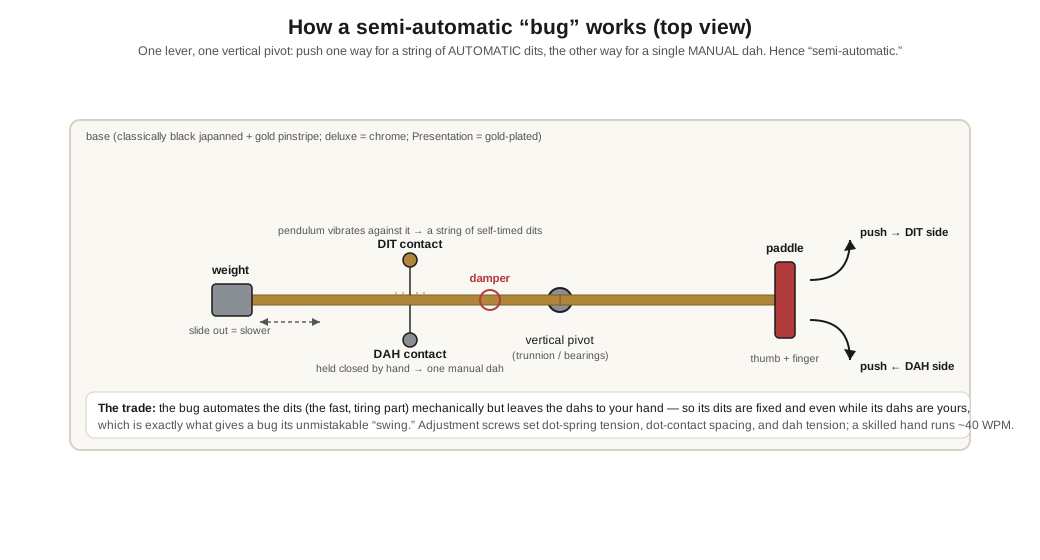
- Push the paddle toward the dit side and you set the far end of the lever — a horizontal pendulum carrying an adjustable weight — swinging. As it vibrates, a contact on the pendulum repeatedly taps the dit contact, and out comes a string of automatic, evenly-timed dits for as long as you hold the paddle over. Let go and a damper brings the pendulum to rest.
- Push the paddle the other way and you simply close the dah contact by hand — a single manual dah, held as long as you hold the paddle.
- Speed is the weight. Slide the weight out toward the end of the pendulum and it swings slower — slower dits; slide it in and the dits speed up. That’s the whole speed control: a chunk of metal you slide along a rod. A skilled bug hand runs around 40 WPM.
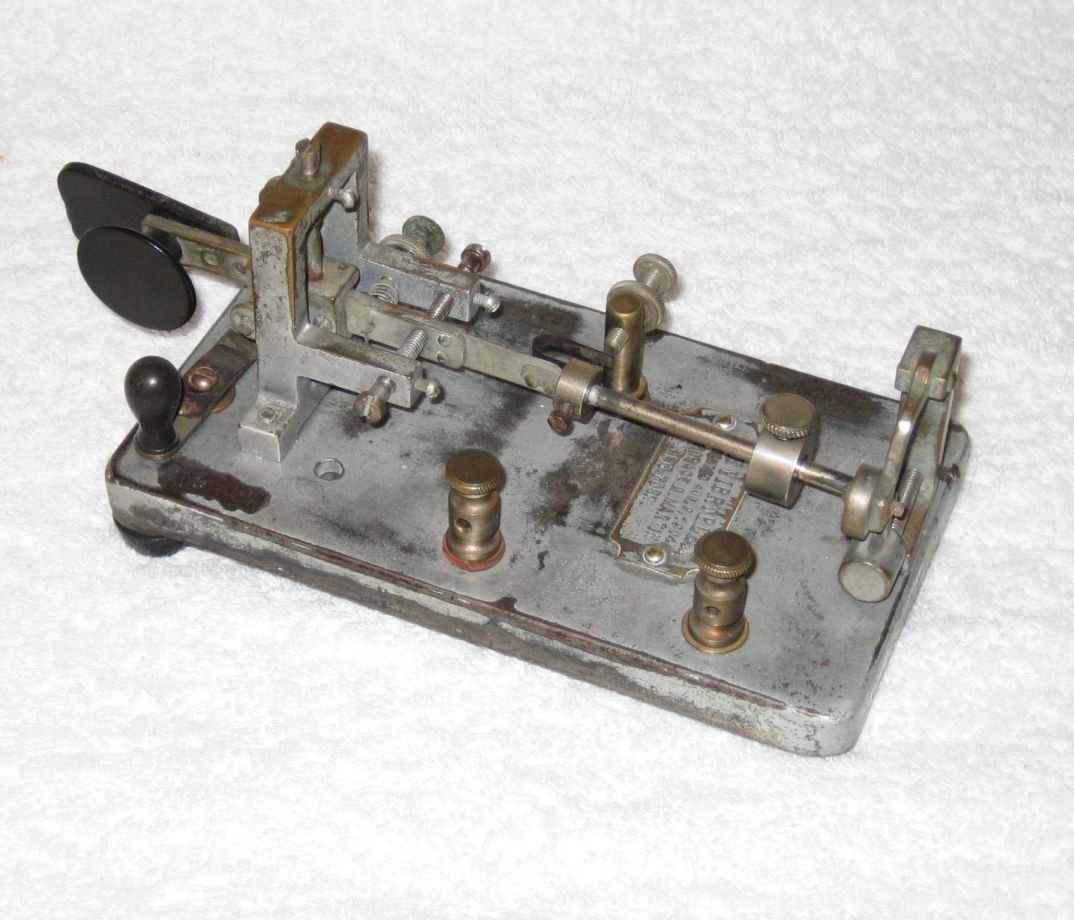
That word semi-automatic is doing precise work: the dits are automatic, the dahs are manual. This is the crucial difference from the fully-electronic keyers in the Paddles & Electronic Keyers and Hi-Mound UFO dives, which time both elements. A bug automates only the half that most needed it.
1.5 The swing
Because a bug makes its dits mechanically-fixed and even but leaves its dahs to your hand, it produces a sending rhythm that no straight key or electronic keyer ever will — the famous bug swing. When a bug operator slows down, the automatic dits keep zinging by at their set rate while the hand-made dahs stretch out, giving the code an asymmetric, slightly hurried-then-lazy lilt. To an experienced ear that swing is as individual as handwriting; you can often recognize a specific operator’s fist on the air purely from how their bug sings. Some purists dislike a heavy swing; I love it, because it is the sound of a human being and a clever machine sharing the work — which is really what this whole sub-project is about.
1.6 Adjusting a bug
A bug rewards patient adjustment and punishes neglect, and there are only a few things to set, all with small screws:
- Dot-contact spacing — how far the pendulum contact travels before it hits the dit contact. Tighter = the dits start cleaner and can run faster; too tight and they run together into a buzz.
- Dot-spring tension — how hard the pendulum is pushed back, which affects how the dits feel and how long the string runs evenly.
- Dah-contact spacing and tension — the feel and travel of the manual dah.
- The weight position — your speed, set to taste and reset whenever you change pace.
Get these right and a good bug is a joy — light, fast, and alive under the fingers. Volume 2 is about the keys themselves: the Vibroplex menagerie (Original, Blue Racer, Lightning Bug, Champion, and the gold-plated Presentation showpiece), the finishes from black-japanned to chrome to brass, the world speed champion Ted McElroy, the rival makers, and why the bug — displaced but never really killed by the electronic keyer — is still on my desk and still worth hunting for.
1.6.1 Sources (Vol 1)
- Wikipedia, “Vibroplex” — Horace Martin, the Autoplex vs. the mechanical semi-automatic key, the 1904 patent / 1905 sale, the mechanism, the lightning-bug etymology (hedged), the “bug” trademark. https://en.wikipedia.org/wiki/Vibroplex
- ARRL, “The First Bugs” — the Autoplex (electric, ~1902–03; patents 732,648 / 767,303;
$20–25) and the move to the purely-mechanical Vibroplex ($8). http://www.arrl.org/the-first-bugs - K4LRG, “Vibroplex History” — Autoplex development date, Vibroplex Company incorporation 1915 (Martin + Albright), Martin’s later sale. https://history.k4lrg.org/Projects/Vibroplex_History.html
- Bug mechanism and the “swing”/fist: Wikipedia “Telegraph key” and “Keyer”; AG6QR “Keys, Bugs, Paddles and Keyers.” Deeper primary anchor for the 1904 narrative: William Holly / Tom French Vibroplex histories and Casale, Centennial of the Martin Vibroplex (Antique Wireless Association).