RTTY on the Air · Volume 1
RTTY on the Air — Vol 1: Two Tones on the Air
Take the teletype's five-bit code off the wire and put it on a radio wave, and you have RTTY. It comes down to two audio tones 170 Hz apart — and one detail about sidebands that has confused hams for seventy years.
1.1 The teletype goes to sea and to the sky
The teletype and its paper tape lived on wires — landlines, leased circuits, the Telex network. RTTY — radioteletype — is what happens when you take that exact same five-bit Baudot/ITA2 code (the Teletype Machines and Paper Tape dives) and send it over a radio instead of a wire. Now a ham in Michigan and a ham in Japan can run their teletypes to each other with no wire between them at all — just the same code Murray designed in 1901, riding an HF signal across the world. This is the sound that shared my father’s shack with the Morse: the steady, insistent warble of RTTY, two notes trading back and forth, and a machine turning them into printed words. This dive is how that works.
1.2 RTTY is two tones
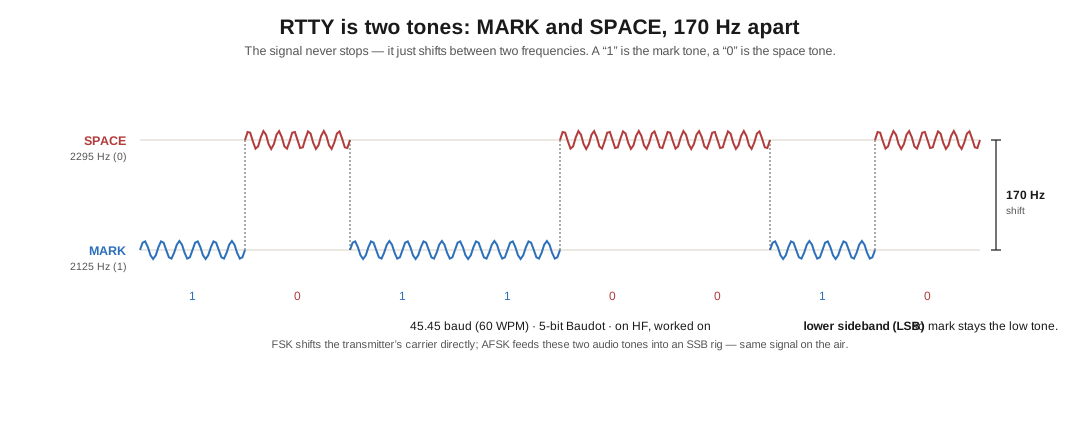
Here is the whole idea (Figure 1). Where Morse is one tone switched on and off, and where the teletype on a wire was current present or absent, RTTY is two tones, and the signal never stops — it just shifts between two frequencies. One frequency is MARK (a “1”); the other is SPACE (a “0”). The ham standard is exact and worth memorizing:
- MARK = 2125 Hz (the lower audio tone)
- SPACE = 2295 Hz (the higher audio tone)
- The gap between them — the shift — is 2295 − 2125 = 170 Hz
- sent at 45.45 baud (60 words per minute), the same “60 speed” as the wire teletypes.
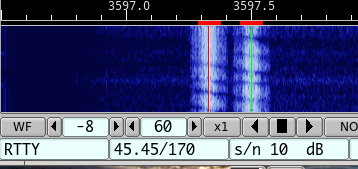
(Older RTTY used a much wider 850 Hz shift; 170 Hz became the amateur standard, and there are other tone pairs in other regions — but 2125/2295/170 is the US ham standard.)
1.3 FSK or AFSK — same signal, two ways to make it
There are two ways to put that two-tone signal on the air, and they produce an identical result:
- FSK (frequency-shift keying) shifts the transmitter’s carrier frequency itself between two RF frequencies 170 Hz apart, keyed by the mark/space data — like Morse’s on/off, but shifting instead of switching. You feed the rig a data line; it does the shifting. (Purists prefer FSK because you can use the radio’s narrow crystal/DSP filters.)
- AFSK (audio FSK) takes the easy road: it generates the two audio tones (2125/2295) and feeds them into an ordinary SSB transmitter’s audio input, and the SSB rig obligingly shifts its RF output to match. This is what a sound card does, which is why AFSK is how most modern software RTTY works.
Same signal comes out of the antenna either way; the difference is just how you made it.
1.4 The sideband trap that confuses everyone
Now the detail that has tripped up hams for seventy years, and it’s worth getting right because it’s genuinely counterintuitive. HF RTTY is conventionally worked on lower sideband (LSB) — and on the air, MARK ends up the higher RF frequency even though it’s the lower audio tone.
Here’s why: an SSB transmitter inverts the audio-to-RF relationship on LSB. Your 2125 Hz mark tone is the lowest audio note, but running it through an LSB transmitter flips it so mark comes out the highest RF carrier. It sounds backwards, and it is — but that inversion is exactly what makes an AFSK signal on LSB come out identical to a direct-FSK signal, so that everyone’s mark and space agree no matter how they generated it. The takeaway: think in two domains — in the audio domain (what your terminal unit or sound card sees) mark is the low tone; on the RF domain (what’s actually on the band) mark is the high frequency. Draw or discuss one at a time and you’ll stay sane. (My figure above is in the audio domain — the tones a decoder hears.)
1.5 Diddle: the idle warble
One more piece and you understand a live RTTY signal. When there’s no text to send, an RTTY station doesn’t go quiet — it sends a continuous stream of the LTRS letters-shift character (all five bits marking), a filler called “diddle.” Diddle keeps the receiving machine synchronized and locked in letters mode, so the instant real text starts, the first characters print correctly and a fade or a noise burst costs you only a character or two instead of a garbled line. That endless soft two-note idle — dee-dah-dee-dah — is the sound of an RTTY station sitting there ready, and it’s a huge part of what I heard as a boy. Volume 2 is about the box that turns those two tones back into text — the terminal unit — and the wonderful green-glowing “crossed bananas” you tuned it with.
1.5.1 Sources (Vol 1)
- AA5AU, “Getting Started on RTTY — Introduction” — the exact standard: 45.45 baud (60 WPM), 170 Hz shift, mark 2125 Hz / space 2295 Hz; FSK vs AFSK producing the same on-air signal. https://www.aa5au.com/rtty/getting-started-on-rtty/introduction/
- HAL “tones” note and eHam “Are You Frequency Confused with RTTY?” — mark is the lower audio tone but, through an LSB transmitter, becomes the higher RF frequency (the audio↔RF inversion, and why LSB is the convention). https://www.navy-radio.com/rtty/hal/misc/hal-tones.pdf
- Wikipedia, “Radioteletype” — 5-bit Baudot/ITA2 by radio; the historical 850 Hz wide shift. “Diddle” (continuous LTRS idle for sync/letters-mode): AA5AU “Diddles by W7AY.” Cross-links: Teletype, Tape & RTTY → Teletype Machines (the code) and → Modern Digital & the Raspberry Pi (software RTTY).