Paper Tape and the Perforator · Volume 1
Paper Tape & the Perforator — Vol 1: The Pink Tape
The reels of punched paper tape spooling out of my father's teletypes are my sharpest memory of that room. Here is what those little rows of holes actually said — and how you read them with nothing but your eyes.
1.1 The pink tape
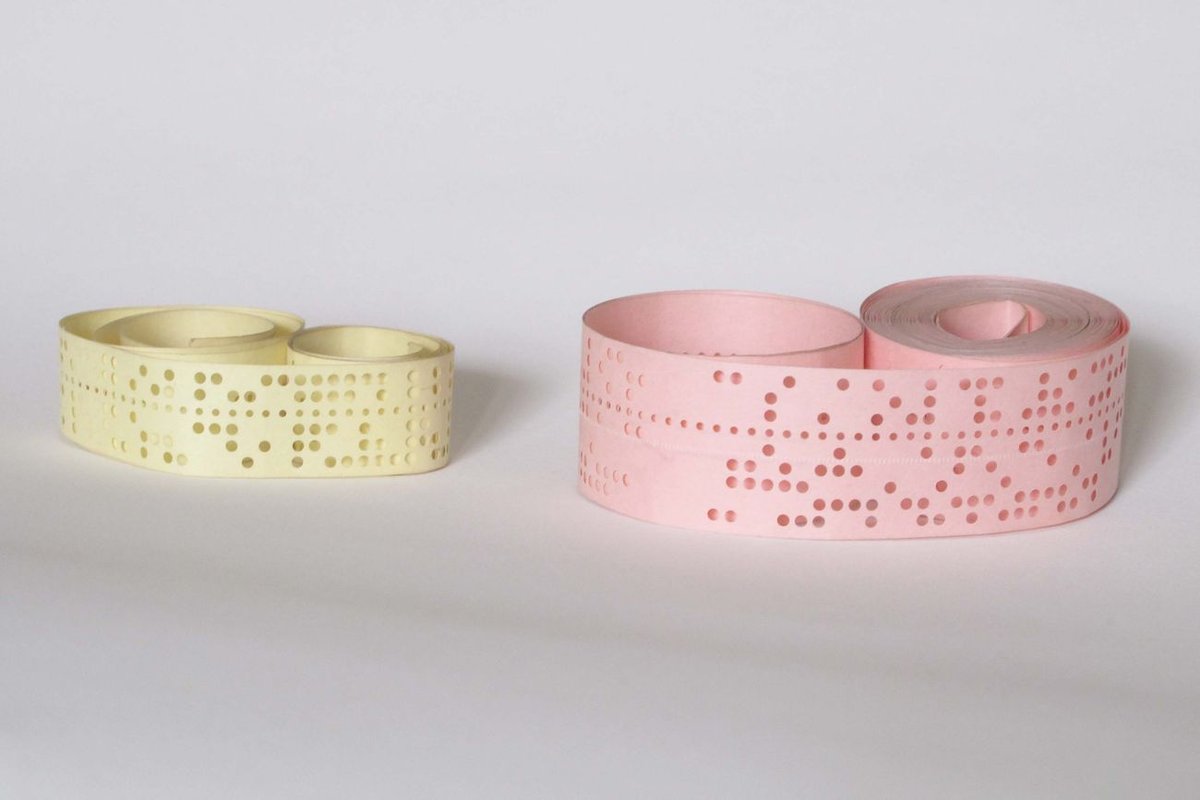
Of everything in my father’s shack, the thing my hands remember best is the paper tape. It came spooling out of the punch in long pale ribbons, curling into the wastebasket, covered in neat little rows of holes — and in my memory it is pink. (I’ve since learned teletype paper and tape came in yellow, buff, blue, and yes, pink; the color is real, even if the pink is partly a boy’s memory.) I would pick up a length of it and hold it to the light and know there was a message in those holes, if only I could read it. This dive is where I finally learned to — and where I get to show you. Punched paper tape is one of the most beautiful ideas in the whole history of communication: a message you can hold in your hand, read with your eyes, store on a shelf, and feed back into a machine years later.
1.2 What punched tape is
A teletype speaks in five-bit characters (the Teletype Machines dive covers the ITA2 code). Punched tape simply writes those five bits onto paper as holes: a hole is a 1 (mark); no hole is a 0 (space). Each character is one column of holes straight across the width of the tape, and the tape’s length is just one character after another. Punch the tape as you type, and you’ve recorded your message in a form that never forgets, never mistimes, and can be sent perfectly by a machine long after you’ve walked away. It is the teletype’s memory, made of paper.
1.3 Reading it by hand
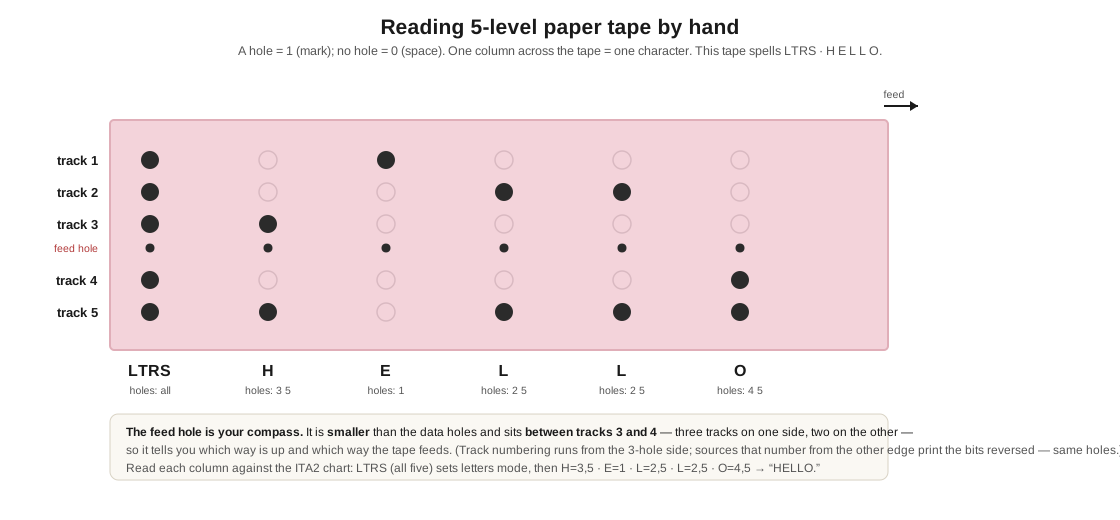
You really can read tape with your bare eyes once you know two things: the layout and the code. Figure 1 is a strip of real 5-level tape, and it genuinely spells a word.
Here’s the whole method:
- Five data tracks run the length of the tape, one bit each. A punched hole in a track = a 1; no hole = a 0.
- The feed hole is your compass. Between the tracks runs a line of smaller holes — the sprocket/feed holes that a toothed wheel grips to pull the tape along. It sits between track 3 and track 4, so there are three tracks on one side and two on the other. That deliberate 3-vs-2 asymmetry, plus the feed hole being smaller, tells you instantly which way is up and which way the tape feeds — you can’t get it backwards.
- Read each column against the ITA2 code. In the figure: the first column has all five holes punched — that’s the LTRS shift character, setting the machine to letters. Then H (tracks 3, 5), E (track 1), L (tracks 2, 5), L again, and O (tracks 4, 5): H-E-L-L-O.
A note on which track is “1.” Sources number the five tracks from opposite edges of the tape, so you’ll see the same letter printed with its bits reversed in different references. It’s not a disagreement about the physical holes — a hole in E’s single track is the same hole either way — just about which edge you call “track 1.” I number from the 3-hole side (matching Teletype’s own pulse-numbering); pick a convention and stick to it.
1.4 Five-level and eight-level
There are two tapes you’ll meet, and telling them apart is easy:
- 5-level (Baudot/ITA2) tape — the classic teletype tape, 11/16 inch wide, five data tracks, feed hole between 3 and 4. This is the tape of the old 5-bit machines (Model 15, 19, 28) and the pink ribbons of my memory.
- 8-level (ASCII) tape — 1 inch wide, eight data tracks, from the ASCII machines (the Model 33 and early computers). Wider tape, more holes per column — an easy visual tell.
(There was even a 6-level tape for typesetting, 7/8 inch — but 5 and 8 are the ones you’ll actually see.)
1.5 What the tape was made of
The tape itself is a small material history. Ordinary paper tape was cheapest and came, as I remember, in colors — yellow, buff, blue, pink; oiled paper tape ran more smoothly through the punches and readers (at the cost of gummy chad). And for heavy or repeated use there was Mylar (polyester) tape — a tough, thin plastic film, sometimes aluminized so an optical reader could see the holes, sometimes laminated paper-Mylar-paper for strength — the tape you’d use for a program or a message you’d send a thousand times without it wearing out. Volume 2 is about the machines that punched it and read it — the perforator, the reperforator, the transmitter-distributor — and the wonderful torn-tape relay system that ran whole message networks by literally ripping the tape off one machine and feeding it into another.
1.5.1 Sources (Vol 1)
- Wikipedia, “Punched tape” — hole = mark / no hole = space; 5-level tape 11/16 in and 8-level tape 1 in; the smaller, offset sprocket hole dividing the tape into unequal widths; oiled paper and Mylar/polyester tape. https://en.wikipedia.org/wiki/Punched_tape
- 5-level layout (feed hole between tracks 3 and 4; data holes 0.072 in / feed holes 0.046 in; 0.1 in pitch; 11/16 in width): deramp.com Teletype Baudot codes doc; Codes & Ciphers (Colossus) tape description. ITA2 letter/hole patterns (E, H, L, O, LTRS) verified across the PRC68 ITA2 guide, Wikipedia “Baudot code,” and UNB ee4253 — with the explicit note that track numbering (and thus printed bit strings) reverses between sources for the identical physical tape.
- Tape colors including pink and Mylar: circuitousroot.com Teletype supplies; vintage-teletype-paper vendor evidence (pink/yellow/blue). ⟨color evidence is vendor/collector-sourced, stronger for printer paper than punch tape specifically — hedged accordingly⟩