Paddles and Electronic Keyers · Volume 1
Paddles & Electronic Keyers — Vol 1: The Paddle and the Squeeze
A paddle makes nothing on its own — it is a pair of switches, and the electronic keyer behind it does every scrap of the timing. That division of labor, and the squeeze it enables, is what this dive is about.
1.1 The instrument that makes nothing
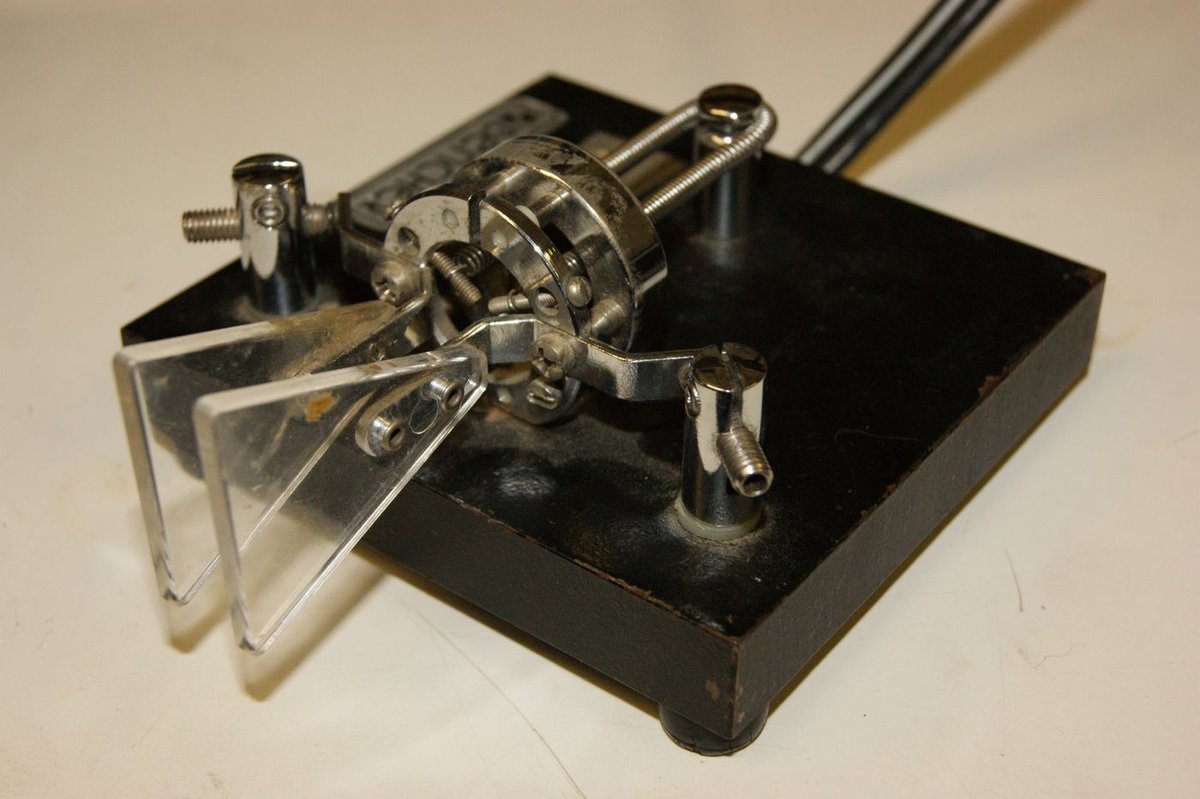
Here is the strangest thing about a paddle, and the key to understanding it: by itself, a paddle does nothing at all. A straight key at least closes a circuit for exactly as long as your hand holds it down. A bug mechanically flings out a string of dits from its own vibrating pendulum. But a paddle is just a pair of dumb switches — a lever (or two) that closes a contact on the left and a contact on the right — and it generates no dit, no dah, no timing whatsoever. Every bit of the actual Morse is formed by the electronic keyer the paddle plugs into: the keyer reads which contact you’ve closed and produces perfectly-timed elements at the speed set by a knob. The paddle is the steering wheel; the keyer is the engine.
That’s the clean line between this dive and the two before it. A bug is a machine that makes dits; a paddle is an input to a machine. (I cover the keyer electronics themselves — the Curtis chips, the dot/dash memories, the memory keyers — over in The Hi-Mound UFO & the Autokeyer Era; this dive is about the thing under your fingers.)
1.2 One lever or two
Paddles come in two families, and the difference is the single most important thing to understand before you buy one (Figure 1).
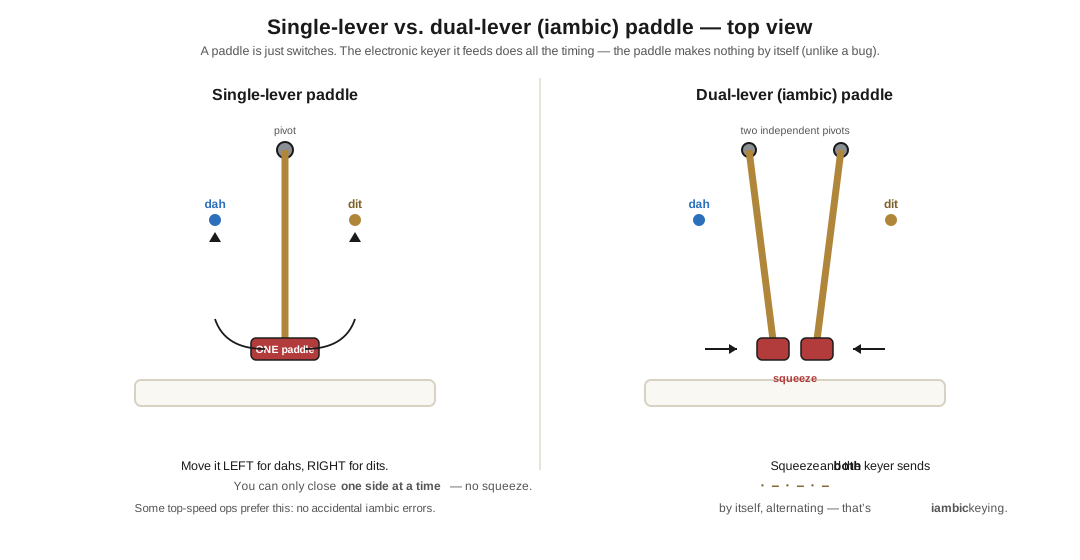
- A single-lever paddle has one finger piece. Push it left for dahs, right for dits. It has two contacts, but the one lever can only ever close one at a time — there’s no such thing as pressing both.
- A dual-lever paddle has two completely independent levers, side by side, each with its own contact. You can close the left one, the right one, or — and this is the whole point — both at once.
1.3 The squeeze: iambic keying
That “both at once” is what makes a dual-lever paddle an iambic paddle. When you squeeze both levers together, the electronic keyer does something a single-lever paddle physically cannot ask it to do: it sends alternating elements automatically — dit-dah-dit-dah-dit-dah — for as long as you hold the squeeze. Suddenly the letter C (dah-di-dah-dit) is a little rocking pinch instead of four separate taps, and AR, AA, AN and all the alternating patterns fall out of a single squeeze. Done well, iambic keying saves something like a tenth of your hand motions and lets you run fast with very little effort. It takes practice — the timing of when you let go matters — but once it’s in your fingers it feels like the code is helping you send it.
Iambic keying requires both halves: a dual-lever paddle and an electronic keyer that understands the squeeze. Squeeze a single-lever paddle and nothing special happens — there’s only one lever to move.
1.4 Mode A vs. Mode B — a keyer setting you feel in the paddle
If you send iambic, you’ll eventually run into the Mode A vs. Mode B question, and it’s worth knowing even though it technically lives in the keyer, not the paddle — because it changes how the paddle feels to use. The difference is entirely about what happens the instant you release a squeeze:
- Mode A finishes the element it’s sending and stops cleanly.
- Mode B finishes that element and then sends one more, opposite element before stopping.
Neither is right; operators simply learn one and lock to it. Mode B was the behavior of the classic Curtis 8044 keyer chip that a generation learned on; Mode A is generally considered more forgiving, with a more generous release window. The practical warning: learn on one, sit down at the other, and your machine-sent letters suddenly grow or lose a dit, and it feels like the floor moved. (The chip history behind A and B is in the UFO dive.)
1.5 Why some of the best operators choose one lever
You’d think iambic is simply “better” — more automation, fewer motions. But some of the fastest, most respected CW operators deliberately choose a single-lever paddle, and their reasoning is worth respecting: with only one lever, you cannot accidentally trigger an iambic element you didn’t mean. Dual-lever timing is unforgiving — a fraction too long on a squeeze, a stray brush of the other paddle, and you’ve inserted a wrong dit. A single-lever paddle asks more motions of you but gives you back total, literal control of every element. It’s the same debate that runs through this whole sub-project: how much of the timing do you hand to the machine, and how much do you keep? The straight key keeps all of it; the bug splits it; the iambic paddle hands over the alternating runs; and the single-lever paddle is the operator who wants the electronics’ speed but not its guesses.
Volume 2 turns to the keys themselves — how you adjust a paddle to your hand (including the magnetic-return trick on the premium ones), what QSK full break-in gives you, and the makers, from the everyman Bencher to the jeweler-grade brass paddles worth saving up for.
1.5.1 Sources (Vol 1)
- Wikipedia, “Keyer,” and AG6QR “Keys, Bugs, Paddles and Keyers: a terminology introduction” — a paddle is a switch/input with no timing of its own; single-lever vs. dual-lever; the keyer forms all elements. https://ag6qr.net/index.php/keys-bugs-paddles-and-keyers-a-terminology-introduction/
- CWops “The Iambic Keyer Myth” and KB6NU “Choosing a key” — iambic requires a dual-lever paddle + keyer; squeeze keying saves ~11% of strokes; why some top ops prefer single-lever (no accidental iambic errors). https://cwops.org/wp-content/uploads/2018/06/iambicmyth.pdf · https://www.kb6nu.com/cw-geeks-guide-to-having-fun-with-morse-code-choosing-a-key/
- WB9KZY “Mode A vs Mode B” and AG6QR “Iambic A or B” — the extra opposite element on release in Mode B; a keyer setting that changes paddle feel; Mode B = classic Curtis 8044 default. http://wb9kzy.com/modeab.pdf
- Keyer-chip electronics cross-referenced to Keys & Keyers → The Hi-Mound UFO & the Autokeyer Era.