Antique Telegraph Keys and Brass Pounders · Volume 1
Antique Telegraph Keys & Brass-Pounders — Vol 1: The Keys of the Wire
Before radio, the key lived on iron wire strung across a continent. The brass camelback, the steel-lever key that replaced it, and the closed loop that every one of them lived in — the ancestors of every ham key that followed.
1.1 Where the key was born
The keys in the Keys & Keyers sub-project — the straight keys, bugs, and paddles a ham reaches for today — all descend from an older, wired world: the landline telegraph, where the key lived on a single iron wire strung on poles across a continent, and a message was read not off a screen but by ear, from the clicks of a sounder. This dive is about those ancestors — the antique keys of the wire — and (in Volume 2) the culture of the operators who pounded them. It’s also, frankly, the brassiest corner of the whole project, and I make no apology for that: I love brass keys, and the 19th-century landline keys are as brass as it gets.
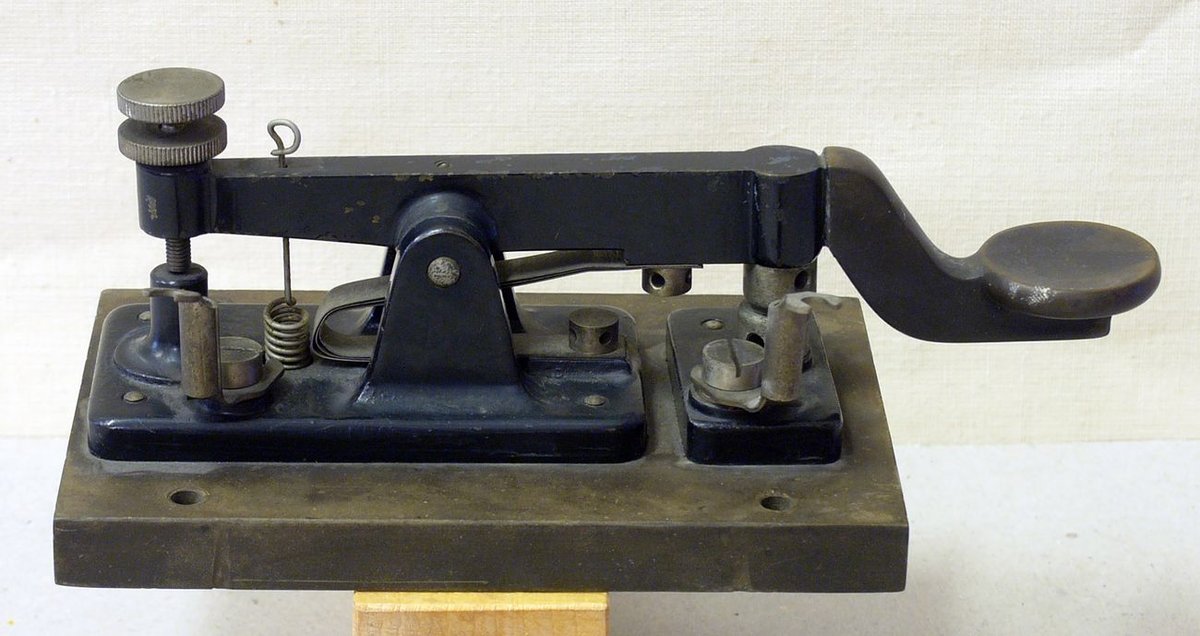
1.2 The camelback: the first American key
The earliest form of American landline key is the camelback (or “humpback”), and you’ll know it instantly by the hump — a heavy brass lever arched up between the knob and the pivot. They came into use soon after Morse’s 1844 line and were the standard key through the Civil War era, roughly 1848 to the 1870s; the Phelps camelbacks were the most widely used keys of the Civil War, alongside makers like Thomas Hall.
The hump wasn’t just decoration (though the good looks surely helped sales). It shifted the lever’s mass back toward the pivot, balancing the key for easier, steadier work. What eventually killed the camelback was a durability problem: the soft brass lever wore against the steel pivot shaft, and the press-fit shaft tended to work loose with years of pounding, developing the “lost motion” that makes a key feel mushy. The fix for that is the next key in the story.
1.3 The steel-lever key: Bunnell, 1881
On 15 February 1881, Jesse H. Bunnell patented the steel-lever key (U.S. Patent No. 237,808), and it became the standard American landline key — the shape almost every key since has echoed. The genius of it is often mis-stated as simply “steel is stiffer than brass.” The real innovation is that Bunnell formed the lever and its pivot trunnion from a single piece of steel. No more brass lever wearing on a separate steel shaft, no more press-fit joint working loose — one rigid piece, so the key kept a firm, precise action for a lifetime. It was strong, light, laterally stable, and responsive; every telegraph company and railroad adopted it, competitors copied it the moment the patent expired, and the basic design is still made today. Set a brass camelback next to a Bunnell steel-lever key and you’re looking at the single most important evolutionary step in the hand key.
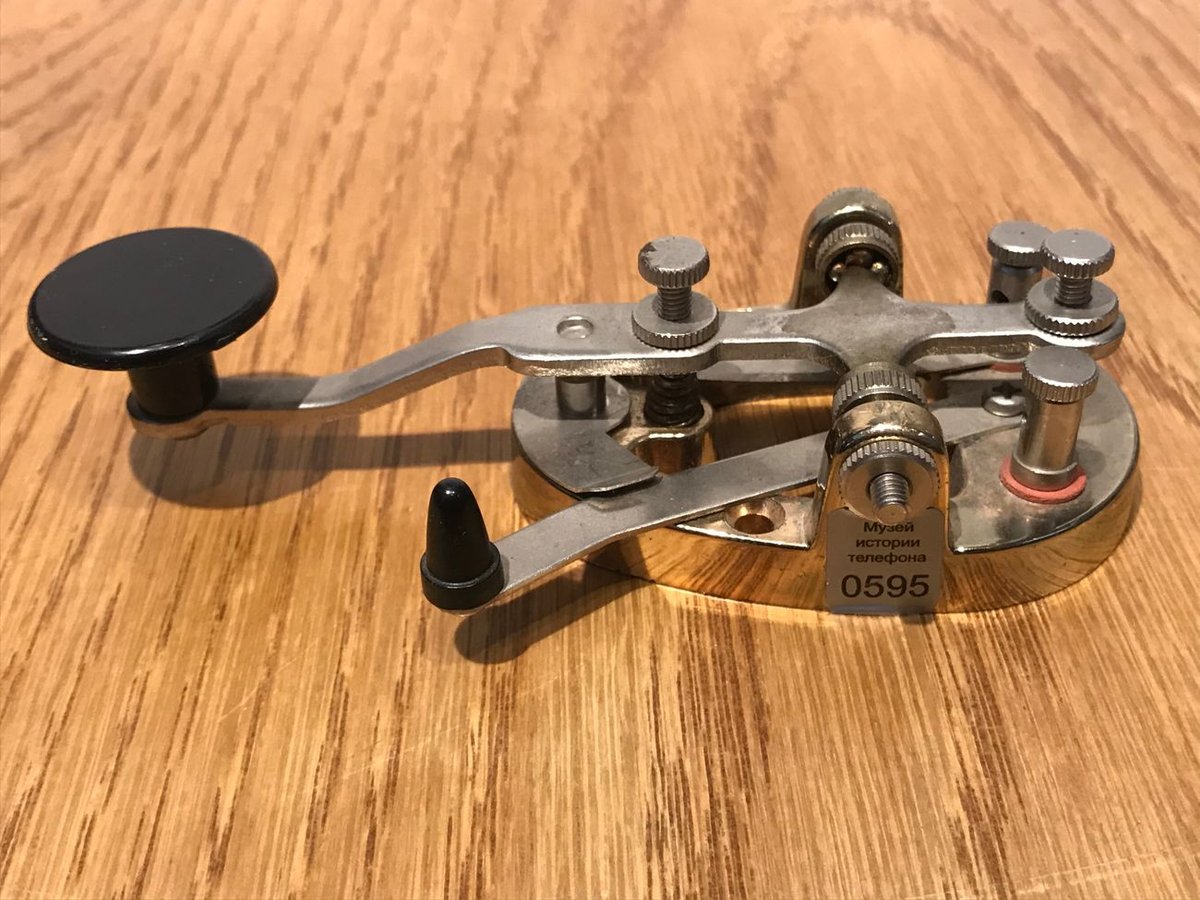
1.4 Legless keys and the KOB
Two bits of collector vocabulary you’ll meet constantly:
- A “legless” key is a key built without downward mounting legs — its terminals sit at the rear top of the base so it can bolt flat onto any surface (or onto a set) without running wires under the table. Bunnell and Foote-Pierson both made legless models. (The term outlived the wire: the 1920 Signal Corps catalog literally lists a “KEY, type J-30 … Legless,” the direct ancestor of the WWII J-38 in the straight-keys dive.)
- A KOB — most often expanded “Key On Board” (you’ll also see “Key on Base”) — is a key and a sounder mounted together on one wooden board, appearing in the 1860s as a compact unit for practice, for learning, and for small offices. Before the KOB, the key, sounder, and relay each sat separately on the operator’s table. A brass key and a brass sounder on a varnished board is one of the most handsome objects in this whole hobby.
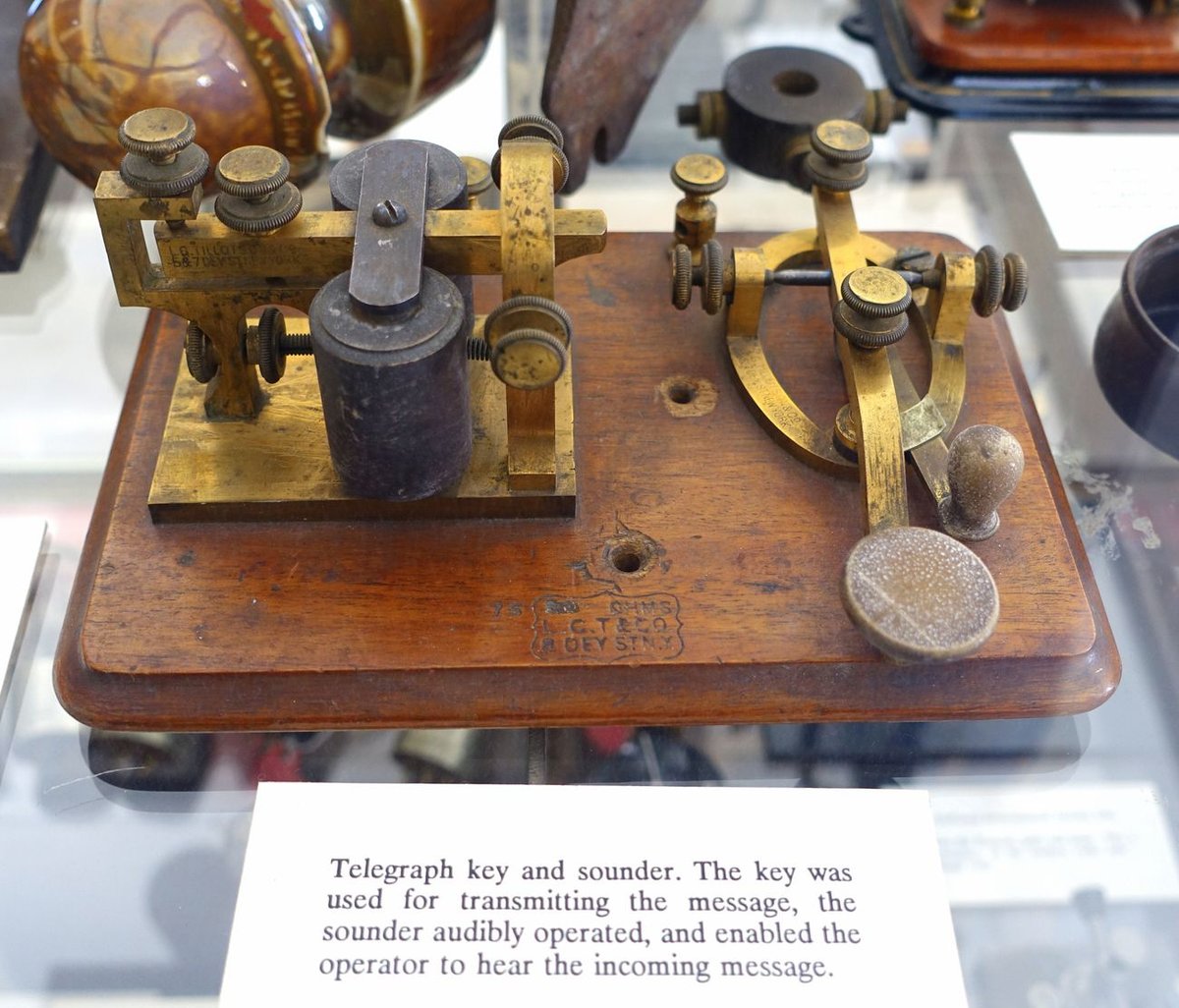
1.5 The makers
- J. H. Bunnell & Co. — the giant. Founded 1878 by Jesse H. Bunnell (born 1843 in Massillon, Ohio; a Civil War military telegrapher), it was one of the largest US suppliers of keys and instruments well into the 20th century, and the steel-lever patent above made its name.
- Signal Electric Mfg. Co. — my Michigan favorite, of Menominee, Michigan, maker of keys, sounders, and KOB learner sets; its M-100 key has a lacquered brass base, a nickel-plated lever, and platinum contacts.
- Manhattan Electrical Supply Co. (MESCO) and Foote, Pierson & Co. — big late-1800s suppliers. A collector’s warning worth carrying: many “Manhattan” instruments were actually made by Bunnell and rebadged, so a MESCO nameplate doesn’t always mean a MESCO key.
- Western Electric made telegraph gear too, though it’s far better remembered for telephones.
1.6 The closed loop every key lived in
Here is the thing that makes landline keys behave so differently from a radio key, and it explains a fossil we met back in the straight-keys dive. Landline telegraphy ran on a closed-circuit series loop (Figure 1): a single wire with an earth return, with every station’s key and sounder wired in series, and current flowing all the time when the line was idle.
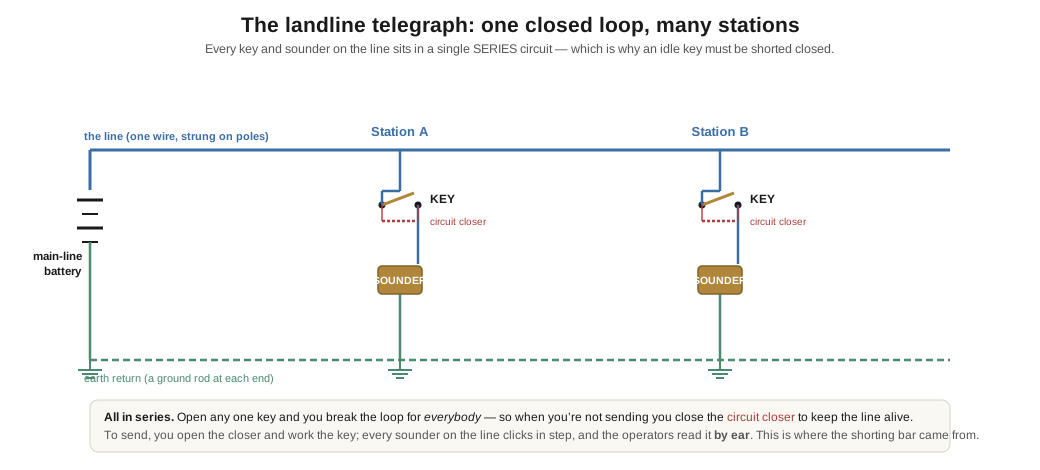
Because it’s all one series circuit, an open key breaks the line for everyone. So every key carries a circuit-closer (a little shorting switch), and — this is the part authors constantly get backwards — its normal, resting position is closed, shorting the key’s own contacts so current keeps flowing to all the other stations’ sounders. To send, you open the circuit-closer and work the key; each press makes and breaks the loop, and every sounder on the line clicks in step. That “default closed” logic is the exact opposite of a radio key (which rests open), and it is why the little shorting bar rode along onto radio keys for decades after it stopped being needed.
And the reading was by ear. Landline operators listened to the sounder’s click (armature down) and clack (armature up) and read the spacing between them directly as American Morse — the spaced-dot code of the Morse & CW history dive, not the International Morse of radio. No tape, no screen; just a trained ear turning clacks into words. Which brings us to the people who could do that — the brass pounders of Volume 2.
1.6.1 Sources (Vol 1)
- Camelback key (era, brass lever, the hump’s weight rationale, wear/loose-shaft failure; Phelps/Thomas Hall): electronics-notes.com camelback page; W1TP Telegraph Museum pre-1881 galleries. https://www.electronics-notes.com/articles/history/morse-code-telegraph/camelback-morse-telegraph-key.php
- Bunnell steel-lever key, U.S. Patent 237,808, 15 Feb 1881, one-piece lever+trunnion: Wikipedia “Jesse H. Bunnell”; telegraphlore.com patents; telegraph-history.org; jhbunnell.com.
- Legless keys and the KOB (“Key On Board,” 1860s): telegraphlore.com “Tools of Telegraphy”; telegraphkeys.com KOB page. Makers Bunnell/Signal Electric (M-100, Menominee MI)/MESCO(Bunnell-made)/Foote-Pierson: jhbunnell.com; k8ir.com; radiomuseum.org.
- Closed-circuit series loop, circuit-closer default-closed, reading by ear on the sounder: Morse Telegraph Club “Ask the Wire Chief”; Wikipedia “Telegraph key”/“Telegraph sounder.” Cross-links: Morse & CW → History (American Morse) and The Telegraph → Sounders, Relays & Landline Instruments.