Making the Parts That No Longer Exist · Volume 2
Making the Parts That No Longer Exist — Vol 2: When Newer Is Genuinely Better
Some replacements are compromises. The loop supply is not one of them: a modern interface drives a 1930s selector magnet better than the 100-volt resistor bank ever did, and it does it from a wall wart, cold.
2.1 The one place modern electronics wins outright
Volume 1 was full of caution: match the duty, respect the fatigue life, do not print a load-bearing steel part. All of that still holds for the mechanism.
The electrical interface is the exception, and it is not a close call. Here a modern replacement is not a compromise made from necessity — it is genuinely, measurably better than what Teletype shipped, and I want to explain exactly why, because the reason is a nice piece of engineering.
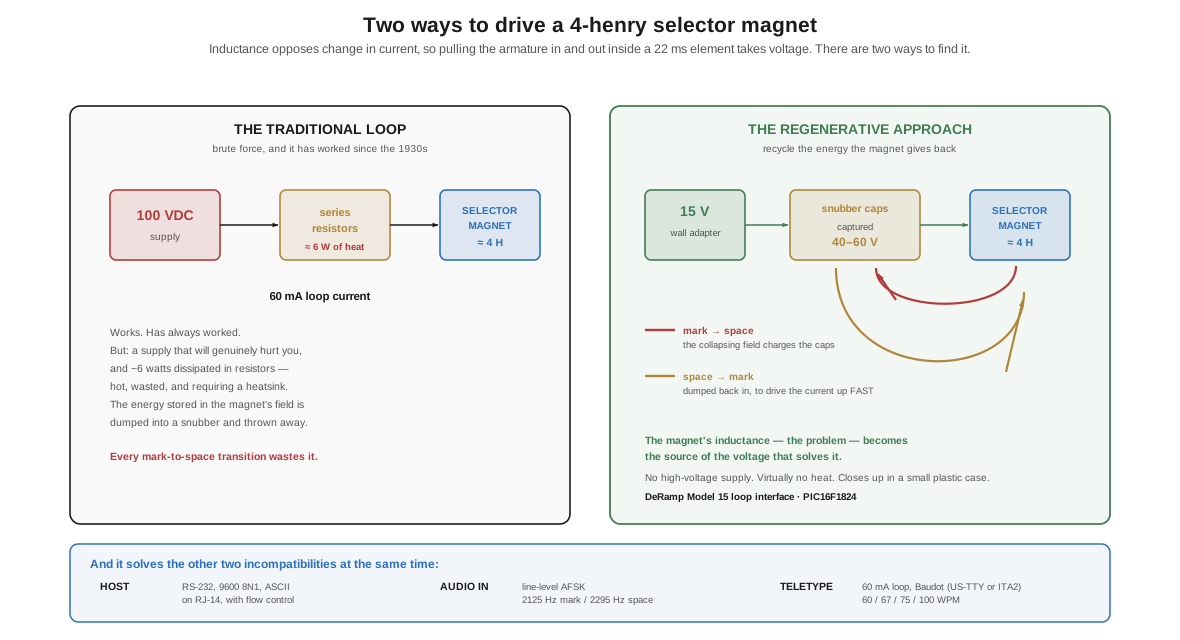
Recall the problem from Restoring a Teletype, Vol 2. The selector magnet is a heavily inductive load — around 4 henries — and inductance opposes change in current. To pull the armature in and release it cleanly inside a 22-millisecond element, you must force current into that coil fast and yank it out fast, and both take voltage.
The traditional answer is brute force: a 100-volt supply with series current-limiting resistors to set the loop current at 60 mA. It works. It has been working since the 1930s. It also dissipates roughly 6 watts in those resistors — hot, wasted, and requiring a supply that will genuinely hurt you.
2.2 The regenerative trick
The DeRamp Model 15 loop interface, by Mike Douglas, solves the same problem by recycling the energy the magnet gives back.
Here is the mechanism, and it is lovely. When the signal goes from mark to space and the current in the selector magnet collapses, the magnetic field stored in that 4-henry coil has to go somewhere. In the traditional circuit it is dumped into a snubber and thrown away as heat. In the DeRamp design, a snubber circuit captures 40–60 volts from that decaying field onto a pair of capacitors — and then, on the next space-to-mark transition, dumps that captured energy back into the loop to drive the current up fast.
The magnet’s own inductance, which is the problem, becomes the source of the voltage that solves it. The board needs no high-voltage supply at all: it runs from a 15 V AC adapter, generates virtually no heat, and can be closed up in a small plastic case. (There is also a processor-controlled switching circuit that can be enabled to boost the snubber capacitor further if a particular machine needs it.)
The rest of the board handles the other two incompatibilities from Restoring a Teletype:
Table 1 — The rest of the board handles the other two incompatibilities from Restoring a Teletype
| Function | How |
|---|---|
| Host interface | RS-232, 9600 baud, 8N1, ASCII, on an RJ-14 jack, with hardware flow control to throttle the host |
| Audio input | Line-level AFSK at 2125 Hz mark / 2295 Hz space on a 3.5 mm jack — for RTTY off the air, or an ITTY internet feed |
| Teletype side | 60 mA current loop, Baudot (US-TTY or ITA2), selectable 60, 67, 75 or 100 WPM, on separate 1/4” jacks for send and receive |
| Brains | A PIC16F1824 doing ASCII↔Baudot translation, baud-rate conversion, AFSK demodulation, and loop voltage control |
One board, and every one of the three incompatibilities is gone.
Read the limitations, because they are real. It is designed for the Model 15’s selector characteristics — typically a pulling magnet of about 200–220 Ω, or a holding magnet with coils in parallel at 50–55 Ω. If your machine has a polar relay driving the selector, that relay must be removed or bypassed and neutral signalling used. It drives one machine, and the printer and keyboard loops must be wired separately rather than in series — there is a half-duplex option for local echo instead. Some Model 28 configurations work; ask first.
And one safety note carried straight from the manual: the current-sense jumper must always have a shorting jumper or a meter in place. Operating with it open is a fault condition. There are other interfaces in the same spirit — W6IWI’s DSP terminal unit among them — and the field is small but active.
2.3 The vintage alternative, and why you might still want it
A terminal unit is the period-correct answer: an ST-6, a HAL, a Flesher, an iRL FSK-1000. It takes audio — from a receiver, or an ITTY stream — demodulates the mark and space tones, and drives the current loop directly. If you are building a station that looks like 1968, a rack-mounted TU with meters and a tuning scope is the entire point, and the “crossed bananas” display from RTTY on the Air is one of the loveliest instruments in radio.
Two cautions, and they are the same two the restoration community repeats. These boxes throw stout voltages and currents around, and misconfiguring one can damage your machine or you — read the manual completely before connecting anything. And loop requirements vary: 60 mA is common but 20 mA machines exist, and matching the TU’s output to your machine’s magnet is not optional. A 60 mA machine on a 20 mA loop will work badly with a narrow range, which is exactly the diagnostic confusion Restoring a Teletype Vol 2 warns about.
2.4 Motors and mains
A failed motor is not usually a failed motor. Before replacing one, check in this order: the brittle lead-in insulation (the most common fault by far), the starting relay and capacitor on a synchronous unit, dried varnish in the bearings, and — on a governed machine — the governor contacts and the switched resistance. The motor itself is a simple, robust, well-made thing and it usually is not the problem.
If it genuinely is: a synchronous motor replacement must match the mains frequency your machine expects, since that frequency is its speed reference. A machine built for 60 Hz and run on 50 Hz will run 17% slow and copy nothing. A governed motor is more forgiving because its speed is set mechanically, but the governor still has to be adjusted to the machine’s speed target.
Modern substitutions are possible and are a genuine engineering exercise rather than a drop-in. People have fitted brushless DC motors with closed-loop speed control in place of governed motors, and the result can hold speed far better than the original mechanical governor ever did. It is also a visible, non-reversible change to a historic machine, so the Volume 1 ethic applies: keep the original, document the change, prefer reversibility.
2.5 Consumables
The things you use up, which are less of a problem than people fear.
Ribbons are still findable, and old stock is remarkably durable — one restorer reports that ribbons manufactured in the 1970s still print clearly, which after fifty years is a genuine testament to the ink. Standard typewriter ribbon on the correct spools works for many machines; re-inking is a known technique.
Paper. This is the fiddly one, because the sizes are not modern. Roll-fed machines want specific widths (8 7/16” bond rolls are one standard); some machines want tractor-feed stock that is not the current standard size. Label and receipt-paper suppliers are the answer — they cut to order and are used to odd widths — and it is worth ringing them to confirm before paying for shipping on a heavy box of the wrong thing.
Oil and grease — see Restoring a Teletype, Vol 1. Under a teaspoon does the whole machine.
2.6 The best modern part is sometimes not a part
Two options worth naming, because they change what a restoration is for.
ITTY — internet teletype. Instead of hanging your machine off an HF receiver and hoping for a signal, feed it an audio stream over the internet — news wire feeds, Teletype-formatted content, other enthusiasts’ transmissions — into a terminal unit or an interface board’s audio input. Your Model 15 clatters away printing a live news wire exactly as it would have in 1962, and it does it every day, reliably, without waiting for propagation. For a machine in a living room this is often what actually gets it used.
Emulation as a diagnostic tool. Before you commit to a mechanical theory about a fault, it is enormously useful to be able to generate a known-perfect signal at a known speed and current. A modern interface board gives you exactly that, and it lets you split the diagnosis cleanly: is my machine sick, or is my signal bad? That question is the hardest one in this whole subject, and it is the reason to build or buy the interface early in a restoration rather than at the end.
2.7 Why bother at all
I want to close the teletype track where the project started, because these three dives have been full of BSP numbers and spring tensions and it is easy to lose the thread.
My father’s shack had a teletype in it, and I was small, and the machine was the most alive thing in the room. It clattered. The carriage flew back and rang a bell. Pink tape spooled out of the perforator onto the floor. Somewhere a long way away another person had typed those words, and the machine in front of me was reproducing them, mechanically, with no help from anyone — and I did not understand a single thing about how.
Now I do. It is a magnet, a friction clutch, five cams, five swords, five slotted bars, and a gear ratio of eight to seven that resets the timing error at every character. There is no cleverness hidden anywhere. Everything it does, it does in front of you, in metal, at a speed you can watch.
That is the reason to keep them running, and the reason it is worth learning to make a spring or bush a pivot or send a platen away to be recovered. A working teletype is the only machine I know of that lets you watch a serial protocol being decoded. Every abstraction in Wireless Modes — the start bit, the sampling instant, the clock recovery, the register, the decoder — is sitting on a bench somewhere in oiled steel, doing it slowly enough to see.
Keep one running. Somebody’s kid should get to watch it.
2.7.1 Sources (Vol 2)
- 🔴 Principal source: ASCII/RS-232/AFSK Interface for the Model 15 Teletype, user manual, deramp.com — the regenerative snubber capturing 40–60 V from the selector magnet’s decaying field on mark-to-space and returning it on space-to-mark, eliminating the high-voltage supply and hot resistors; the 15 V adapter and the note that the board generates virtually no heat; the PIC16F1824 handling ASCII/Baudot translation, baud-rate conversion, AFSK demodulation and loop voltage control; RS-232 9600 8N1 host interface on RJ-14 with flow control; line-level AFSK input at 2125/2295 Hz on 3.5 mm; 60 mA loop, US-TTY or ITA2, 60/67/75/100 WPM, separate 1/4” send and receive jacks; the pulling magnet (200–220 Ω) and parallel-wired holding magnet (50–55 Ω) limitation; the polar-relay bypass requirement; the separate printer and keyboard loop requirement with a half-duplex local-echo option; and the warning that the current-sense jumper J2 must never be left open. https://deramp.com/downloads/teletype/Model%2015/loop%20interface%20board/User%20Manual.pdf
- Selector magnet inductance (~4 H), the traditional 100 VDC supply, and the ~6 W dissipated in current-limiting resistors — Trammell Hudson, “Model 15 Teletype.” https://trmm.net/Model_15_Teletype/
- Vintage terminal units, ITTY, consumables, and parts sources — the iRL FSK-1000 and the caution that terminal units throw stout voltages and currents and can damage things or people if misconfigured; 60 mA common with 20 mA machines also in service; 1970s-manufactured ribbons still printing clearly; tractor-feed and 8 7/16” bond paper sourced from label and POS suppliers; W2JC’s new-old-stock supply list and “Mr RTTY” for parts; W6IWI’s DSP terminal unit as another hobbyist interface. David Stickelman, “Getting started with a teletype.” http://stickelman.net/index.php/2025/02/23/getting-started-with-a-teletype-my-consolidated-notes-on-restoration/
- Motor faults before motor replacement — brittle oil-saturated lead-in insulation as the common failure; the Model 28 synchronous motor unit’s starting relay and capacitor. kb8ojh.net, “Teletype Model 28 KSR.” https://kb8ojh.net/station/teletype/ · governor contacts and the switched resistance: BSP P70.013, see Inside the Teletype Mechanism, Vol 2.
- ⚠ Substituting a modern brushless motor with electronic speed control for a governed motor is described here as a known approach, not as a documented procedure. ⟨no single authoritative write-up was found; treat it as a design exercise and ask Greenkeys before committing⟩
- Cross-links: Restoring a Teletype (both volumes); Inside the Teletype Mechanism; RTTY on the Air (terminal units and the crossed-bananas display); Modern Digital & the Raspberry Pi; Wireless Modes → How a Signal Carries Information (the abstractions this machine performs in steel).