Inside the Teletype Mechanism · Volume 2
Inside the Teletype Mechanism — Vol 2: From Code Bars to Ink
Five steel bars lying in a pattern, a bail that falls, and a type bar that flies. Then the power train that drives all of it — and the Model 28's completely different answer to the same problem.
2.1 The register is a set of slots
Volume 1 left five code bars lying in a pattern — each pushed left or right according to whether its bit was marking or spacing. Now the machine has to turn that pattern into one specific letter out of the sixty-odd it can print, and the way it does so is so simple that it took me a while to believe it.
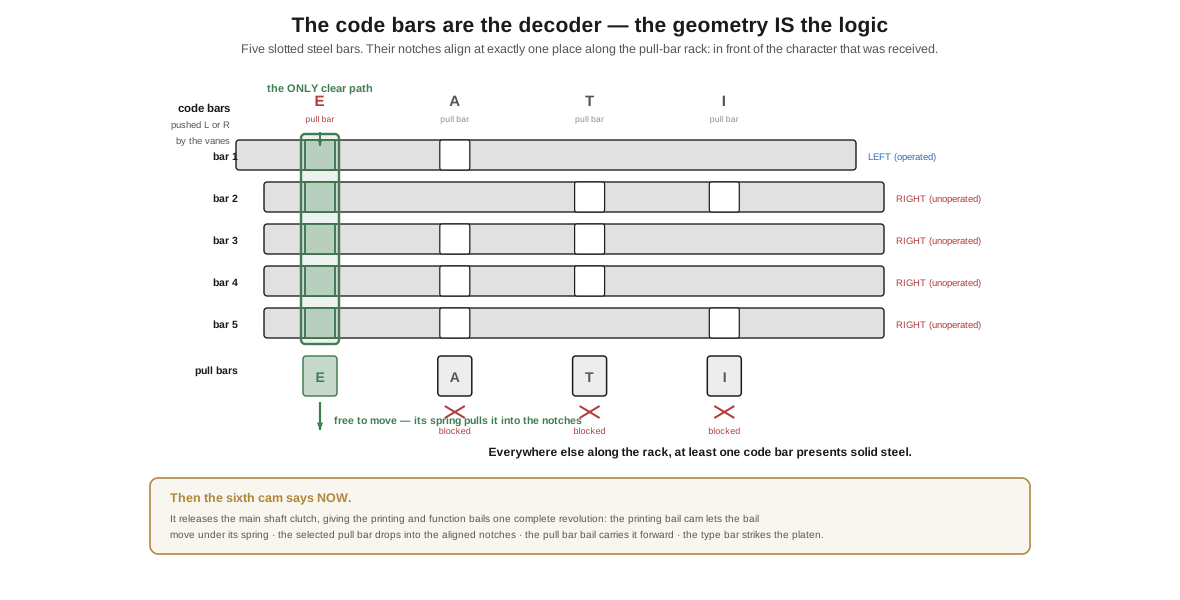
Each code bar has notches cut along its length. Behind them sits a rack of pull bars, one for every character and function the machine can perform. Each pull bar has a set of teeth positioned to match one particular code combination.
When all five code bars are pushed into the pattern for a given character, the notches in all five bars line up — and they line up at exactly one place along the rack: in front of the pull bar for that character. Everywhere else along the rack, at least one code bar presents solid steel instead of a notch, and the pull bar there simply cannot move.
The manual’s own worked example is the letter E (the five-unit code for which is 1-0-0-0-0 — one hole, the most common letter, exactly as Murray intended; see Teletype Machines). Code bar number 1 goes left, bars 2, 3, 4 and 5 go right, and there is now a notch in each of the five bars opposite the “E” pull bar and nowhere else.
That is the decoder. A five-bit-to-one-of-sixty-four demultiplexer, made of slotted steel bars, resolving in the time it takes a spring to pull. There is no logic in it. The geometry is the logic, and I think it is one of the most elegant pieces of mechanical design I have ever had explained to me.
2.2 The sixth cam, and the blow
There are five data cams on the selector cam sleeve. There is also a sixth, and its job is to say now.
After the fifth element has been sampled and the code bars have settled, the sixth cam releases the main shaft clutch, which allows the printing bail and the function bail to make one complete revolution. From here the machine is no longer reading; it is acting.
- The printing bail cam lets the printing bail be pulled forward by its spring.
- The selected pull bar — the only one that can move — is pulled down by its own spring into the aligned notches.
- The pull bar bail, driven by the printing bail, carries that pull bar forward.
- Which drives its type bar up and forward to strike the platen, through the ribbon, printing the character.
The type bars are arranged in a fan, exactly like a manual typewriter’s, and they strike the same way. The difference is that a typewriter’s key lever is connected to its type bar by a direct linkage from your finger, and a Teletype’s is selected by five steel bars agreeing with each other.
Functions work identically. Carriage return, line feed, space, LETTERS shift, FIGURES shift, and the bell are not printed characters — they are actions — but they are selected by exactly the same code-bar-and-notch arrangement, operating function levers through the function bail rather than pull bars through the printing bail. This is why the LTRS/FIGS shift from Teletype Machines is mechanically cheap: it is simply another position of the same rack, sliding the whole type-bar basket so a different set of characters presents to the platen.
2.3 The power train: one shaft, everything
Everything above is driven from a single main shaft, and understanding its layout makes the whole machine legible.
- The main shaft gear, near the right end, meshes with the motor pinion. The main shaft therefore turns continuously the entire time the machine is switched on. Nothing is ever “started”; things are released.
- The transmitting shaft driving gear takes power off to the keyboard cam shaft, so the sending side runs from the same shaft as the receiving side.
- The main shaft spacing gear meshes with the spacing shaft gear, driving the escapement that moves the carriage one position per character.
- The function bail cam and the printing bail cam operate their respective bails.
- The main shaft clutch is what the sixth selector cam releases, coupling power to the printing and function bails at the right instant.
- The selector cam sleeve rides on the left end of the shaft, driven through a friction clutch — which is why it can be held stationary by the stop arm while the shaft beneath it keeps turning.
Everything in the machine is a clutch, a cam, a bail, or a spring. Power is always available and is gated by latches. Once you see that pattern, a Teletype stops being an incomprehensible thicket and becomes readable.
The keyboard works the same way in reverse. It has its own cam sleeve, held apart by a clutch throwout lever. Press a key and the driven clutch member meshes, the cam sleeve makes exactly one revolution, and the throwout lever disengages it again. During that revolution, the key’s selector bars set five locking levers, each of which permits or prevents its contact lever from closing a contact as the cams go round — serialising the five-unit code onto the line, one element at a time, in the correct order with a start and a stop around it. It is a parallel-to-serial converter made of levers.
2.4 The motor, and the governor
The Model 15 came two ways, and the difference matters enormously to anyone restoring one.
A synchronous motor locks to the mains frequency and needs no regulation at all. If your supply is 60 Hz and stays there, the machine runs at the right speed, full stop.
A governed motor has a mechanical speed regulator on the end of the motor shaft, and it is a lovely piece of engineering in its own right. The governor contact arm is a bent metal strip with a contact on one end, held by a flat spring at the other. The spring holds that contact closed against a companion contact until centrifugal force overcomes the spring tension. When the contacts fly open, a resistance is switched into the motor circuit, slowing the motor; as it slows, the contacts close again and the resistance is shorted out. The motor therefore hunts continuously around a set point determined entirely by the spring tension — which is adjusted by a speed adjusting wheel protruding through the governor cover.
And how do you know when it is right? With a stroboscope. There is a speed target — concentric rings of alternating marks — and a lamp with a switch mounted on a bracket at the right rear corner of the motor base. Under the flicker of the mains-powered lamp, the ring corresponding to the correct speed appears to stand still. Turn the adjusting wheel until it stops drifting and the machine is on speed.
That is a mains-referenced strobe used as a frequency standard, in a machine from the 1930s, so that a mechanical governor can be calibrated by eye. I love it.
A restoration note that belongs here. Governor contacts are a maintenance item — they arc, they pit, and they burn. A governed machine that runs at the wrong speed, or hunts audibly, or refuses to hold a range, very often needs its governor contacts cleaned and its spring tension reset, not a new motor. And the resistance switched by those contacts is a real component that can fail open. This comes back in Restoring a Teletype, Vol 2.
2.5 The Model 28’s different answer
The Model 28, a generation later, does the same job with a substantially different architecture, and comparing the two is the fastest way to understand what Teletype learned in twenty years.
Six clutches on one main shaft. Where the Model 15 has essentially one main-shaft clutch plus the selector’s friction drive, the 28’s typing unit has six normally-open clutches, engaging for a third, a half, or a full rotation depending on the function. It is a far more granular power-distribution scheme, and it is what lets the machine do more things per character.
Gearing. The motor runs at 3600 rpm and the main shaft turns at 368 rpm at 60 WPM, through a reduction that includes a nylon drive gear — a detail worth remembering, because a nylon gear is exactly the kind of part that ages badly and is exactly the kind of part Making the Parts That No Longer Exist is about.
The type box instead of type bars. This is the big one. Rather than a fan of individual type bars, the 28 uses a removable type box holding 64 characters — 32 for LETTERS and 32 for FIGURES. The box travels on a carriage, and for each character it is positioned in two dimensions — roughly an inch of travel vertically and horizontally — so the right character lands under a single hammer, which strikes it. LETTERS and FIGURES shift the box left or right to select the appropriate half.
The consequences are enormous and all good. Changing the font or the character set means swapping a box — released by a sprung lever and a screw — instead of replacing dozens of type bars. One hammer replaces sixty striking mechanisms. And the printing carriage lifts about one character height at the end of each character so that its resting position is below the line being typed, letting the operator read the text as it arrives rather than peering around the mechanism.
The stunt box. The 28’s answer to function decoding is a sequential selector that can mechanically trigger a long list of non-printing operations, and it is programmable in the sense that its contacts and levers can be configured for a given installation. This is where features like automatic line feed on carriage return, or triggering an external alarm on a particular character sequence, actually live.
The answerback. Many machines carry a “HERE IS” mechanism — a rotating drum carrying Baudot-encoded sheet-metal keys that, when triggered, transmits a fixed identifying message. It is a physical read-only memory, cut from sheet metal, and its contents are your station’s identity. A restorer replacing those keys with ones spelling out his own callsign is doing something that would have been entirely familiar to a Western Union technician in 1955.
The 28 was, deservedly, considered the most rugged machine the company built. It is also, as anyone who has lifted a typing unit will tell you, extremely heavy — which is the next dive’s problem.
2.5.1 Sources (Vol 2)
- 🔴 Primary source: Teletype Corporation / Bell System Practices, Description of Teletype Model 15 Teletypewriter, Section P70.013 — the code bar notches aligning opposite a single pull bar (with the letter “E” worked example); the sixth cam releasing the main shaft clutch to give the printing and function bails one revolution; the printing bail cam, pull bar spring, pull bar bail and type bar striking the platen; the main shaft layout (main shaft gear meshing with the motor pinion, transmitting shaft driving gear, spacing gear, function and printing bail cams, main shaft clutch, selector cam sleeve on a friction clutch); the keyboard’s clutch throwout lever, one-revolution cam sleeve, selector bars, locking levers and contact levers; and the governor (contact arm, centrifugal force, resistance switched into the motor circuit, speed adjusting wheel), the speed target and its lamp, and the note that some machines use synchronous motors instead. https://navy-radio.com/manuals/tty/p70.013-iss1-5110.pdf ⟨served via the Internet Archive raw mirror; the live host 403s automated fetches⟩
- Model 28 architecture — six normally-open clutches engaging for 1/3, 1/2 or full rotation; 3600 rpm motor reduced to 368 rpm main shaft at 60 WPM through a nylon drive gear; the removable type box with 64 characters (32 LTRS + 32 FIGS) positioned in two axes under a single hammer; the printing carriage lifting one character height; the carriage driven by braided steel cables with a spring-driven return and an air dashpot; the synchronous motor with starting relay and capacitor; and the HERE IS answerback drum with Baudot-encoded sheet-metal keys. kb8ojh.net, “Teletype Model 28 KSR.” https://kb8ojh.net/station/teletype/
- The Model 28’s stunt box as a sequential selector for mechanically initiating non-printing functions, and its reputation as the most rugged machine Teletype built: Wikipedia, “Teletype Model 28” (→ its citations). https://en.wikipedia.org/wiki/Teletype_Model_28
- Cross-links: Teletype Machines (LTRS/FIGS and the code lineage); Paper Tape & the Perforator; Restoring a Teletype; Making the Parts That No Longer Exist (that nylon drive gear).